A Crystal Trap for Rare Events express
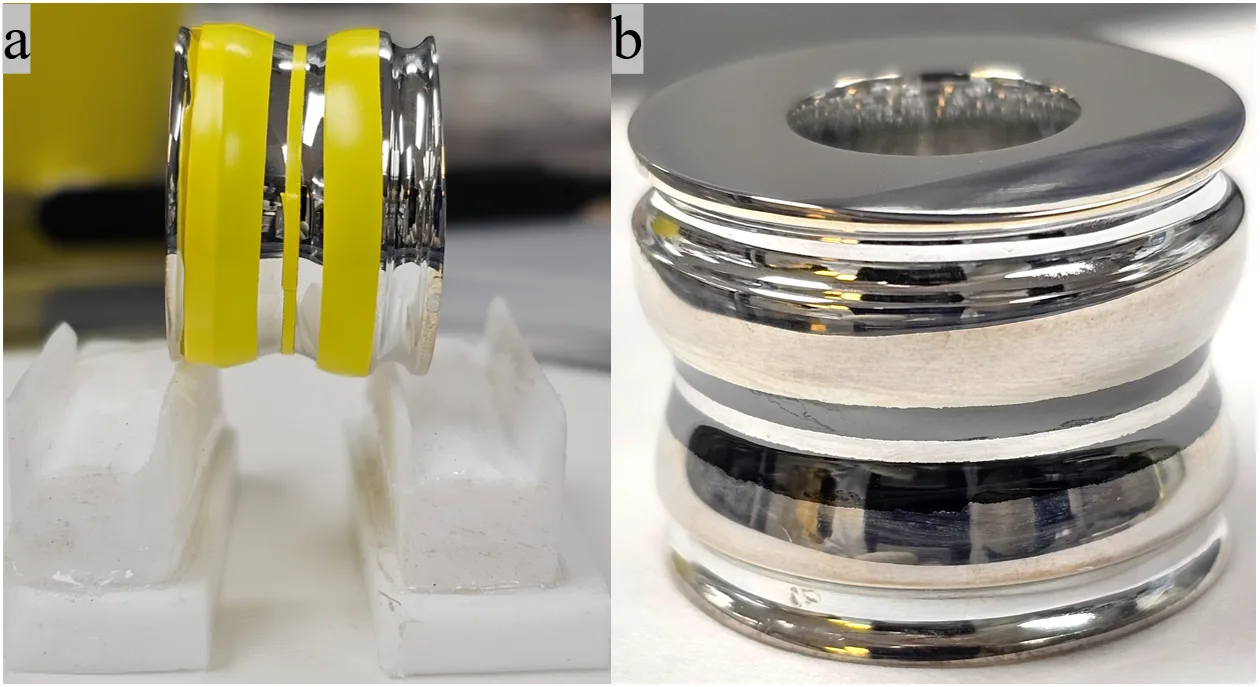
To catch a whisper in a noisy room, you need a highly sensitive microphone that barely makes noise itself. In the physics of rare events, that role is played by detectors made of ultra-pure germanium — a semiconductor crystal that turns a passing particle into a tiny electrical pulse. But the bigger the crystal, the harder it is to keep it 'quiet': its electrical capacitance grows, and so does the noise.
A new idea is to replace the flat contact with a ring-shaped groove cut around the crystal. This shape should keep capacitance low even in large crystals, just like in small point-contact detectors. But cutting a groove in germanium is no easy task: the material is brittle, the surface must be perfectly restored after machining, and then coated with thin layers of amorphous germanium and aluminum. Until now, no one had managed to get such a detector to work.
The team at the University of South Dakota has built two compact prototypes of these detectors for the first time and tested them at liquid nitrogen temperature. Both samples held voltage steadily, and when about 340 volts were applied, they began to 'feel' particles — matching calculations. The detectors picked up gamma rays from americium-241 (found in household smoke detectors) and cesium-137 (a product of nuclear reactions). This proved that the whole technological chain (drilling, groove cutting, polishing, deposition, and assembly) works.
These aren't full-sized detectors yet, just a proof of principle. The next step is to learn how to apply a lithium contact to the uneven groove surface. If that works, such crystals could form the basis of future experiments searching for neutrinoless double beta decay — a process that could explain why the Universe contains matter and not just light.
Original abstract
as written by the authors arXiv:2603.28505
Rare-event experiments such as LEGEND-1000 require high-purity germanium (HPGe) detectors with excellent energy resolution, low electronic noise, and scalable low-background packaging. The germanium ring-contact (GeRC) concept addresses this need through a recessed ring-and-groove electrode geometry intended to preserve point-contact-like low-capacitance signal formation in larger crystals. However, reliable GeRC fabrication has remained unproven because the non-planar groove geometry complicates machining, surface recovery, conformal passivation, and especially the eventual formation of a robust lithium-diffused outer contact. We report the fabrication and first cryogenic operation of two compact n-type GeRC process-validation prototypes produced from in-house HPGe crystals at the University of South Dakota. An optimized workflow was developed for core drilling, groove cutting, non-planar polishing, conformal amorphous-germanium (a-Ge) encapsulation, Al patterning, and GeRC-specific cryogenic mounting. Two independent sputtering systems were used to test whether the thin-film sequence remains operable across substantially different deposition environments. At 77~K, both devices biased stably, showed an inferred depletion onset near 340~V from a pulser-based capacitance proxy consistent with electrostatic modeling, and produced identifiable full-energy peaks from $$^{241}\mathrm{Am}$$ and $$^{137}\mathrm{Cs}$$. These results establish a proof-of-principle process and readout baseline for geometry-specific GeRC development. They do not yet constitute a deployment-ready large-mass GeRC technology, but they define the foundation for the next step: integrating conformal lithium-paint deposition and controlled diffusion on the ring-and-groove topology.
Germanium is one of the few materials that can be purified to the point where there is only one impurity atom per trillion atoms. A crystal the size of a fist made of this material is one of the purest solid objects in the Universe.
In Stanislaw Lem's novel 'His Master's Voice', scientists search for a signal amid cosmic noise using ultra-sensitive detectors — germanium crystals like these could well have sat in their laboratory.