Cryogenic temperature refers to extremely low temperatures, typically below minus 100 degrees Celsius (about 173 Kelvin). At these temperatures, materials exhibit unusual properties: electrical resistance can vanish, thermal noise drops dramatically, and quantum effects become observable. In physics experiments, cryogenic conditions are essential for detectors that must isolate faint signals from the thermal jitter of atoms.
History
The field of cryogenics began in the late 19th century with the liquefaction of gases; helium was first liquefied by Heike Kamerlingh Onnes in 1908, who then observed superconductivity in 1911.
How it works
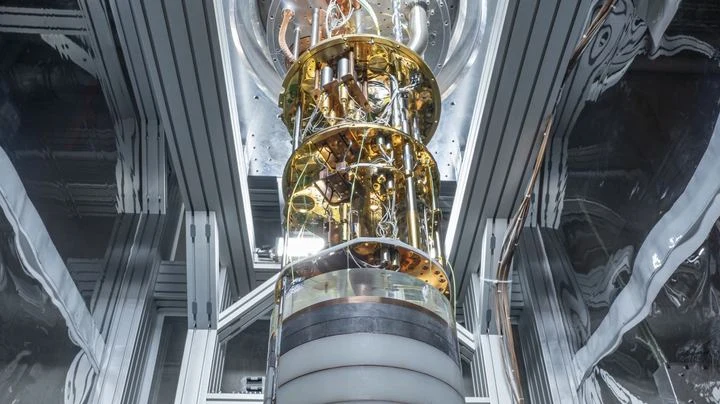
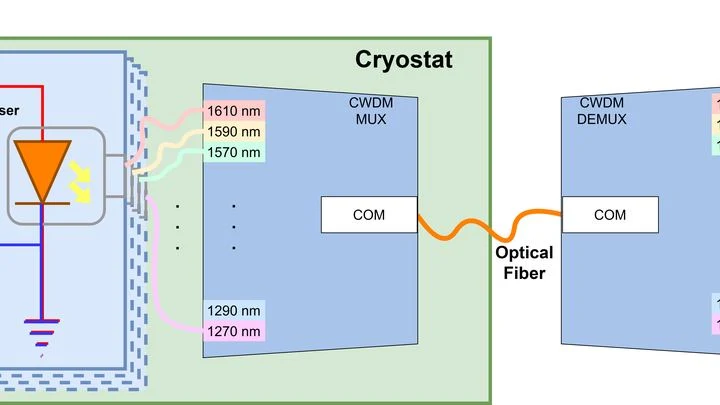
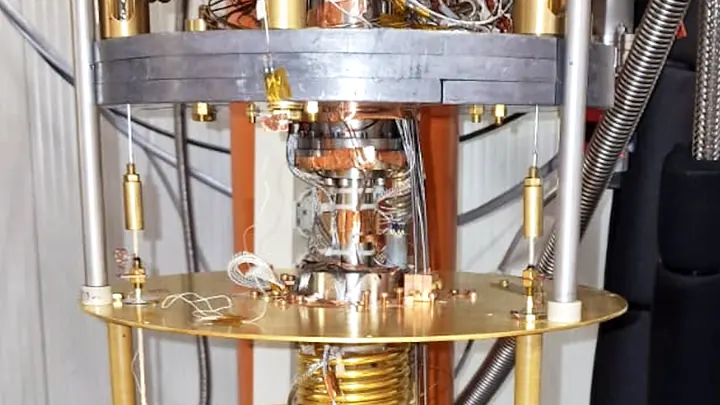
Cooling a system to cryogenic temperatures reduces the random thermal motion of its constituent particles. This is achieved using cryostats, which employ liquid helium or mechanical refrigerators to remove heat. At such low temperatures, the thermal energy (k_B T) becomes smaller than the energy scales of quantum transitions, allowing delicate quantum states to persist and weak interactions to be detected without being swamped by noise.
In practice
Cryogenic temperatures are used in superconducting magnets for MRI machines, quantum computers, and particle detectors like those at the Large Hadron Collider, as well as in space telescopes to cool infrared sensors.
Fun fact
At cryogenic temperatures, some materials become superconductors, allowing electric current to flow forever without any energy loss.
Deep inside a mountain, where cosmic-ray muons are muffled by a thick layer of rock, stands a detector that catches not light but its absence. Positronium is a tiny atom in which an electron and its antiparticle, the positron, circle each other like a pair of dancers. Usually they come together and vanish in a flash of two or three gamma quanta.
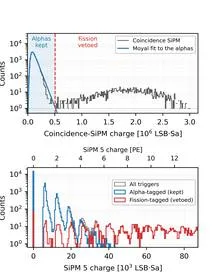
The stage is bathed in icy light, and on it stand silicon spectators. Each is an array of tiny avalanche diodes capable of spotting a single photon, but only if the surrounding temperature drops to 165 K.
A frozen orchestra where musicians swap seats when the conductor, magnetism, sets a new score. In a spinel crystal, iron and magnesium atoms sit in two types of seats: some surrounded by four neighbors, others by six. At room temperature, they barely stir, but cool the material to 5 K and a mass migration begins.
Instead of an ice bath, a warm gas blanket. That is how the cryogenic current comparator at Japan's National Metrology Institute is now cooled. Previously, this instrument, which compares electric currents to within billionths of a percent, required immersion in liquid helium.
A quantum lab is like a kitchen where the chef waits a day for the stove to cool down. Superconducting qubits only work at temperatures of a few hundredths of a kelvin, and each 'cool, measure, warm up' cycle eats a whole day. A team of engineers built a fridge the size of a melon, weighing 3 kg, that does the job in just two hours.
Earth's magnetic field is not constant: it trembles from the solar wind, from distant thunderstorms, and from the subway running nearby. To notice these tremors, you need an instrument that doesn't tremble itself. Physicists have built such an instrument from ytterbium atoms cooled to nearly absolute zero.
Hot water after a shower, warm air from ventilation, the heated walls of an engine — all this is heat below 100°C. Usually, it dissipates without doing any useful work. Now it can be captured and turned into electricity.
Inside the new device is a wire made of a nickel-titanium alloy. This material remembers its shape: when heated, it contracts; when cooled, it returns to its original shape.
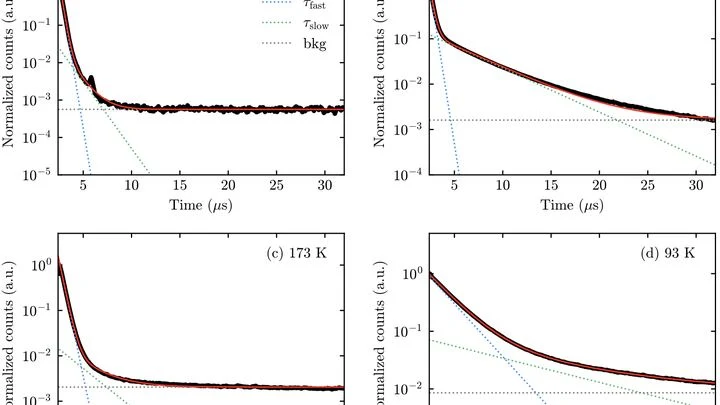
A sodium iodide crystal doped with thallium is like photographic film for invisible particles. When a gamma ray or a hypothetical dark matter particle hits it, it flashes with faint light. Two silicon photomultipliers pressed against the crystal's ends catch the flash from both sides.
Quantum technology urgently needs a universal 'translator' between the languages of microwaves and light. Superconducting qubits communicate on centimeter wavelengths, while photons in optical fiber talk at optical frequencies.
Dark matter is the invisible scaffold that holds galaxies together. But how did it come to be? The standard answer: particles of dark matter once stopped colliding and "froze out" in the amount we see today. However, there's a trickier path — UFO, or ultra-fast freeze-out.
Here, everything is like coffee that cools down and then heats up again as you carry it through a cold corridor.
Textbooks divide particles into two camps: bosons love to crowd into the same state, fermions absolutely refuse. But nature allows a third option. Anyons are quasiparticles whose behavior lies somewhere in between. They can 'remember' how they were exchanged and obey a nonstandard exclusion principle.
The oven slowly cools. While it's hot, the dough rises vigorously, but once the temperature drops, the process stalls. That's roughly how dark matter was born in the 'freeze-out' model: in the hot early cosmos, particles collided and abounded, but as the universe expanded and cooled, their number froze, like baked goods set in place.
Quantum laws reign supreme in the microworld, but macroscopic objects usually behave classically: the thermal motion of atoms drowns out quantum effects.
If you stick two identical thermometers into a pot of hot water, they'll both read the same, and we relax, thinking the temperature is measured correctly. But in a rarefied gas heated to millions of degrees, this trick stops working.
An invisible fence blocks the strait. You can't climb over it or dive under it: it's not made of steel, but of a stream of particles penetrating the water column. That's one way to describe the idea of detecting nuclear submarines by their antineutrino emission.
In the first moments after the Big Bang, the universe was a boiling soup of elementary particles. Even the light neutrinos were actively colliding with everything around. But the rapid expansion cooled this soup, and the neutrinos broke free, becoming almost indifferent to the surrounding world.
Strike a diamond and it rings, but sound lives inside it even without a strike. Waves of compression and rarefaction constantly ripple through it, like the ripples a stone makes on water. Except this ripple is the thermal jitter of the atoms themselves, and it can be detected with a laser.
A giant planet hangs in space in complete solitude, separated from its star by a distance 160 times greater than the path from the Sun to Pluto. The light from its parent star arrives so faintly that the surface temperature barely exceeds 200 degrees Celsius — about as warm as a well-heated sauna.
Light leaves a trace even when there is almost none of it. A single photon, a tiny bundle of energy, strikes a silicon wafer and knocks out a handful of electrons. The trouble is that the handful is too small to notice. You need an amplifier.
Usually, the signal is amplified by applying a voltage to metal contacts on the detector's surface.
Imagine trying to examine a snowflake without letting it melt or get damaged. That's roughly the challenge facing scientists who want to study individual proteins — the tiny molecular machines of life. In solution, a protein constantly jiggles and clumps with its neighbors, and in an electron microscope, the beam destroys it.
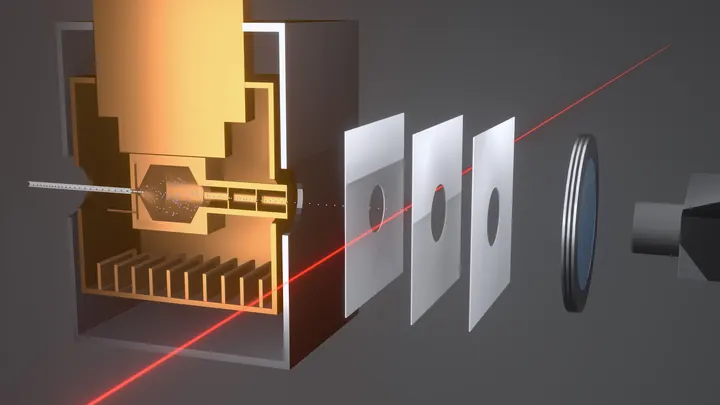
A metal needle descends onto a piece of superconductor. All of this happens inside a refrigerator that cools the sample to 30 thousandths of a degree above absolute zero — a hundred times colder than outer space. A weak current is passed through the needle, and by how electrons travel through the tiny contact point, physicists read what is happening inside the material.
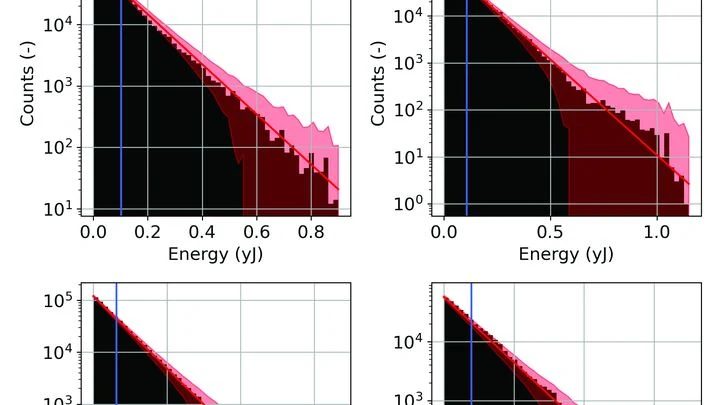
A detector that hunts for rare particles is like an ear trying to catch a whisper in a noisy room. The quieter the signal, the harder it is to tell apart from random noise. In the NUCLEUS experiment, such detectors, cryogenic calorimeters, are cooled to near absolute zero so they can pick up even a faint pulse of heat from a single particle.
To catch a whisper in a noisy room, you need a highly sensitive microphone that barely makes noise itself. In the physics of rare events, that role is played by detectors made of ultra-pure germanium — a semiconductor crystal that turns a passing particle into a tiny electrical pulse.
Quantum materials are like finicky flowers: they only bloom in the cold. At room temperature, they hide their unusual properties, but when deeply cooled, they become superconductors or change their magnetic behavior. To understand how they work, you need to examine their atoms in the very cold where these properties reside.
In a dark chamber where the temperature sits just four degrees above absolute zero, a sapphire crystal the size of a grain of rice lies waiting. When a neutrino, a ghostly particle that barely notices matter, flies through it, the crystal shudders and warms by a tiny fraction of a degree.
A semiconductor film just one atom thick is like a communal apartment: it houses negatively charged electrons and positively charged 'holes.' When light hits such a film, an electron and a hole can pair up into an exciton — a bound state of an electron and a hole, akin to a hydrogen atom.
A seismometer is the planet's ear. It picks up the faintest tremors in the ground and turns them into an electrical signal. But this ear isn't perfect: its sensitivity depends on temperature. In the cold and in the heat, the instrument hears slightly differently, and that introduces error into measurements.
A handful of sand on a vibrating table is like a crowd on a dance floor that still holds the rhythm of the old song for a second after the DJ has switched to a new one. Scientists made a thin layer of grains bounce on a vertically shaking platform and abruptly changed the shaking intensity.
At 0.1 K, just three-tenths of a degree above absolute zero, matter stops following the usual rules. Helium becomes superfluid: it flows without friction, seeps through cracks, and behaves like one giant quantum liquid. Seeing what happens inside such cold is a challenge at the edge of possibility.
Fragile as ice in a furnace, quantum entanglement usually perishes from the slightest heat. Near a black hole, where space is twisted by Einstein's gravity and Hawking radiation Hawking's heats things up, any bond should be destroyed.
A thermos of liquid xenon cooled to minus 100 degrees Celsius. Inside are sensitive sensors that catch rare signals from dark matter particles. To bring these signals out, copper cables are usually used. But over the long haul, the signal weakens, and adjacent cables start 'cross-talking' — that's called crosstalk.
A cage of sixty carbon atoms, shaped like a soccer ball, lets small molecules slip inside. Carbon buckyballs, fullerenes, pack into a crystal like oranges in a crate, leaving gaps between them. At 570 degrees Celsius and 30 atmospheres of pressure, hydrogen seeped into those gaps.
Ancient lead that lay on the seafloor for two thousand years has become the heart of a detector searching for the most elusive substance in the universe. From it, researchers grew a transparent lead tungstate crystal weighing 13 grams and cooled it to near absolute zero.
A thermal imager typically works like a thermometer with a sensor array: it measures how much each pixel heats up and turns that into a picture. But this method has a limit — the device's own noise obscures faint heat.
An oven with three racks, each baking a different dish: that's the image that comes to mind when you look at the galaxy I Zw 18. The top rack is blazing at 21,200 kelvins, the middle one at 17,290, and the bottom at 16,170.
Inside a refrigerator that cools matter to near absolute zero beats a mechanical heart — the pulse tube. It pumps gas and extracts heat, but along with the cold it brings tremors. Each beat of this heart shakes the instruments sitting next to the sample and ruins delicate measurements.
A quantum computer is like an orchestra that can only perform in complete silence. The slightest noise, and the delicate melody falls apart. For quantum devices, heat is that noise: even faint infrared radiation from nearby components heats up the qubits and erases their quantum states.
The usual way to freeze a living cell is like trying to put a spacesuit on it: you first need to get a protective substance inside, but while it's crossing the membrane, the cell can burst from salt imbalances or get poisoned by the chemicals.
A tiny seesaw weighing 1.5 nanograms oscillates not from the wind, but from the heat of its surroundings. Physicists nearly stopped it by cooling it to 0.006 degrees above absolute zero.
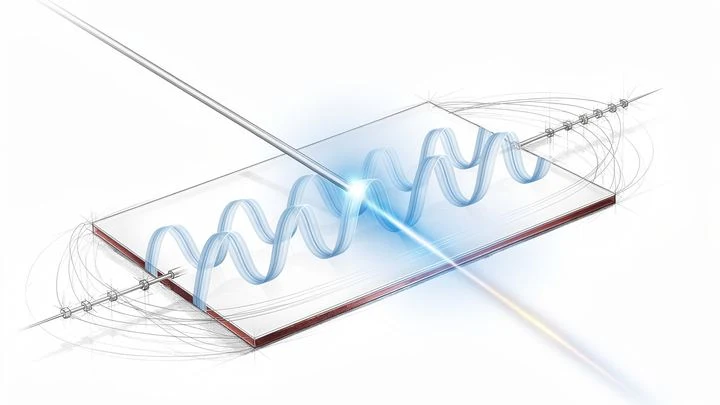
In the world of microchips, where streams of photons, quanta of light, carry information, a fundamental problem arises: light passing through matter inevitably heats it. This heating spawns thermal fluctuations — chaotic, unpredictable jostling of atoms that disrupts precise device operation.