An electrical pulse is a brief, sudden change in electric current or voltage. Unlike a steady signal, a pulse is a discrete event — a spike, a dip, or a short burst — that carries information or triggers a response. It is the fundamental unit of signaling in electronics, from the firing of a neuron to the switching of a transistor.
History
The concept of electrical pulses dates back to the early experiments with telegraphy in the 19th century, where Morse code was transmitted as short and long pulses. The modern understanding of pulse propagation in circuits was formalized by Oliver Heaviside in the 1880s.
How it works
A pulse is created when a voltage or current source is rapidly switched on and off, or when energy is released in a short burst. The shape of the pulse — its height, duration, and rise/fall times — determines what it does. In digital circuits, a pulse can represent a '1' or a '0'; in a neuron, an action potential is a pulse that travels along the axon; in a laser, a pulse concentrates energy into a tiny time window, enabling extremely high peak power.
In practice
Electrical pulses are used everywhere: in computer clocks, pacemakers, radar systems, and pulsed lasers for material processing and medical surgery.
Fun fact
A single neuron can fire up to 1,000 pulses per second, and the timing between pulses carries information about stimulus intensity.
A superconducting detector usually works like an honest ruler: absorb a photon, get a pulse whose amplitude is strictly proportional to the energy. This mode is convenient, but it has a ceiling: a weak signal easily gets lost in the amplifier noise.
Now imagine a swing.
An empty dance floor where people occasionally appear. Each moves on their own, chaotically, with no connection to the others. But when the right music starts and the hall cools down a bit, the dancers suddenly begin to form long chains and move in unison. That's roughly how electrons behave in a dilute three-dimensional gas.
$$10^{-35}$$ seconds. A tiny instant during which the Universe manages to expand by a factor of $$10^{26}$$. Immediately after, it goes through thousands of rapid transformations — like a ball bouncing along a chain of tunnels. This cascade is the essence of chain inflation, first proposed by Alan Guth.
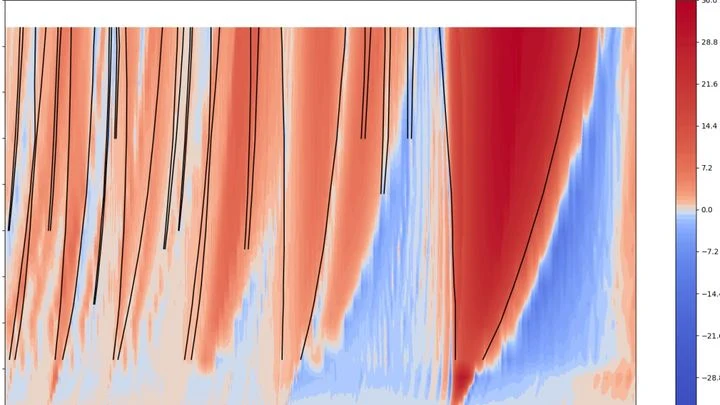
The Sun is constantly struck by blows — magnetic reconnection in the plasma releases energy, making the corona flare up. After each such blow, magnetohydrodynamic waves linger in the plasma loops, like the fading ring of a bell.
For over a century, astronomers puzzled over the capricious behavior of RR Lyrae stars: their brightness periodically waxed and waned with unpredictable amplitude, like a lighthouse with a faulty mechanism. The Blazhko effect, discovered in 1907, taunted scientists for decades.
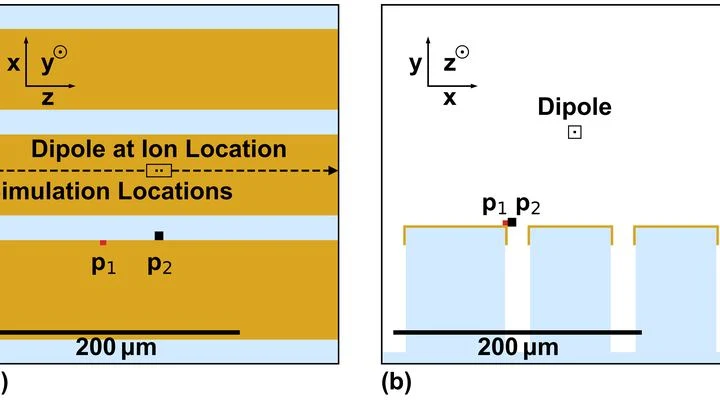
A quantum computer is like an orchestra where each ion is a musician and laser pulses are the conductor's baton. But if someone in the audience rustles, the delicate melody of quantum states goes off key.
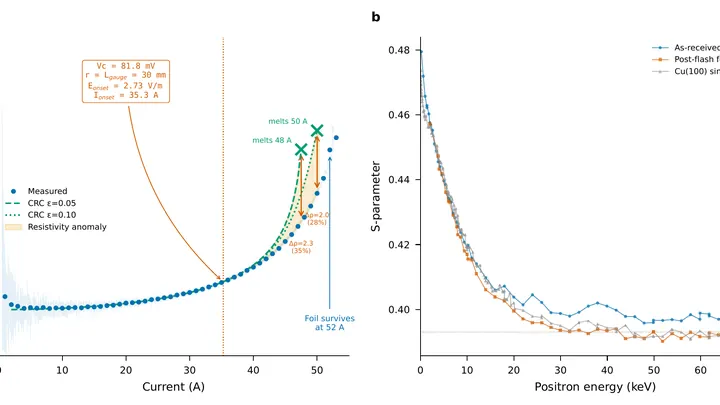
A copper wire under current is a familiar sight, but inside it something unexpected is happening. A strong electric current doesn't just heat the metal: it knocks atoms out of their rightful places, leaving behind tiny voids, as if a few balls were suddenly removed from a tightly packed arrangement.
Light in a particle detector behaves like a voice in the mountains. One shout, and the echo repeats several times, growing fainter with each reflection. So it is in a silicon detector: a real flash from a particle gives rise to false ones that confuse measurements.
Each breath slightly speeds up the heart, and each exhale slows it down. This rhythm, visible on an ECG, is called respiratory sinus arrhythmia. For a long time, it was dismissed as a mere side effect of the nervous system. But new research shows that this coordination is not a coincidence: it's a way to save energy.
In a silicon crystal, a phosphorus atom holds an extra electron on two very closely spaced orbits. These orbits are like two neighboring floors in a building where the staircase is almost invisible. A short laser pulse in the mid-infrared range pushes the electron from the lower floor to the upper one, and it starts swinging between them like a pendulum.
In the ocean, sometimes a huge solitary wave appears out of nowhere and then vanishes. Such rogue waves are rare but dangerous. Similar rare and intense spikes occur in other systems, from financial markets to lasers. The problem is that they are hard to predict, let alone trigger on demand.
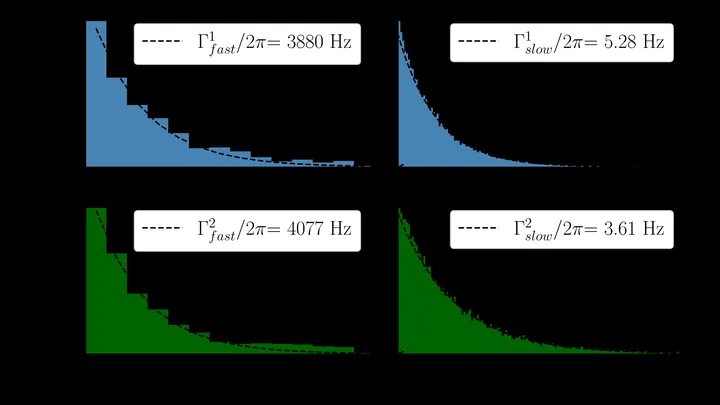
In the superconducting circuits that make up quantum computers, extra particles, quasiparticles, are born from time to time. They are like random passersby who barge into the processor's work and spoil the calculations.
An ordinary sensor is like a scale that always shakes a little on its own. Even in total silence and at zero temperature, every particle jitters — this is quantum jitter, and it limits the precision of any measurement.