Entropy as a Faulty Meter: How Much Energy Does Life Actually Spend?
Context
In the physics of living systems, entropy production often serves as an indirect measure of energy consumption. For microscopic objects such as bacterial flagella or hair cells, nonzero irreversibility proves that the system is actively driven. However, for larger organisms, where energy costs are obvious, the meaning of such estimates remains unclear. This work stands apart among studies of irreversibility: it applies statistical tools to a system whose true power is known, which makes it possible to test how closely the entropy bound approaches reality.
Methods
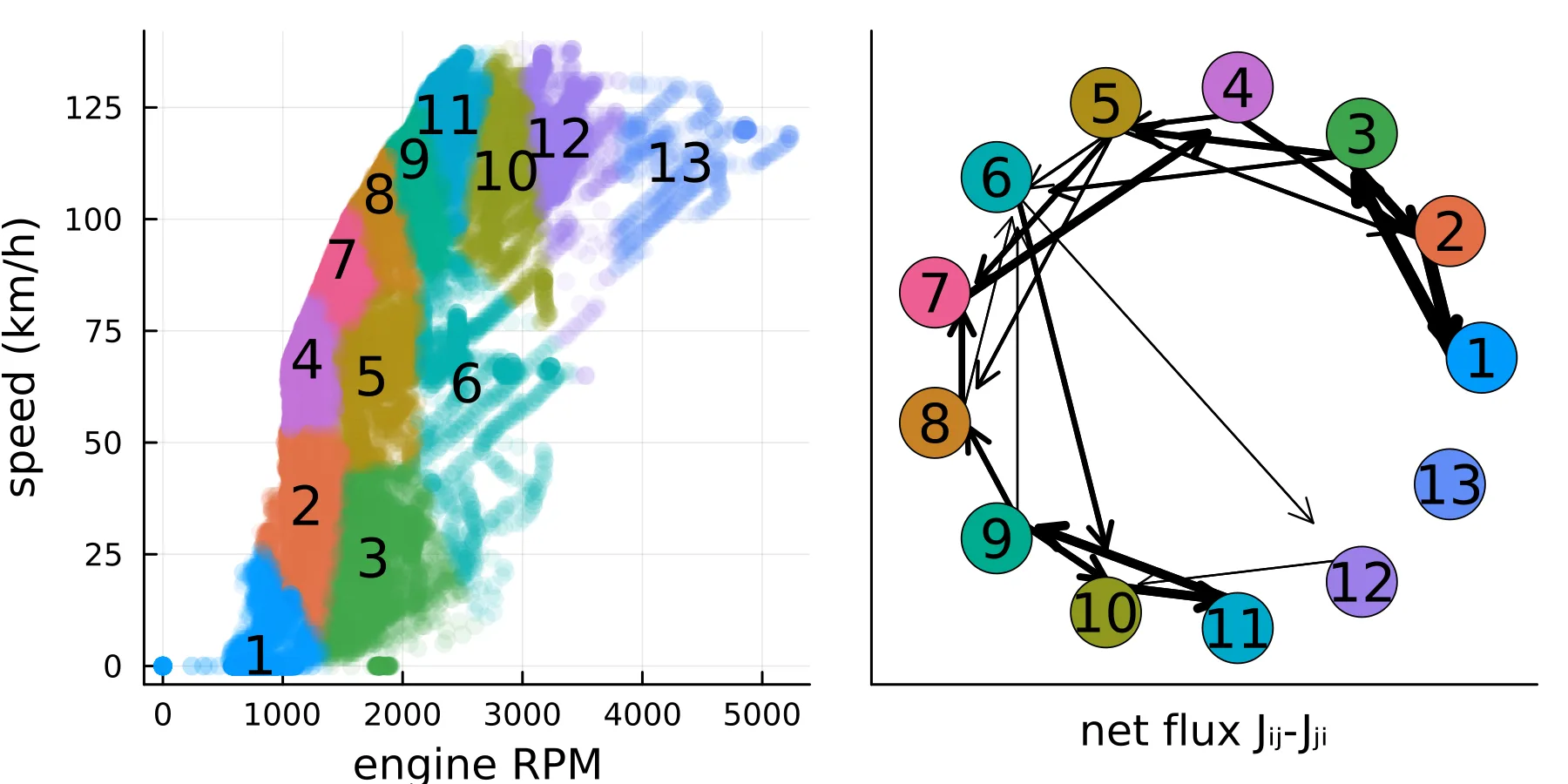
Data were collected from the OBD-II port of a Subaru car using a Freematics device: speed, engine RPM, and coolant temperature were recorded every 140 ms. Temperature was treated as constant, and speed and RPM were used as a two-dimensional trajectory x(t). Several methods were applied to estimate entropy production: a Gaussian approximation in the frequency domain, state discretization via k-means clustering and construction of a Markov chain, and three variants of estimates based on k nearest neighbors, including a new KSG-like method. In addition, a lower bound was computed from the thermodynamic uncertainty relation using the variance of the trajectory's RPM around its mean. Energy consumption was estimated from fuel consumption: 30 miles per gallon at 60 miles per hour gives a thermal power of about 72 kW.
Results
All methods yielded nonzero irreversibility values, but with a large spread: from 0.02 to 0.8 bits/s. After bias correction, the authors adopted a consensus estimate of Σ ≈ 0.5 bits/s. At room temperature this corresponds to kBTΣ ≈ 2×10⁻²¹ J/s. The actual engine power, estimated from gasoline consumption, is 7×10⁴ J/s. Thus, the gap between the entropy bound and the actual energy consumption reaches 25 orders of magnitude. This is far larger than previously reported for neurons (8 orders) and hair cells (4 orders). Extending the Markov estimates to higher orders showed an almost linear growth of irreversibility, which points to physics on time scales far from the sampling step.
Implications
The work demonstrates that for macroscopic living systems, entropy production computed from a limited set of observables is not a useful indicator of energy consumption. Unlike neighboring studies that focus on microscopic objects or individual cells, this one provides the first direct comparison with the known power of a whole organism. This calls into question the interpretation of irreversibility as a measure of biological activity in cases where the observed degrees of freedom do not reflect the functional purpose of the system.
Future development
It is possible that entropy production will prove useful as an aggregate statistic for detecting regularity in heart rhythm, brain waves, or the collective motion of flocks and traffic flows. However, this will require independent grounds unrelated to energetics. It also remains to be understood why different estimation methods give such different results, and more reliable bias correction procedures need to be developed.
Impact
The results matter for biophysicists studying active processes in cells and organisms, as well as for time series analysts who use entropy measures to characterize complex systems.
Next steps
The same methods should be applied to other macroscopic systems with known energy consumption to test whether the gap is universal. It is also necessary to compare irreversibility estimates with direct measurements of heat release in controlled experiments.
Key open problems
In biophysics, the question of which observed degrees of freedom reflect the functional purpose of an organism remains open. This work shows that irreversibility computed from arbitrary macroscopic variables may carry no information about energy expenditure, which limits its applicability for testing hypotheses about the efficiency of biological processes.
The Subaru car used in the experiment has a continuously variable transmission (CVT), which is evident from the absence of radial lines in the clustering plot: fixed gear ratios would have shown up as characteristic rays.
Key numbers
- gap between the bound and power: 25 orders of magnitude
- irreversibility estimate: 0.5 bits/s
- entropy power: 2×10⁻²¹ J/s
- actual engine power: 7×10⁴ J/s
- data recording frequency: 140 ms