The counter that comes up short
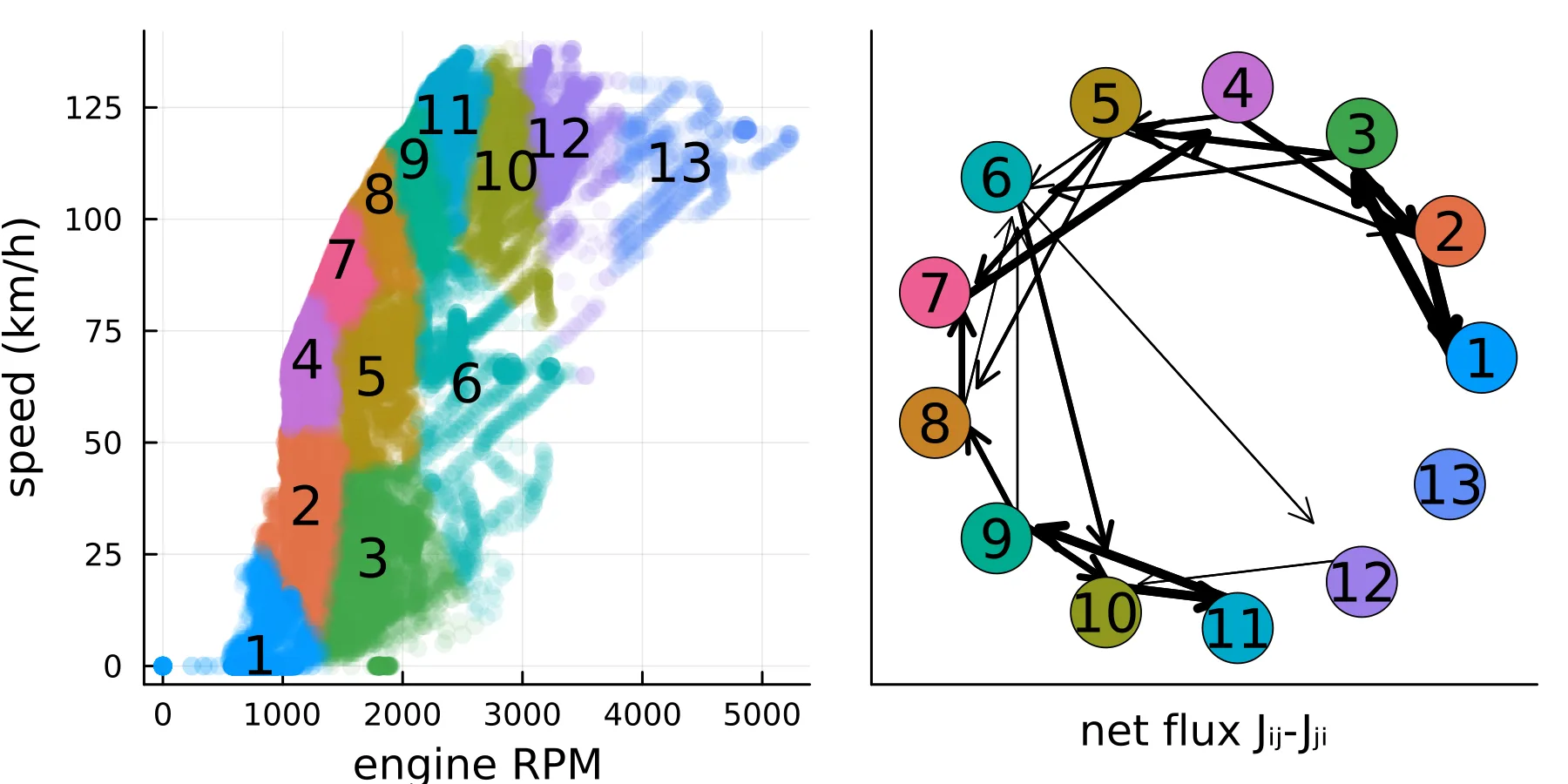
Every 140 milliseconds, a small device connected to the car recorded speed, engine rpm, and coolant temperature. An ordinary Subaru was driving down the road, and its onboard computer turned into a measuring laboratory. That is how physicists set out to test how well a popular statistical measure reflects real energy expenditure.
The measure is called entropy production. It gauges how irreversible a process is: whether you can tell forward motion from a rewind just by looking at the record. For microscopic objects, such as bacterial flagella, a nonzero value proves that the system is actively burning energy. But what happens when the system is large and its energy consumption is obvious?
The authors collected the data and applied several methods for estimating irreversibility. The spread turned out to be wide: from 0.02 to 0.8 bits/s. After correcting for bias, they settled on a consensus estimate of about 0.5 bits/s. At room temperature, that corresponds to a power of 2×10⁻²¹ J/s. And the engine's actual power, estimated from gasoline consumption, is 7×10⁴ J/s. A gap of 25 orders of magnitude.
That is far larger than what has been reported for neurons (8 orders of magnitude) and hair cells (4 orders of magnitude). Extending the estimates to higher orders revealed a nearly linear growth of irreversibility, which points to physics on timescales far from the sampling step. But even with that growth, the gap remains enormous.
The work shows that for macroscopic living systems, entropy production computed from a limited set of observables is not a useful indicator of energy consumption. This is the first direct comparison with the known power output of a whole organism. It calls into question the interpretation of irreversibility as a measure of biological activity when the observed variables do not reflect the system's functional purpose.
Entropy production might still prove useful as an aggregate statistic for detecting regularity in heart rhythm, brain waves, or the collective motion of flocks and traffic flows. But that would require independent grounds unrelated to energetics. For now, the counter that comes up short is a reminder: not every measure that looks scientific tells us what we want to measure.
The Subaru car used in the experiment has a continuously variable transmission (CVT), which is evident from the absence of radial lines in the clustering plot: fixed gear ratios would have shown up as characteristic rays.