Internal energy U is the total energy of chaotic (thermal) motion of microparticles of a system and the potential energy of their interaction. Unlike the mechanical energy of a body as a whole, internal energy does not depend on the body's speed or position in space, but is determined by its temperature, volume, and chemical composition. The first law of thermodynamics relates the change in internal energy (ΔU) to the amount of heat transferred (Q) and work done on the system (W): ΔU = Q - W.
History
The idea that heat is related to particle motion dates back to the work of Benjamin Thompson (Count Rumford) at the end of the 18th century, but quantitative description began in the 19th century. James Joule in 1843 experimentally proved the equivalence of mechanical work and heat. Rudolf Clausius introduced the concept of internal energy in 1850, formulating the first law of thermodynamics. Ludwig Boltzmann developed a statistical interpretation, linking internal energy to the microscopic motion of particles. James Clerk Maxwell and others developed the kinetic theory of gases, which gave an explicit form of the dependence of internal energy on temperature.
How it works
The change in internal energy of a system occurs according to the first law of thermodynamics: ΔU = Q - W, where Q is heat transferred to the system, W is work done by the system on the external environment. For an ideal gas, internal energy increases with temperature: faster-moving molecules have greater kinetic energy. During phase transitions (melting, vaporization), energy is spent on overcoming intermolecular forces, not on increasing temperature — this is how latent heat arises. In the thermodynamics of non-equilibrium processes, the local change in internal energy is described by the heat conduction equation. Closely related concepts: entropy (measure of disorder), enthalpy (U + pV), free energy. Laws: first law of thermodynamics, second law of thermodynamics (establishing the direction of processes).
In practice
Understanding internal energy makes it possible to efficiently convert heat into work in engines and refrigeration units, as well as to predict chemical reactions and phase transitions.
Fun fact
Even ice at subzero temperature has internal energy: water molecules in the crystal lattice continue to vibrate, and only at absolute zero (−273.15 °C) does this motion theoretically cease.
Billions of tiny motors hum inside every living creature. Cells ceaselessly pump substances, burn sugar, and build new proteins, and all this invisible motion warms us from within. To maintain order, life must dissipate heat into the environment, like a stove that never goes out.
The power of this internal heating is almost independent of size.
In a pot of boiling soup, churning currents carry heat to the walls, and the soup cools. In a tokamak, a huge magnetic bottle for plasma, the same thing happens: turbulent eddies carry energy outward, hindering the ignition of a fusion reaction. But sometimes the plasma seems to find a way to calm itself.
An ordinary phone battery breathes — not with air, but with contact. Inside a solid body, where there are no liquids, lithium presses against the electrolyte (the ion-conducting substance) during charging and pulls away during discharging, like a lung on inhale and exhale. This 'breathing' is not poetry but physics: each cycle creates and destroys the contact points through which current flows.
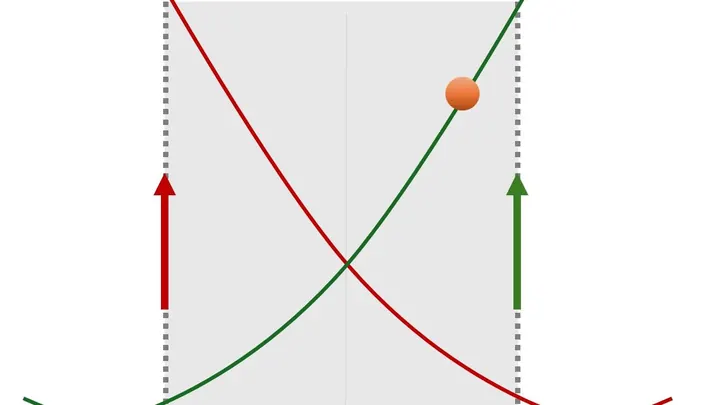
The Mpemba effect is surprising: hot water sometimes freezes faster than cold. Scientists built a simple model: a bead in a thick, honey-like medium, on a landscape with two dips and a wall at the edge. The bead moves viscously, unable to hop over the central bump.
A flexible thread, coiled into a loop, was locked in a tiny box with liquid. It can either absorb water and swell like a sponge, or expel the moisture and shrink into a tight ball. The choice between these states depends on whether the thread has a knot – and which one.
The reason lies in entropy, a measure of disorder.
A cell is a city where tiny motors work nonstop. They carry cargo, move cilia, and make muscles contract. All this work generates heat, just like a car engine warms up. But measuring the heat from a single motor a few nanometers in size is no easy task.
Stochastic modeling helps us peek into this world.
In a freezer, ordinary water turns to ice, but in living cells, such ice is a disaster: sharp crystals tear membranes apart like needles popping a balloon. Scientists who preserve cells for medicine have learned to avoid this calamity, but each method speaks its own language. A new study offers a common vocabulary — thermodynamics.
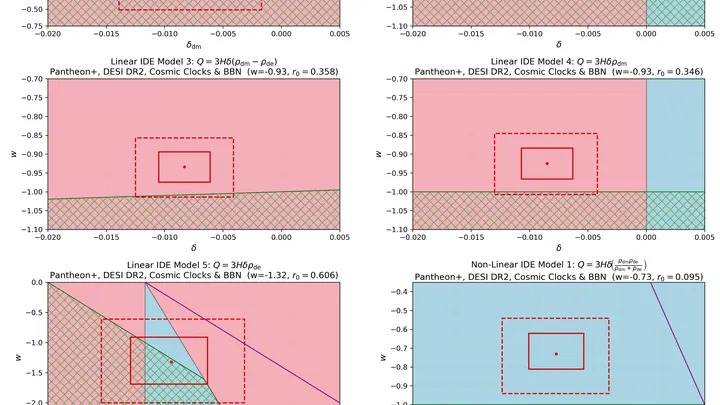
In the cosmic dance, dark energy and dark matter exchange energy. For a long time, dark energy was thought to be a constant force accelerating the universe — an insight that earned the Nobel Prize for Riess, Perlmutter, and Schmidt.
Water in a glass cools, ice melts, and a kettle heats the stove: that's how the world works: heat always flows from hot to cold. This is the second law of thermodynamics, a law that has never been broken.
Two qubits, quantum bits, two-level systems, glide through hot and cold thermal baths. One moves at 0.8 times the speed of light. At that moment, familiar thermodynamics cracks: a moving qubit senses temperature differently than a stationary one. For it, the cold bath can feel hotter, and the hot bath colder.