The meter that reads the wrong thing
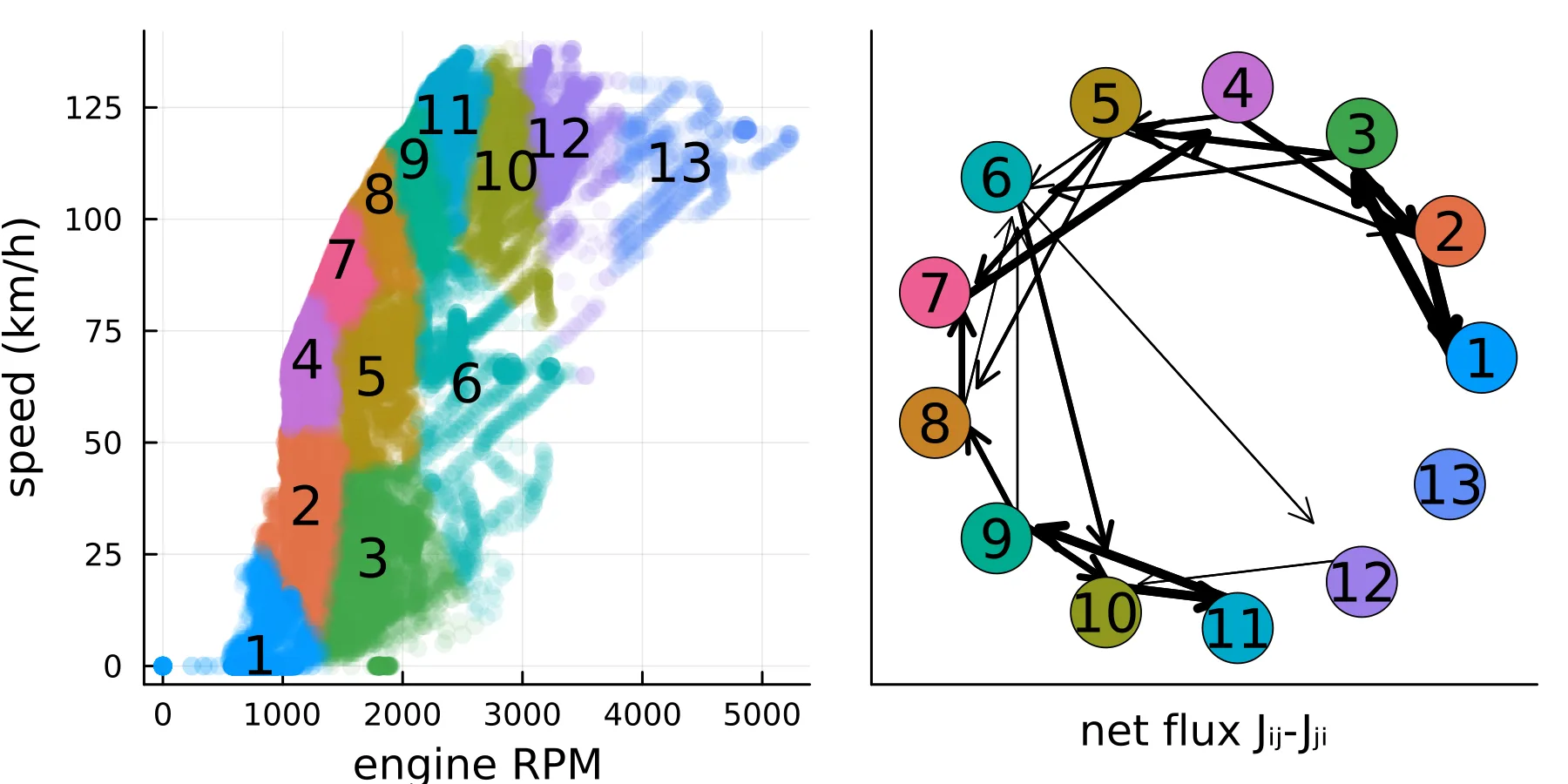
Every 140 milliseconds, a device in the car recorded speed, engine rpm and temperature. That was how the physicists hoped to test how well a popular measure reflects real energy expenditure.
The measure is called entropy production. It gauges how irreversible a process is: whether you can tell forward motion from a rewind by looking at the record. For tiny objects, such as bacterial flagella, a nonzero value proves that the system is actively burning energy. But what happens when the system is large and its energy consumption is obvious?
The authors applied several estimation methods and got a value of about 0.5 bits/s. At room temperature, that corresponds to a power of 2×10⁻²¹ J/s. The actual engine power, meanwhile, is 7×10⁴ J/s. A gap of 25 orders of magnitude. That is far larger than for neurons or hair cells.
The conclusion is simple: for large systems, entropy production computed from limited data is a poor reflection of energy consumption. It may prove useful for analyzing heart rhythm or the movement of flocks, but that would require other grounds. For now, the meter that reads the wrong thing is a reminder: not every measure that looks scientific tells us what we want to measure.
The Subaru car used in the experiment has a continuously variable transmission (CVT), which is evident from the absence of radial lines in the clustering plot: fixed gear ratios would have shown up as characteristic rays.