Vanishing Points in Old Sky Photographs express
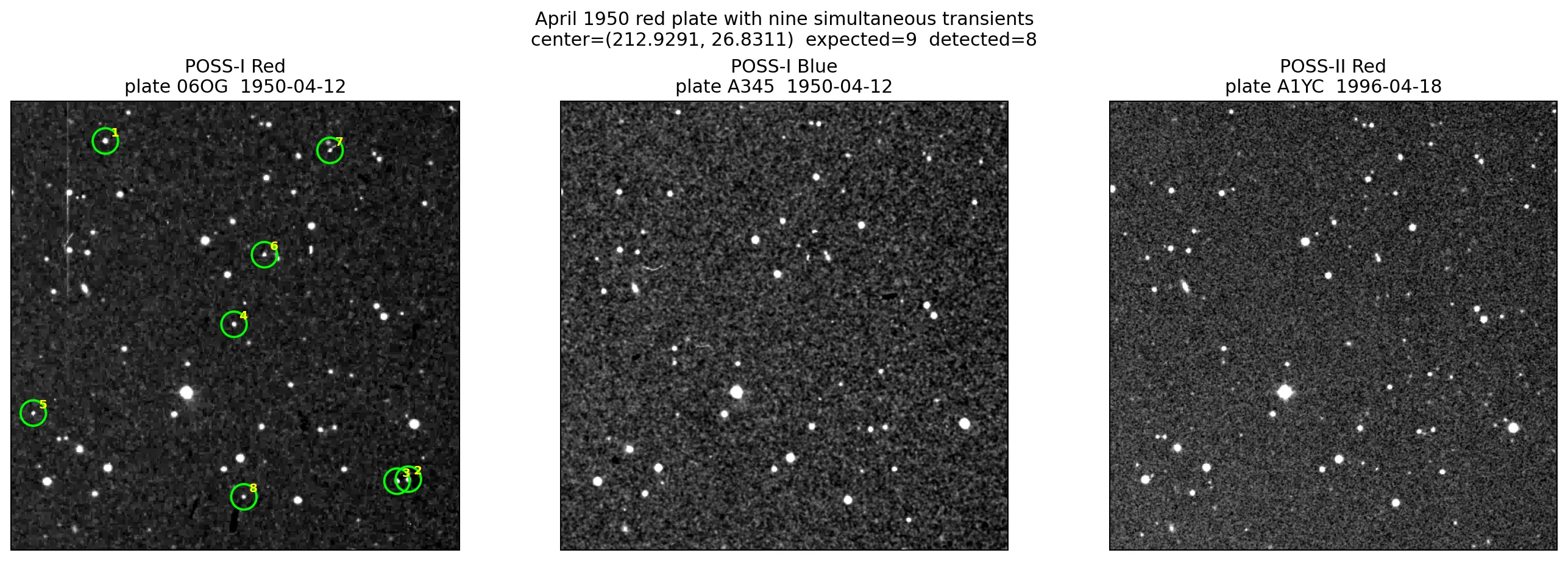
In the 1950s, telescopes photographed the sky on glass plates. Now those images are digitized, and they can be compared with modern surveys. Astronomers wrote a program that automatically finds bright points on old frames and checks whether they appear in new images. If a point was there but is now gone, it's a candidate for a 'vanished source.'
The program checked 30-minute patches of sky across the entire survey and, after filtering out false positives, found 2.85 million such candidates. Comparison with a catalog of 5,399 previously known 'vanished' objects yielded matches in 3,450 cases: that's 63.9%. The average coordinate discrepancy is only 0.94 arcseconds, meaning the points align almost perfectly.
Next, they checked whether the disappearances were linked to specific observation nights. It turned out that on the day after some nights, there are slightly more candidates than on random days, but the difference is small and could be due to chance. A statistical test gives a 17% probability of randomness, while a stricter model gives 71%. This means no temporal pattern is evident so far.
The main takeaway: the method works and confirms old findings, but more thorough checks are needed to search for rare events. The archival plates remain a treasure trove of mysteries, and now there's a tool to sift through them.
Original abstract
as written by the authors arXiv:2604.04810
We present an independent pipeline for detecting candidate vanished sources on digitized first-epoch Palomar Observatory Sky Survey (POSS-I) photographic plates. The pipeline detects and PSF-filters sources on POSS-I Red DSS cutouts, applies local astrometric registration refinement, and identifies candidates by cross-epoch matching against POSS-I Blue and POSS-II Red with Pan-STARRS DR1 rejection. On a 20-case benchmark harness, the pipeline recovers 8/9 sources in the April 1950 field and 3/3 in the July 1952 field, with a false positive rate of about 0.2 per 10 arcmin field on random non-crowded controls. A full-footprint sweep over the POSS-I coverage using 30 arcmin patches yields a filtered catalog of 2.85 million candidate vanished sources after post-processing PSF cuts, deduplication, and Pan-STARRS DR1 rejection. Cross-matching against the published 5,399-source Solano et al. (2022) catalog yields 3,450 matches (63.9%) with median separation 0.94 arcsec; among unrecovered catalog entries within our footprint, we find no Pan-STARRS DR1 counterpart within 3 arcsec. Applying Bruehl and Villarroel (2025)-style temporal windows to this catalog over the 368 POSS-I observation nights in the 1949-1957 interval gives a post-test calendar-day relative risk of 1.35 for the +1 day window, but the effect is not statistically significant (95% CI 0.91-2.00; two-sided Fisher p = 0.17) and is sensitive to coding unobserved days as zero-transient days. A negative binomial model of nightly candidate counts with nightly patch coverage as exposure is likewise null (IRR = 1.03, 95% CI 0.89-1.18, p = 0.71). The catalog-level replication is strong; the temporal association remains inconclusive.
The Palomar Survey plates were digitized in the 1990s, and each image takes up about 1 gigabyte, the entire archive weighs in at tens of terabytes.