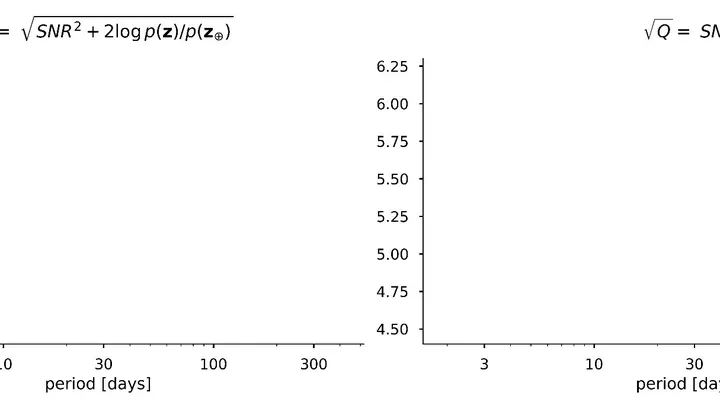
A false positive is an error in classification where a test or model incorrectly identifies a candidate as belonging to a target class when it actually does not. In physics and related fields, this concept is central to signal detection, data analysis, and experimental design. For example, when searching for a rare particle decay or a faint astronomical signal, false positives can arise from background noise, detector artifacts, or statistical fluctuations that mimic the signature of interest.
How it works
The mechanism involves setting a threshold for what counts as a positive detection. If the threshold is too low, many noise fluctuations will exceed it, producing false positives. If too high, real signals may be missed (false negatives). The balance is often quantified using the false positive rate, which is the probability of declaring a detection when none exists. In practice, researchers use statistical methods like hypothesis testing and machine learning classifiers to minimize false positives while retaining sensitivity.
In practice
False positive control is critical in particle physics (e.g., Higgs boson discovery), astronomy (e.g., exoplanet detection), and medical imaging, where a false alarm can lead to wasted resources or incorrect conclusions.
Fun fact
In the search for gravitational waves, the LIGO team used a false alarm rate of less than one per 200,000 years to claim a detection, ensuring that the first event was not a statistical fluke.
Two figure skaters on a lake frozen to the horizon. They are so far apart that their silhouettes turn into dots, and their mutual attraction becomes almost an article of faith. By Newton's law, they should circle in an unimaginably slow waltz. But telescopes see otherwise.
Ordinary AI looks at medical images like puzzles made of unfamiliar pieces: it considers any two unmatched pictures completely different. It's like trying to tell twins apart without knowing they're related. In medicine, however, patients with the same condition look nearly identical on MRI, and the algorithm mistakes 'relatives'.
The gamma sky, captured by the Fermi telescope, is a grand symphony of thousands of sources. Here, the rhythmic pulsations of pulsars, the powerful chords of active galactic nuclei, but most of all — unidentified objects, whose part remains a mystery.
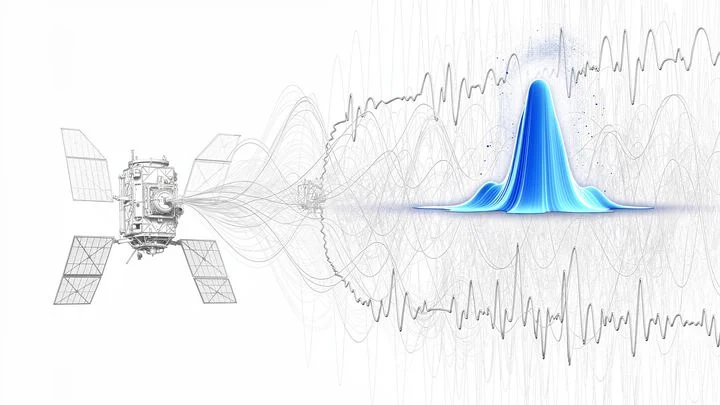
Imagine an orchestra tuning up: the violins rise in pitch: that's the familiar 'chirp' of black hole mergers in LIGO detectors. Now picture a funeral march: a sound that descends, like a fading siren. That's exactly the gravitational-wave signature a system with one negative mass should leave.
The hunt for life on distant planets is like diagnosing a rare disease with a test of unknown accuracy. A single positive result means nothing: maybe it's a glitch? We search the atmospheres of exoplanets (worlds around other stars) for traces of water and other compounds, but any signal could be a false alarm.
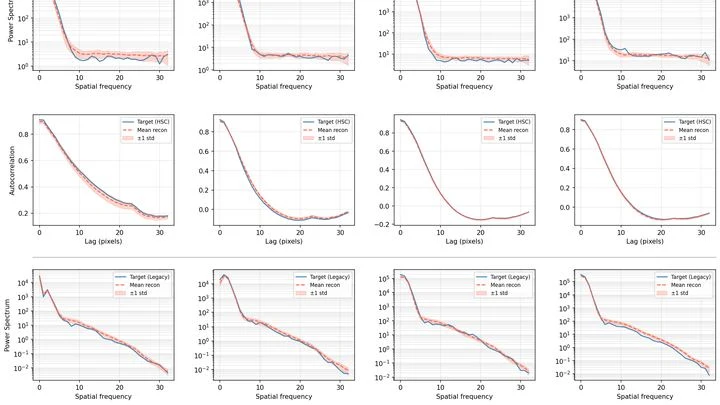
If you photograph the same mountain with a film camera and a modern smartphone, you get different images: colors are brighter in one, details are blurrier in the other. The same goes for telescopes: each instrument sees the sky in its own way, adding its own distortions to the true light of galaxies, like a filter through which we look.
Two accomplices are interrogated separately: betray or stay silent? If neither knows what the other will do, their choice breaks the classical rule of probability. It’s like riding an old bicycle over bumps — the hard seat jolts you off. The textbook rule, the classical model, fails. The authors of a new study found a simple fix: the cyclist needs a soft saddle.
Imagine reality as an undeveloped photograph: until the moment of measurement, it exists only as a cloud of probabilities — a superposition of all possible states. Only the act of observation, like developing film, forces a particle to acquire definite properties.
Porous zeolite minerals work like tiny sponges with holes of a strictly defined size. Through such holes, molecules of one kind pass while others get stuck: this is the basis for water purification, gas separation, and catalysis in petrochemistry.
Light, regardless of its source, consists of photons — elementary particles, quanta of the electromagnetic field. The simplest light detector, such as a photometric illuminance meter, operates in a binary mode: it merely registers whether photons hit it or not, giving a 'yes/no' answer.
Genetic diagnostics is like comparing two photos taken with different cameras. If one camera slightly shifts the colors, the image will show "defects" that don't exist in reality.
The night sky is dotted with stars, and many of them have planets. But how do you spot a tiny dark disk against the glare of a distant sun? The Kepler telescope spent nine years watching hundreds of thousands of stars, waiting for a planet to pass in front of its star and briefly dim it. That 'wink' is the only way to find worlds like ours.
The Wigner function is a kind of topographic map of probabilities: hills correspond to regions where a particle is most likely to be found, and valleys to where its appearance is practically ruled out.