Carbon nanotubes with calcium trap hydrogen express
Hydrogen is an ideal fuel: when used, it only produces water, not carbon dioxide. The trouble is that hydrogen is the lightest gas, its molecules leak out of any container. Right now, cars store hydrogen in heavy tanks under extreme pressure, canceling out weight benefits.
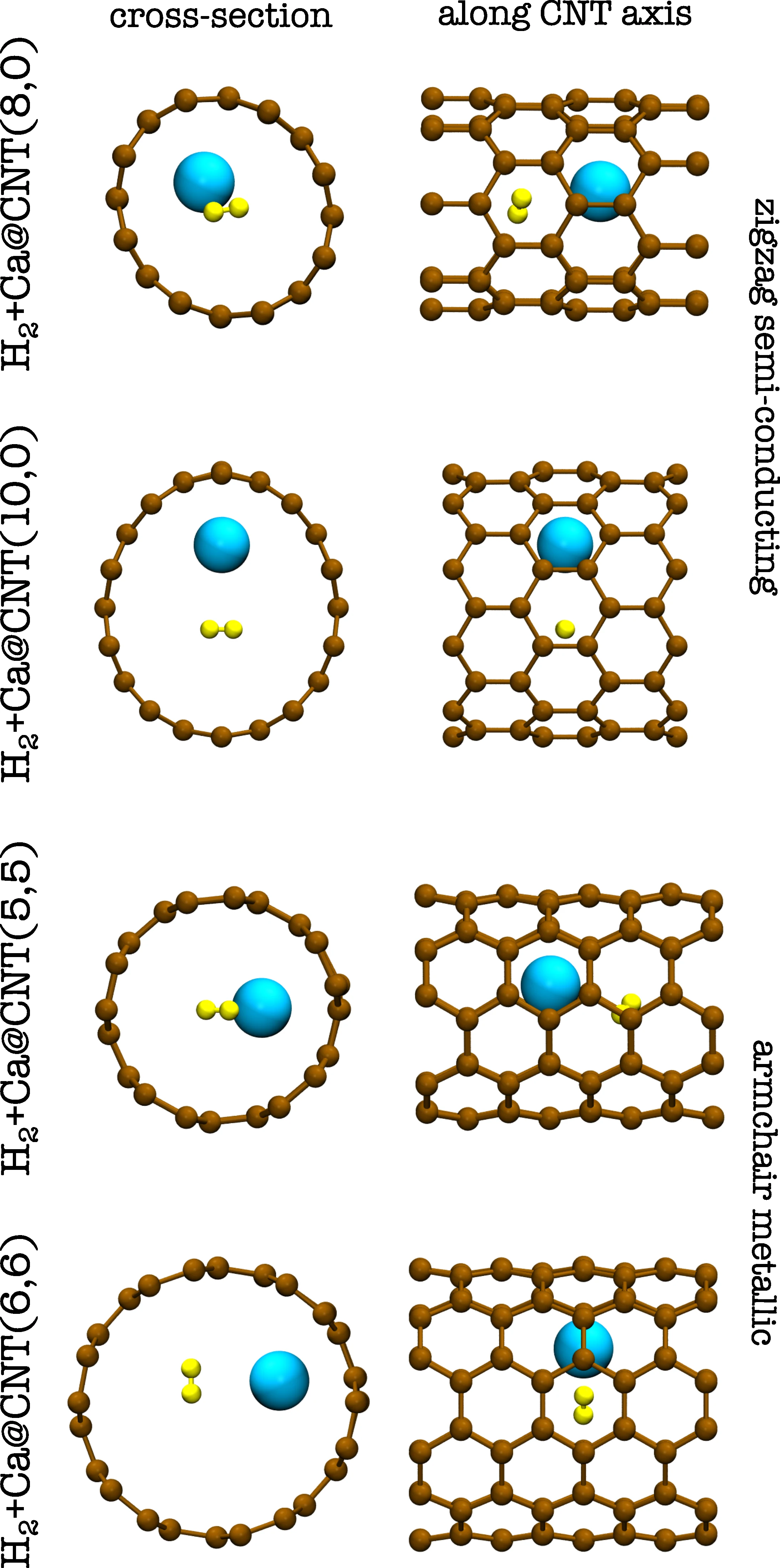
Researchers bypassed the problem without high pressure. They took carbon nanotubes (hollow cylinders just an atom thick, like a rolled-up mesh) and tucked calcium atoms inside. Calcium, the very metal our bones are made of, turned out to be the perfect 'Velcro': hydrogen sticks to it just enough to stay put, yet releases easily when needed.
This principle provides clear material design targets. If engineers can mass-produce these nanostructures, hydrogen cars will become truly lightweight and long-range.
Original abstract
as written by the authors arXiv:2604.07110
Hydrogen technology is set to be a key energy alternative for mitigating pollution and reducing CO$$_2$$ emissions. However, the current storage mechanism of hydrogen molecules in carbon fibre tanks detracts from the fuel economy of hydrogen in mobile applications, necessitating the development of alternative storage mechanisms. Adsorbing hydrogen in its molecular form (H$$_2$$) at typical operating conditions of proton exchange membranes can potentially meet storage requirements. However, H$$_2$$ is the smallest molecule with only two electrons and therefore it has very limited propensity to physisorb in a material within the binding energy window of $$-0.2$$ to $$-0.4$$ eV that is suitable for storage. Calcium atom decorators on graphene have previously shown promise for tunable H$$_2$$ binding, but the system is thermodynamically unstable toward the formation of calcium hydride. Moreover, the absolute adsorption of H$$_2$$ is challenging to predict accurately and is typically overestimated with van der Waals inclusive density functional approximations. In this work, we perform state-of-the-art fixed-node diffusion Monte Carlo alongside a selection of density functional approximations for two strategies of anchoring Ca: (i) Ca on boron doped graphene and (ii) Ca inside carbon nanotubes. We predict reliable Ca and H$$_2$$ binding energies, and establish that Ca is anchored inside carbon nanotubes and on boron doped graphene, while boosting the H$$_2$$ adsorption energy. Importantly, the H$$_2$$ adsorption energy is found to be improved by the anchoring strategies, with the energy inside a Ca decorated carbon nanotube reaching the viable storage window. The reference DMC binding energies provide much-needed benchmarks for developing data-driven methods and guiding experiment in the systematic design of hydrogen storage materials.
Hydrogen is the most abundant element in the universe, but on Earth it's almost never found in pure form, so we have to extract it from water or hydrocarbons.