Hydrogen storage is the challenge of safely and efficiently holding hydrogen gas for use as a fuel. Because hydrogen has the highest energy per mass of any fuel but the lowest density, storing enough of it for practical applications—like powering a car or a grid-scale generator—requires either extreme compression, cryogenic cooling, or a material that can absorb or trap hydrogen molecules. The field is central to the 'green hydrogen' economy, where hydrogen produced from renewable electricity is stored and later converted back to power or used as a chemical feedstock.
History
The concept of storing hydrogen in solid materials gained traction in the 1970s with the discovery of metal hydrides, though the field of carbon nanotube hydrogen storage became prominent in the late 1990s after reports of high uptake (later found to be exaggerated).
How it works
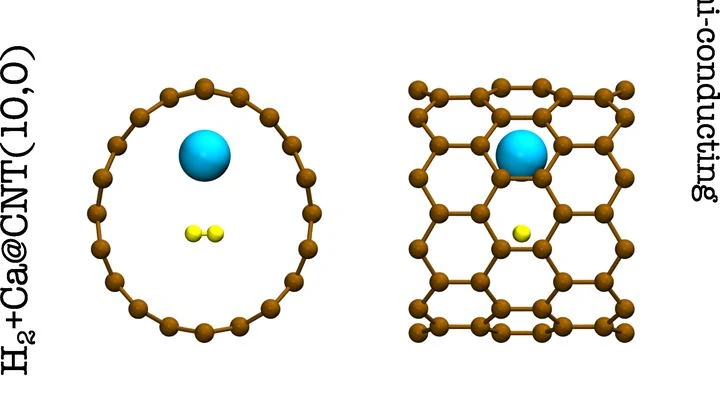
The most promising materials-based approaches rely on physisorption (weak van der Waals attraction) inside porous structures like carbon nanotubes or metal-organic frameworks, or chemisorption (stronger bonding) in metal hydrides. The key metric is gravimetric and volumetric capacity: how much hydrogen a material can hold per unit mass and volume. Recent work has shown that doping carbon nanotubes with calcium can enhance hydrogen binding, while other research focuses on membranes that selectively let hydrogen pass while blocking other gases, improving the efficiency of electrolysis and fuel cells.
In practice
Used in hydrogen fuel cell vehicles (e.g., Toyota Mirai uses high-pressure tanks, but materials-based storage is being developed for lighter, safer alternatives) and in stationary energy storage for renewable grids.
Fun fact
A single gram of carbon nanotubes, if fully loaded with hydrogen, could theoretically store enough energy to lift a small car about a meter off the ground.
Inside the steel of a future fusion reactor, tiny helium bubbles form, and on their walls a chemical drama unfolds. Chromium and tantalum atoms, like sentinels, take positions at the cavity boundary and change the rules of the game for hydrogen.
A gas target is like a funnel: the steeper its walls, the stronger the flow. But in this funnel, it is not water that flows, but ultraviolet light, born when a powerful laser pulse passes through a cloud of argon. The efficiency of this conversion is usually minuscule, about 0.001%: out of a thousand laser photons, only one turns into useful ultraviolet.
Hot water after a shower, warm air from ventilation, the heated walls of an engine — all this is heat below 100°C. Usually, it dissipates without doing any useful work. Now it can be captured and turned into electricity.
Inside the new device is a wire made of a nickel-titanium alloy. This material remembers its shape: when heated, it contracts; when cooled, it returns to its original shape.
A steel cylinder that has held hydrogen for a long time sometimes breaks not along the usual grain boundaries but right through the crystal grains, leaving a strange pattern, as if the crack chose the wrong road. For a long time, people looked at this and wondered: why?
Quantum batteries harness quantum effects to circumvent the limitations of ordinary devices imposed by entropy — a measure of disorder and energy losses. Imagine a bucket under a powerful jet: filling is lightning-fast. But the bucket has holes: the environment constantly drains the energy.
A kettle cools on the table. Heat escapes into the air, and is wasted. Yet you could squeeze a bit of electricity out of it. Devices that can do this are called thermomagnetic generators. Inside them, there are no pistons or turbines — only a material that changes its magnetic properties when heated and cooled.
Previously it was thought that hydrogen barely mixes with liquid iron at low pressure, so it wasn't expected in the Moon's core. New experiments have flipped that view.
Hydrogen is an ideal fuel: when used, it only produces water, not carbon dioxide. The trouble is that hydrogen is the lightest gas, its molecules leak out of any container. Right now, cars store hydrogen in heavy tanks under extreme pressure, canceling out weight benefits.
Researchers bypassed the problem without high pressure.
Mars is an icy desert with an average temperature of minus 60. To warm it without biology, scientists propose three approaches with a single idea: create a thick heat-trapping blanket.
First, deploy transparent film-blankets over bases. They let sunlight in but keep heat from escaping, allowing us to harvest water from the soil and grow plants.
Conventional solar panels convert light into electricity, but here light splits water into hydrogen and oxygen. Hydrogen is a clean fuel, but the process is slow. To speed it up, helper substances that donate electrons are added. Often this is alcohol, but it's a shame to waste it.
When servers in a data center run at full tilt, they get as hot as a forgotten iron. That heat goes to waste, and cooling them eats up even more energy. Engineers in Germany have proposed putting that heat to work: let it drive liquid through thin tubes all by itself, with no motors or pumps.
Their device looks like a flat box with an asymmetric bottom.
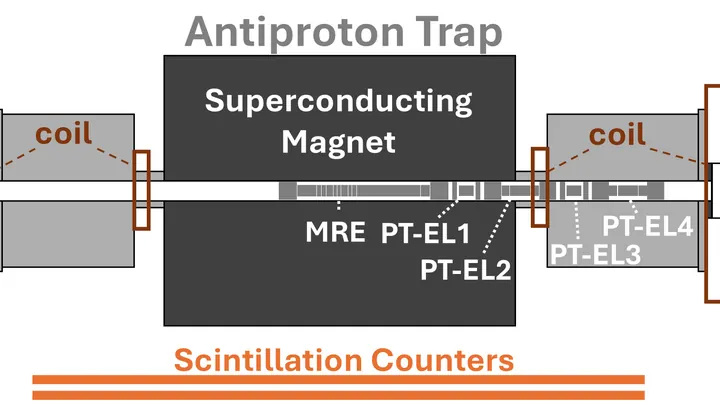
At CERN's antimatter factory, antiprotons are born with the energy of a bullet from a rifle. You can't just put them in a box: they instantly annihilate upon touching ordinary matter. So physicists devised a way to catch them in electromagnetic traps — invisible cages made of fields.
Hydrogen is the lightest gas, but it has a knack for sneaking into metals. If you pump hydrogen into a steel cylinder at high pressure, some atoms will squeeze between the metal atoms. The metal can become as brittle as a stale cracker. But you can also turn this property on its head — store hydrogen inside a metal sponge.
Hydrogen is a champion in energy per kilogram, but storing it is a hassle. As a gas, it takes up a huge volume, and if you compress it or cool it to a liquid, you need heavy tanks and lots of energy. There's a third way: some solid materials absorb hydrogen like a sponge soaks up water and hold it within. Heat it up, hydrogen comes out; cool it down, it gets absorbed back.
An ordinary heat engine is like a mill between the hot and cold banks of a river: the greater the drop, the stronger the current. Here, the drop is tiny, just one or two degrees, but water can still turn the wheel. The secret is that water is made to boil not by heating but by a sudden drop in pressure, so steam bursts out even from barely warm liquid.
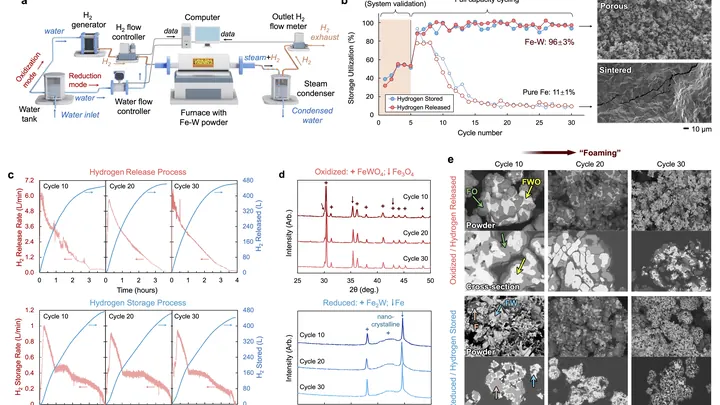
Iron powder heated to 650–800 degrees absorbs hydrogen like a dry sponge soaks up water. But after a few cycles, the particles fuse into a dense lump, and the sponge stops working. Adding tungsten changes the picture: with each heating, the powder foams itself, staying loose and porous.
An old T-shirt was dissolved in alkali to produce a gel, and it became the heart of an energy storage device. The second component was made from chitosan, a substance derived from shrimp shells. No metals: just recycled cotton and seafood.
The gel was soaked in ammonium salt, and its conductivity nearly doubled: from 17.1 to 37.8 millisiemens per centimeter.
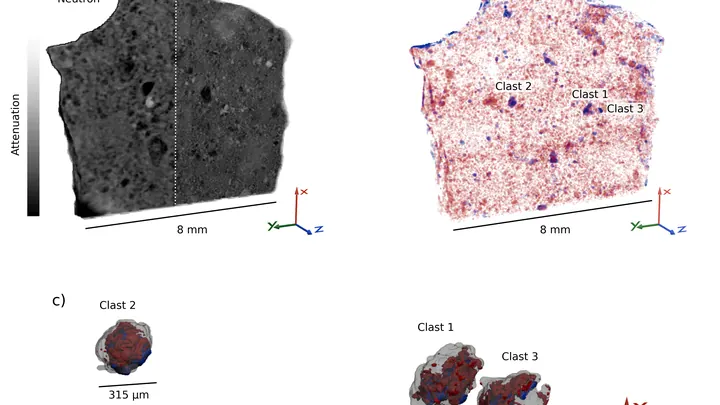
To find out if a Mars rock holds water without smashing it, scientists used neutron and X-ray scanning — similar to medical imaging. Neutrons pick up hydrogen, the foundation of water, allowing them to map moisture inside the sample.
The usual way to freeze a living cell is like trying to put a spacesuit on it: you first need to get a protective substance inside, but while it's crossing the membrane, the cell can burst from salt imbalances or get poisoned by the chemicals.