Calcium is a chemical element (symbol Ca, atomic number 20) that plays a dual role in biology and geochemistry. In the context of photosynthesis, it is an essential component of the oxygen-evolving complex, the enzyme cluster in plants, algae, and cyanobacteria that splits water molecules to release oxygen. Without calcium, this complex cannot assemble or function, making the element indispensable for the oxygen-rich atmosphere we breathe. Beyond biology, calcium is abundant in rocks and minerals, and its presence in cosmic dust and planetary bodies influences the chemical evolution of disks around young stars.
History
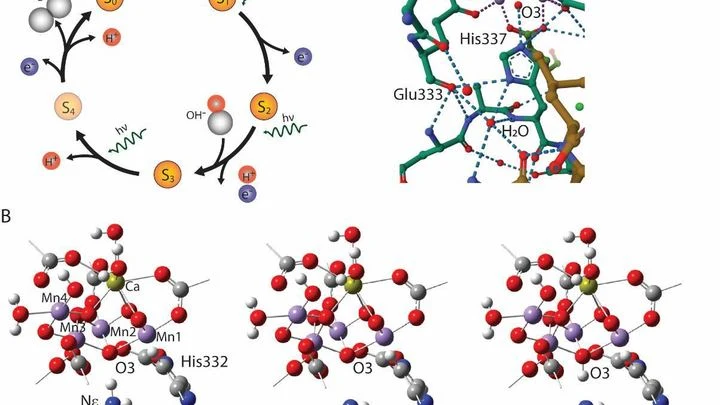
Calcium was isolated as an element in 1808 by Humphry Davy through electrolysis of lime. Its role in the oxygen-evolving complex was established in the 1970s–1980s through spectroscopic and biochemical studies, notably by Bessel Kok and others who identified the four-step cycle of water oxidation.
How it works
In the oxygen-evolving complex, calcium sits alongside manganeseatoms in a cluster that cycles through oxidation states. The calcium ion (Ca²⁺) provides structural stability and helps orient water molecules for the reaction, though it does not itself undergo redox changes. Its ionic radius and charge allow it to coordinate with amino acid residues and inorganic ligands, holding the cluster together during the high-energy steps of water splitting. In geochemical contexts, calcium's behavior as a cation affects mineral formation and the alkalinity of solutions, as seen in the reversible transformation between calcium hydroxide and calcium carbonate in aqueous environments.
In practice
Calcium is used in artificial photosynthesis research to mimic the oxygen-evolving complex, and in materials science for creating biocompatible ceramics and cements. It is also a key tracer in astrochemistry for studying the composition of protoplanetary disks.
Fun fact
The calcium ion in the oxygen-evolving complex is the only metal ion in that cluster that does not change its oxidation state during the entire water-splitting cycle.
Two mica plates, smooth as mirrors, slowly approach each other in a calcium solution. At a distance of fifty nanometers, an invisible barrier suddenly appears between them: as if someone had stretched a web of molecules between the walls. This web prevents the plates from touching, even though by all calculations they should glide freely toward each other.
Every star is a living archive, and its spectrum a multilayered manuscript. Over billions of years, the history of the galaxy is written into it: the galactic chemical evolution of the Milky Way leaves a smooth trace in elemental abundances.
For years, the Sun teased astrophysicists. In its atmosphere, refractory elements, like spices in a basic recipe, were slightly less abundant than in nearly identical twin stars. Suspicion arose: could our star be modest, skipping the planetary "dessert" that others devour with gusto?
From carbon, nitrogen, oxygen, and sulfur, you can assemble 10⁶⁰ different small molecules: that's a 1 with 60 zeros, more than the stars in the visible universe. Life uses only a tiny fraction of this menu, but not randomly.
In a crystal of water and caustic cesium, oxygen and cesium atoms sit in place like beads in a rigid lattice. Hydrogen atoms behave differently: they are like passengers constantly changing seats. In this layered material, each oxygen is linked to three neighbors via hydrogen bridges, forming a honeycomb-like pattern.
A chemical detective searches for life on other planets. Its tool is a mass spectrometer that identifies molecules by weight (the same device earthly forensic scientists use to analyze clues).
Conventional solar panels convert light into electricity, but here light splits water into hydrogen and oxygen. Hydrogen is a clean fuel, but the process is slow. To speed it up, helper substances that donate electrons are added. Often this is alcohol, but it's a shame to waste it.
The kitchen of a distant galaxy isn't limited to its bright disk. Around every star system, there's an invisible cloud of gas, like steam above a pot of soup. Astronomers peeked into this steam around galaxies that appear as they were just one and a half billion years after the Big Bang.
When a chef prepares a dish, not only the proportions of ingredients matter but also their total amount. Two pies with the same sugar-to-flour ratio but made from different batch sizes will turn out differently. So it is with disks around young stars: carbon and oxygen are the key 'spices,' and their absolute amounts change the look of the cosmic 'kitchen' no less than their ratio.
Life may be hiding in the oceans beneath the ice of Europa, Ganymede, and Callisto. Its carbon-based building blocks perhaps baked before the moons were born — in a disk of gas and dust around a young Jupiter. This giant cosmic oven ran on slow frictional heating, not harsh ultraviolet light.
A crystal one atom thick is like a sheet of paper you can write on with electricity. Such a material promises to become the foundation for tiny, fast microchips. But before putting it into production, you need to know exactly what it's made of. And that's where the usual formula falls apart.
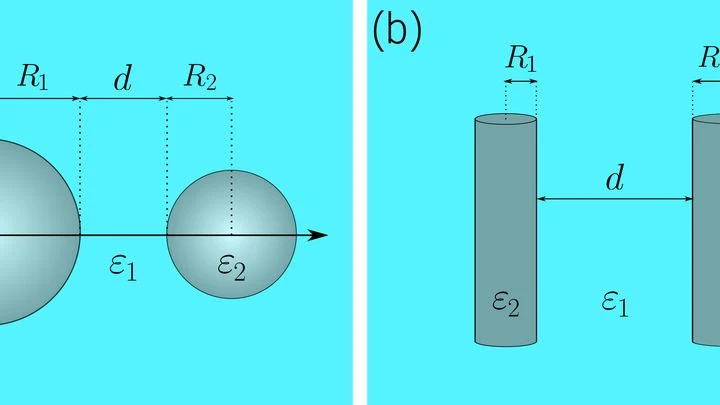
In a glass of salty water, even if it sits perfectly still, something is always happening. Tiny salt particles, ions, float and collide, sending ripples through the water. These ripples are invisible, but they create a force that attracts or repels nearby objects.
Previously, it was thought that this force only acts over very short distances, as if it quickly fades out.
A piece of chromium exposed to air gets covered in invisible armor, an oxide film, within a minute. That film protects the metal from rust, but for a battery it's a disaster: the film blocks chromium ions, so no current flows.
Scientists mixed five metals — chromium, bismuth, copper, tin, and nickel.
In every leaf, in the light, a factory works that splits water into oxygen and hydrogen. The oxygen goes into the air we breathe, and the plant uses the hydrogen for food. The heart of this factory is a protein complex with four manganese atoms and one calcium atom.
The second interstellar guest, comet 3I/ATLAS, shines unusually due to rusting metal grains in its icy core. As it gets closer to the Sun, it behaves like an old tin can tossed into a fire: the heat melts the ice, water seeps into the metal, and vigorous corrosion begins.