Carbon-based materials—such as graphene, carbon nanotubes, and porous carbons—are central to modern catalysis and energy storage. Their high surface area, electrical conductivity, and chemical tunability make them ideal supports for catalytic nanoparticles or as active catalysts themselves. They also play a key role in high-temperature applications, where their thermal stability and low thermal expansion are advantageous.
History
Carbon as a catalyst support dates back to the early 20th century, but the modern era began with the discovery of fullerenes (1985), carbon nanotubes (1991), and graphene (2004), which opened new avenues for tailored carbon materials.
How it works
In catalysis, carbon materials provide a large surface for reactions and can stabilize metal nanoparticles, preventing them from sintering. The electronic interaction between the carbon support and the metal can modify the catalyst's activity. In energy storage, porous carbons store charge in electric double layers (supercapacitors) or host lithium ions in battery anodes, while their conductivity ensures fast electron transport.
Imagine a book with latches on its pages: you can only flip a page if you know how to click its edge. That is roughly how the mechanical metamaterial we are about to discuss works. Each cell is a small mass inside a larger one, connected by an elastic beam. The beam can sit in two stable positions, like a switch.
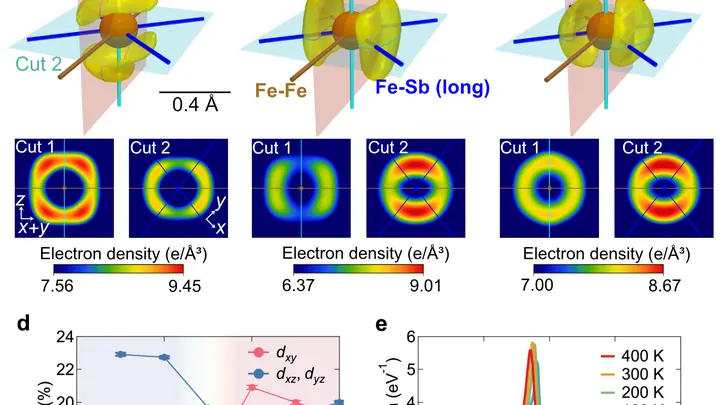
A house with cork walls suddenly gets covered in copper sheets, but only when frost sets in. That's roughly how FeSb₂ behaves when made into a film just a few atomic layers thick. Under normal conditions, it's a narrow-gap insulator: electrons sit tightly in place like spectators in an overcrowded hall.
Some crystals behave like a switch: nudge the temperature or pressure, and they turn from a conductor into an insulator. This is called a metal–insulator transition (a change in the ability to conduct electricity).
Today's Freon-based refrigerators and air conditioners silently poison the atmosphere. An alternative is solid-state caloric materials that cool under rapid pressure changes via the barocaloric effect.
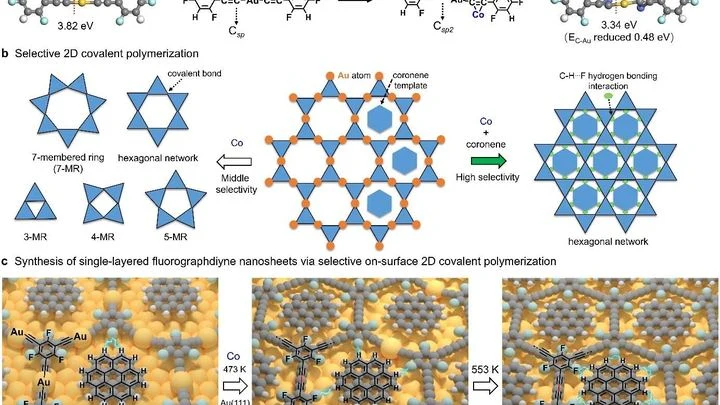
Crocheting, but instead of yarn you have individual molecules, and instead of a hook, a gold surface. Until now, attempts to knit such molecules into a smooth fabric ended in a tangle: the threads hooked where they shouldn't, and the pattern went awry.
A team of scientists has found a way to fix this.
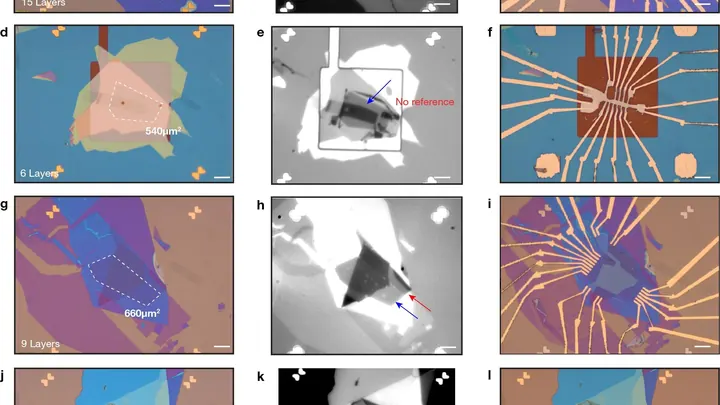
A graphene sheet is a one-atom-thick grid of carbon atoms. Stacking several such sheets with a specific twist yields a material with unusual properties: it can be a magnet or a superconductor depending on how you poke it. The trouble is that in natural graphite, such 'properly twisted' layers are rare, and growing them artificially is tricky.
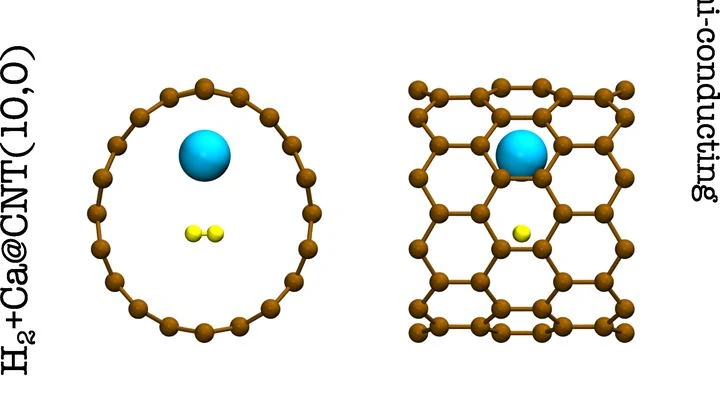
Hydrogen is an ideal fuel: when used, it only produces water, not carbon dioxide. The trouble is that hydrogen is the lightest gas, its molecules leak out of any container. Right now, cars store hydrogen in heavy tanks under extreme pressure, canceling out weight benefits.
Researchers bypassed the problem without high pressure.
Plain water in a glass is clear and calm. But if you add tiny carbon dots made from sugar and citric acid in an ordinary microwave, the water starts to glow when a charged particle flies through it.
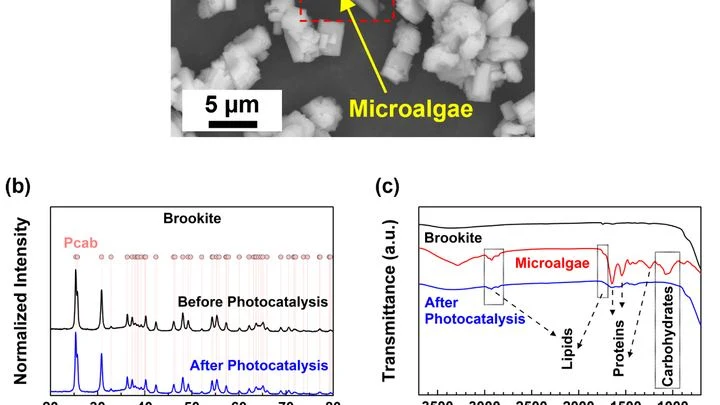
Conventional solar panels convert light into electricity, but here light splits water into hydrogen and oxygen. Hydrogen is a clean fuel, but the process is slow. To speed it up, helper substances that donate electrons are added. Often this is alcohol, but it's a shame to waste it.
A conventional graphite anode in a sodium battery is like a cramped garage that barely fits a large truck. Sodium is larger than lithium and doesn't fit well between graphite layers, so batteries quickly lose capacity.
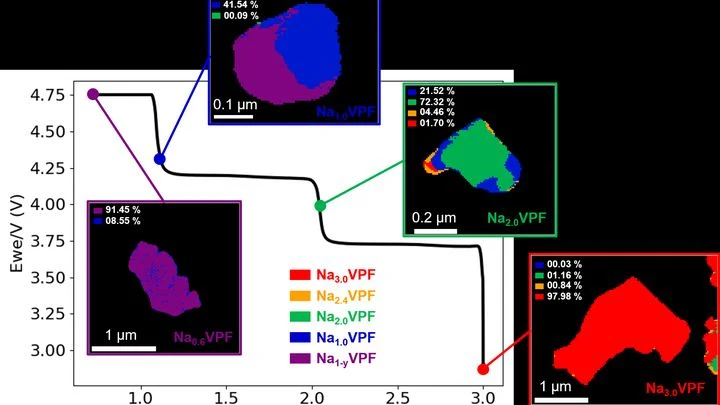
Inside each tiny particle that makes up the cathode of a sodium-ion battery, sodium is unevenly distributed — like sugar clumping in tea. This reduces the battery's capacity and lifespan. To see this hidden landscape, scientists used X-ray microscopy and trained artificial intelligence to interpret the data.
The microchips inside smartphones and computers are getting denser: billions of transistors are packed onto a sliver of silicon the size of a fingernail. When they work, they give off heat like tiny stoves. If that heat isn't drawn away, the chip overheats, starts glitching, or fails outright.
To align particle spins in one direction, physicists usually cool a substance to near absolute zero and place it in a strong magnetic field. That is expensive and bulky.
A new method resembles tuning many spinning tops with a gentle touch: mediator molecules temporarily bind to target atoms and pass on their order.
On a hot day, a car roof gets so scorching you can't touch it. Usually, cooling a surface requires air conditioning or at least some shade. But there are materials that cool themselves by simply reflecting sunlight and radiating heat into space. The problem is that such coatings are hard to apply quickly and onto uneven objects.
A new method, called solution blow spinning, solves this.
In a jeweler's workshop, gold is never mixed with ruthenium: one is soft and shiny, the other refractory and brittle. But at the nanometer scale, these metals merge into a single alloy that, when heated, begins to separate like oil and water in a cooling broth.
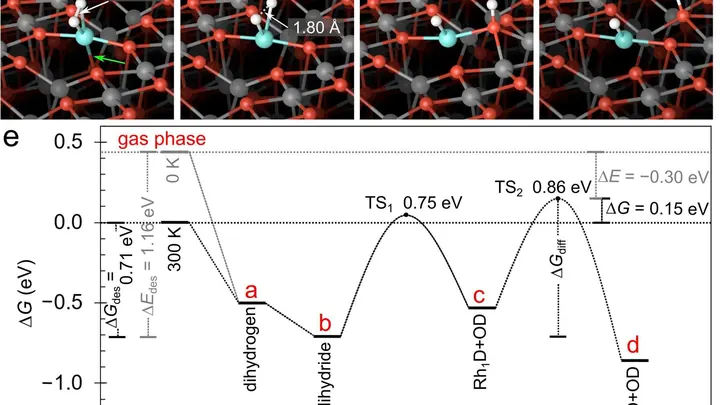
Chemistry has two worlds: in one, the catalyst is a solid particle and the reaction happens on its surface; in the other, it's a dissolved molecule where everything occurs around a single metal center. These worlds rarely meet. But in a new study, they collide.
The researchers took iron oxide, a black powder used in magnetic tapes, and scattered single rhodium atoms across its surface.
A graphene sheet is placed in a solution of sodium sulfate — an ordinary salt, similar to table salt. Near the surface, water stops being uniform: it arranges into layers, like a stack of pancakes. Between and within these layers, ions, charged particles from the dissolved salt, distribute themselves.
The temperature in a room drops by a few degrees while the refrigerator runs without a single moving compressor. Inside, there is no Freon, but a piece of metal that is alternately magnetized and demagnetized.