Radiation therapy speeds up: dose in seconds express
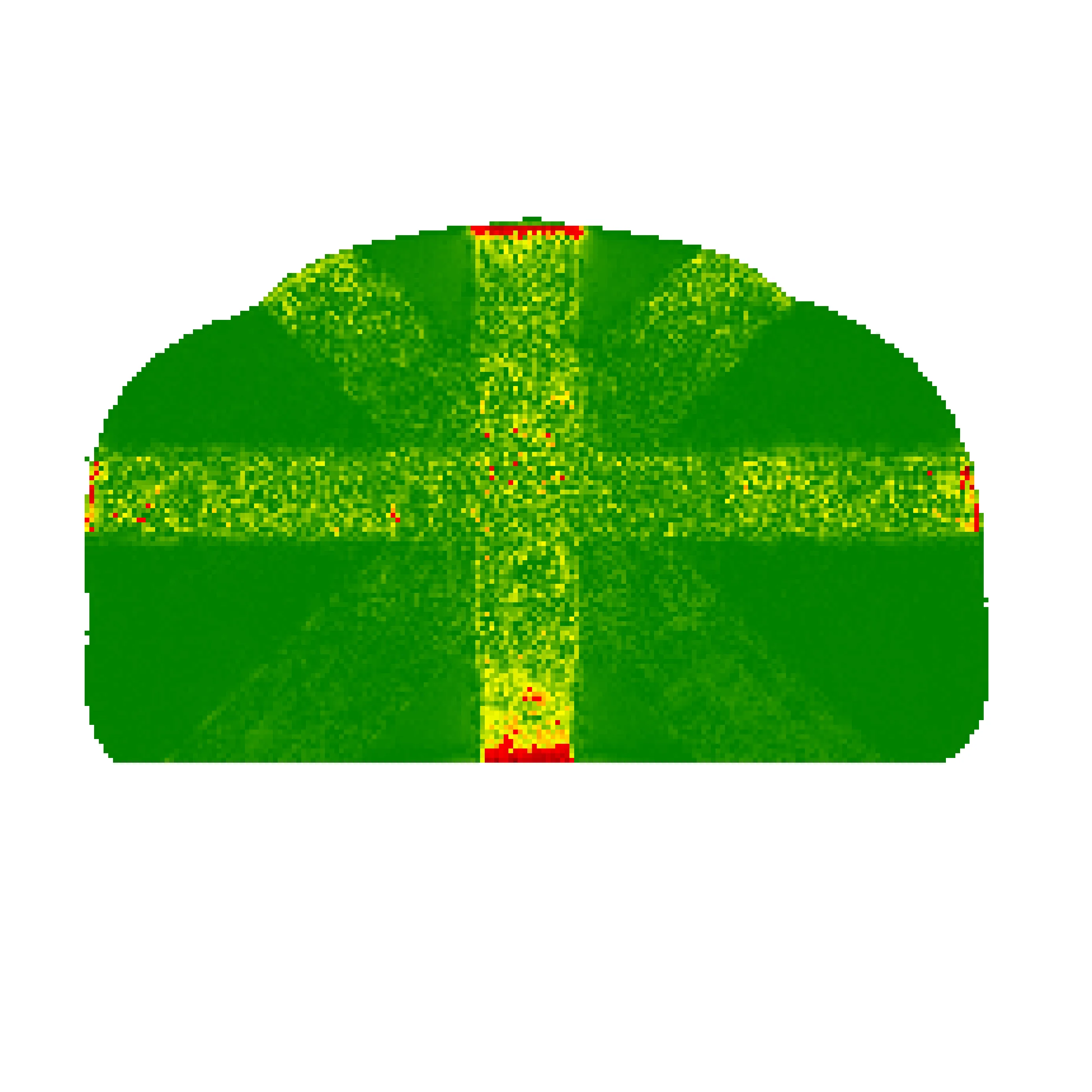
Prostate cancer radiation therapy requires precise calculation of the radiation dose at every point in the body. The classic Monte Carlo method simulates millions of particles and takes hours, while adapting the plan to daily anatomical changes needs seconds. The new Energy-Shifting neural network learns from simple monoenergetic beams and immediately outputs the dose for complex real radiation, like an interpreter who hears every word and instantly conveys the meaning in another language.
The TransUNetSE3D architecture combines attention blocks (Transformer) and adaptive squeeze-and-excitation modules to capture global relationships and important details. Trained on anatomical textures and beam similarities, the network achieves accuracy above 98% (gamma criterion 3%/3 mm) on data from a TrueBeam 6 MV linear accelerator. This paves the way for real-time dose calculation right in the treatment room.
Original abstract
as written by the authors arXiv:2604.09157
We introduce a novel learning framework for accelerated Monte Carlo (MC) dose calculation termed Energy-Shifting. This approach leverages deep learning to synthesize highly complex polyenergetic dose distributions directly from simple monoenergetic inputs under identical beam configurations. Unlike conventional denoising techniques, which rely on noisy low-count dose maps that compromise beam profile integrity, our method achieves superior cross-domain generalization on unseen datasets by integrating high-fidelity anatomical textures and source-specific beam similarity into the model's input space. Furthermore, we propose a novel 3D architecture termed TransUNetSE3D, featuring Transformer blocks for global context and Residual Squeeze-and-Excitation (SE) modules for adaptive channel-wise feature recalibration. Hierarchical representations of these blocks are fused into the network's latent space alongside the primary dose-map parameters, allowing physics-aware reconstruction. This hybrid design outperforms existing UNet and Transformer-based benchmarks in both spatial precision and structural preservation, while maintaining the execution speed necessary for real-time use. Our proposed pipeline achieves a Gamma Passing Rate exceeding 98% (3%/3mm) compared to the MC reference, evaluated within the framework of a treatment planning system (TPS) using 6MV TrueBeam Lineac Accelerator (LINAC) for prostate radiotherapy. These results offer a robust solution for fast volumetric dosimetry in adaptive radiotherapy.
The gamma criterion 3%/3 mm means: in 98% of points, the calculated dose differs from the reference by no more than 3%, or the point is shifted no further than 3 mm.