Drug delivery is the science of transporting therapeuticagents to specific targets in the body, maximizing efficacy while minimizing side effects. It involves designing carriers — such as nanoparticles, implants, or microneedles — that control the release, timing, and location of a drug. The field is critical for treating diseases like cancer, where targeted delivery can spare healthy tissue, and for chronic conditions requiring sustained medication levels.
History
The concept of controlled drug release dates back to the 1950s with the development of sustained-release oral formulations. The modern era of targeted delivery began in the 1970s with liposomes, and the first FDA-approved nanoparticle drug (Doxil) appeared in 1995.
How it works
Drug delivery systems work by encapsulating or binding the drug to a carrier that protects it from degradation, controls its release rate, and directs it to the desired tissue. This can be achieved through passive targeting (e.g., nanoparticles accumulating in tumors due to leaky blood vessels) or active targeting (e.g., surface ligands binding to specificcell receptors). Release mechanisms include diffusion, degradation of the carrier, or external triggers like pH, temperature, or magnetic fields. Implantable devices can provide controlled, long-term release, while microneedles offer painless transdermal delivery.
In practice
Drug delivery is used in chemotherapy (e.g., liposomal doxorubicin), vaccines (mRNA in lipid nanoparticles), insulin pumps, and drug-eluting stents. It is also central to genetherapy, where viral or non-viral vectors deliver therapeutic genes to specificcells.
Fun fact
Some drug delivery systems use magnetic nanoparticles that can be guided to a tumor by an external magnet, concentrating the drug exactly where it's needed and reducing systemic exposure.
In an ultracold cloud of atoms cooled to near absolute zero, regions with different spin orientations emerge, like patches with different magnetization. The boundaries between them are called domain walls. Usually they are stationary, but in this experiment the walls started moving on their own.
A mail carrier delivers letters along one-way streets. As long as he only drives forward, the route is simple and predictable. But if U-turns are suddenly allowed, he'll start doubling back, crossing his own tracks, and the delivery pattern gets tangled. That's roughly how an infection behaves when people can get sick more than once.
In a city where danger zones pop up and vanish without warning, a malicious GPS is always trying to steer you into a trap. This unpredictable foe operates at every intersection. Yet a mathematical universal framework calculates all possible ploys and charts a path that guarantees safety even amid severe interference.
A person in a boat turns by shifting their body weight. An unmanned vessel uses the same trick: a sliding weight inside the hull does the steering. Its movement is controlled by a neural network, anticipating the chaos of waves and gusts of wind. The propeller pushes the boat forward, while the weight shifts balance — like moving from one foot to the other.
A drop of thick shampoo falls into water and freezes into a strange rope. A liquid that both flows and springs back is called viscoelastic. In it, tiny particles under ultrasound behave quite differently than in water. Viscoelasticity is a material's ability to both spread like honey and return to shape like rubber.
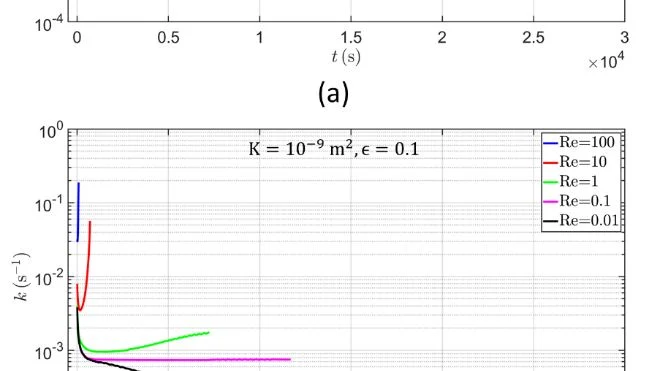
A porous implant filled with a drug works like a sponge that slowly releases the substance into the surrounding fluid. But if the fluid flows quickly, it washes out the drug differently than in a calm environment. The authors computed on a computer how different flow rates and properties of the porous structure affect drug release.
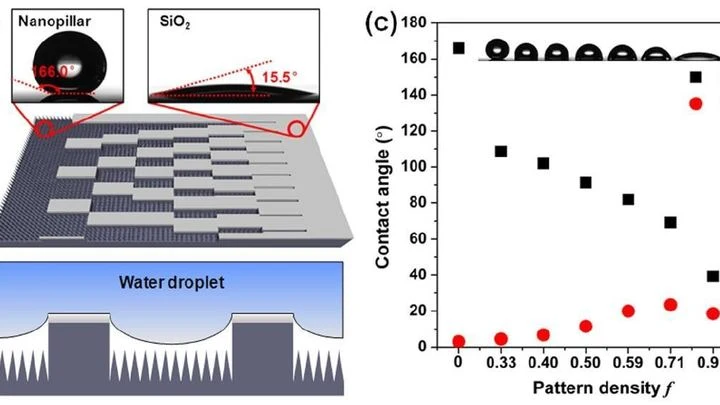
A drop of water on a table usually sits still. But make the table slightly softer on one edge and stiffer on the other, and the drop will crawl toward the stiffer side. This phenomenon is called durotaxis: the liquid itself chooses where to flow, without pumps or electricity.
This trick works because the surface under the drop is not uniform.
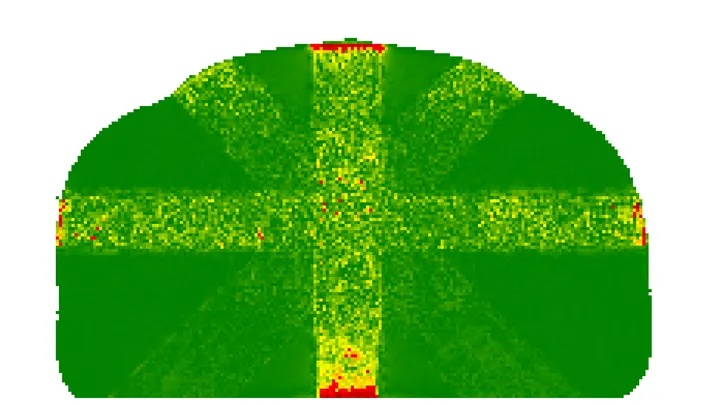
Prostate cancer radiation therapy requires precise calculation of the radiation dose at every point in the body. The classic Monte Carlo method simulates millions of particles and takes hours, while adapting the plan to daily anatomical changes needs seconds.
In a hospital, blood from a finger prick usually goes to the lab, and the result comes back the next day. The new method promises to cut that wait to a few minutes. Instead of catching light reflected off a sample, it reads the electrical voltage that arises at the boundary between two media, like the faint tingle you feel when you touch a battery with wet fingers.
Light in semiconductors is born from pairs of charges, an electron and a hole, that attract each other like a magnet to a fridge. Such a pair is called an exciton. If you add one more charge to the pair, you get a trion — a trio of three particles.
Nitinol is a metal with a memory: compressed into a tiny tube, it springs back into shape inside a vessel and keeps it open. But simply inserting a stent isn't enough: it must not clog with clots. To prevent that, a drug is applied, which should be released slowly, like water from a sponge, not all at once.
In a freezer, ordinary water turns to ice, but in living cells, such ice is a disaster: sharp crystals tear membranes apart like needles popping a balloon. Scientists who preserve cells for medicine have learned to avoid this calamity, but each method speaks its own language. A new study offers a common vocabulary — thermodynamics.
In disordered materials, such as organic semiconductors or inks made from two-dimensional materials, electrons don't move smoothly like water through a pipe. Instead, they hop from one spot to another, like a ball bouncing across a rough surface. This kind of motion is called hopping transport.
Primary human cells, taken straight from the body, are the most honest material for studying diseases and testing drugs. But getting foreign genetic material into them is tricky: cells don't like intruders. Standard methods either damage the cell or work unevenly, especially when the sample is heterogeneous — which it almost always is.
The new platform tackles this with a vortex flow.
After an injection under the skin, a drug doesn't just spread out like ink in water. Antibody molecules carry an electric charge, and that charge makes them interact with surrounding tissues — much like a magnet attracts or repels iron filings.