An atomictransition is a change in the energy state of an atom, typically involving the absorption or emission of a photon. When an electron moves from a higher energy level to a lower one, the atom releases a photon with a specific frequency; conversely, absorbing a photon can boost the electron to a higher level. These transitions are the fundamental mechanism behind many phenomena, from the colors of glowing gases to the precise ticking of atomic clocks.
History
The concept of quantized energy levels and transitions was formalized by Niels Bohr in 1913, building on Max Planck's quantum hypothesis. The modern quantum mechanical description was developed in the 1920s by Erwin Schrödinger and Werner Heisenberg.
How it works
The energy levels of an atom are quantized, meaning electrons can only occupy specific discrete orbits. A transition occurs when an electron jumps between these allowed levels, and the energy difference between the levels determines the frequency of the photon involved. This frequency is highly stable and unique to each element, making atomic transitions a reliable 'ruler' for measuring time and frequency.
In practice
Atomictransitions are used in atomic clocks, which define the international standard for time (the cesium-133 transition), and in lasers, where stimulatedemission from transitions produces coherent light. They also underpin spectroscopy, used to identify elements in stars and materials.
In 1905, Einstein showed that the chaotic motion of pollen in water results from the jostling of invisible molecules. A century later, physicists have learned not only to observe but also to control motion at the quantum level.
A surfer glides across the ocean surface until a big wave comes, and then they're flying forward. Similarly, a free electron interacts with light: usually the energy exchange is barely noticeable, but if the surrounding medium begins to oscillate rhythmically, each wave crest pushes the particle harder and harder.
Atomic nuclei are wrapped in fluffy electron coats — in such attire, they can't get close enough to embrace. But swap the light coat for a heavy one: a muon, a particle from the standard model, shrinks the cloud by nearly 200 times.
A black hole is a cosmic pocket into which everything, even light, falls. But the pioneering work of John Wheeler, Stephen Hawking, and Roger Penrose showed: sometimes, due to the colossal spacetime curvature, the pocket turns inside out.
A swing only gets going if you push it in rhythm. Miss the beat, and your effort is wasted. Light interacts with an atomic nucleus in much the same way: a photon is usually absorbed only when its energy exactly matches the gap between nuclear levels. But what if the photon's energy doesn't fit? The authors of a new study have found a workaround.
Prostate cancer radiation therapy requires precise calculation of the radiation dose at every point in the body. The classic Monte Carlo method simulates millions of particles and takes hours, while adapting the plan to daily anatomical changes needs seconds.
Light usually pushes an atom straight ahead, like wind pushing a sail. But if the beam is twisted into a corkscrew, the picture changes: the atom can fly off to the side, as if caught by a spinning wheel. In the new work, physicists calculated that such a vortex photon can transfer almost all of its rotation to the atom — up to 100 percent.
About 380,000 years after the Big Bang, the universe cooled enough for electrons and protons to finally combine into neutral hydrogen. Although this event is called recombination, it was actually their first meeting — the heat had kept them from sticking together until then.
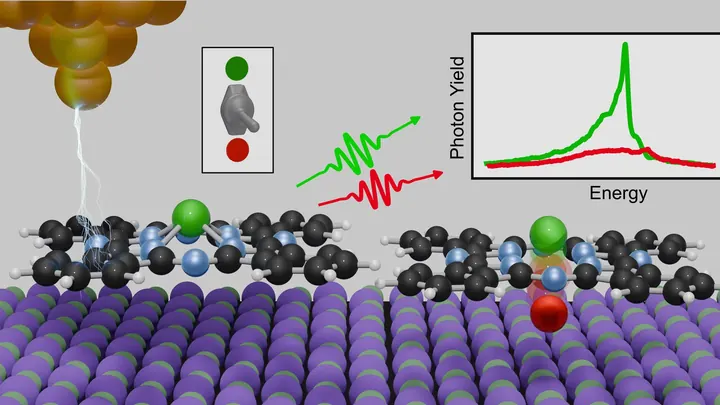
In a molecule resembling chlorophyll and built from carbon, a metal atom at the center acts as a toggle. Shifting it by fractions of a nanometer can make the molecule glow, quench, or boost its brightness a hundredfold.
Ordinary window glass may seem frozen forever, but inside, atoms never stay still. In amorphous germanium telluride (GeTe)—a material used in rewritable discs and non-volatile memory — physicists have for the first time directly tracked how atomic bonds stretch and bend in trillionths of a second.
A semiconductor film just one atom thick is like a communal apartment: it houses negatively charged electrons and positively charged 'holes.' When light hits such a film, an electron and a hole can pair up into an exciton — a bound state of an electron and a hole, akin to a hydrogen atom.
A glowing dot the size of a molecule. Run a current through it, and it flashes like a tiny lightbulb. That's what the experiment with dye molecules on a thin salt film looks like.
When current enters a molecule, one electron hands it energy. The molecule immediately gives that energy back, as light. It's like a swing: give it one push, and it rocks and then stills.
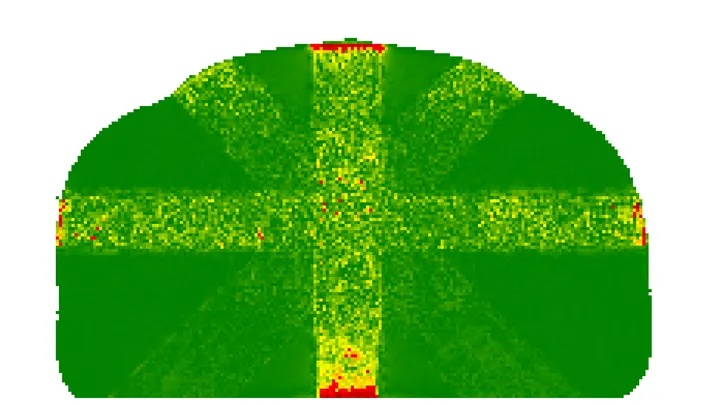
The tip of a scanning tunneling microscope approaches a crystal surface so closely that an electric current jumps between them. Electrons from the needle are injected into a layered semiconductor and land in an atomic vacancy — a spot where one atom is missing from the lattice. This void acts as a tiny trap for charge.
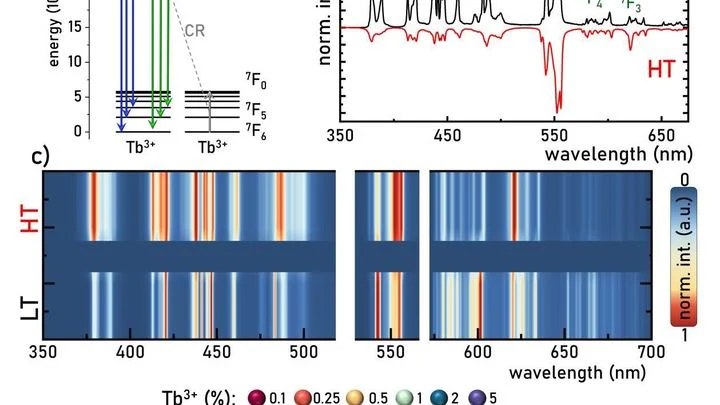
A piece of material glows blue. Heat it up, and the glow turns green, as if someone flipped a switch at a traffic light. That's how the new luminescent thermometer described in the paper works.
Inside the material are terbium ions — a rare-earth metal that knows how to shine. At room temperature, they emit blue light.
Igniting a miniature sun is a long-held dream of humanity. Typically, scientists try to confine scorching plasma (a gas of charged particles) at temperatures of hundreds of millions of degrees. But plasma tends to escape magnetic traps, and confinement comes at enormous cost.
A thin film of thorium dioxide, just 10 nanometers thick, is deposited on a steel disk. A laser pulse strikes it, but instead of the expected glow, the detector catches a stream of electrons.