Popular

Secrets of the Lunar Garden: How Meteorites Mix Cosmic Dust ⚡ экспресс

Original: "Gardening on the Moon: An Advection-Diffusion Model to Guide the Search for Supernova Debris in the Lunar Regolith"
arXiv:2604.09524 · 2026-04-10 · CC BY 4.0 · ⏱ 1 min · Exoplanets High Energy Instrumentation
Meteorites churn the Moon like gardeners, and a new model shows how stardust from ancient explosions gets scattered in the process.
Abstract

Scientists have built a unified stochastic model of lunar regolith (the surface layer) mixing under meteorite impacts. It reproduced data on soil maturity and iron-60 content in Apollo drill cores over hundreds of millions of years. The results show that the capture of supernova dust does not depend on local iron content, indicating a uniform influx of particles. The model predicts depth profiles of other isotopes, such as plutonium-244, motivating searches in samples from depths up to a meter in the Artemis mission.

Links in the knowledge graph 1

📄 Showing the "Simple" version — "Popular" is not ready yet. Add it to favorites to help prioritize it.

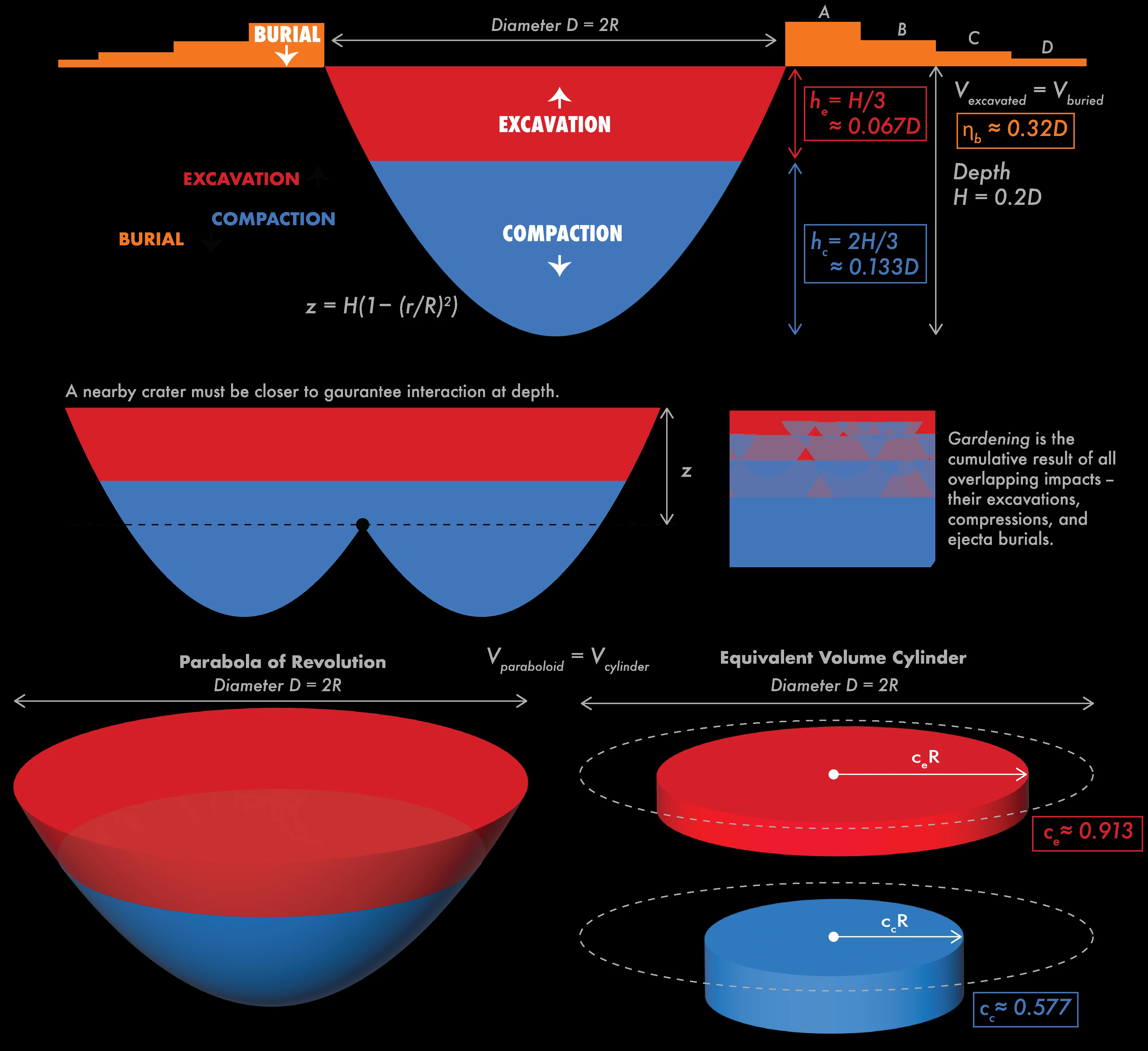
Lunar soil is a garden that meteorite impacts constantly dig over. Instead of a shovel, asteroids shake up the surface, scattering cosmic dust and bringing deep layers to the top. This cosmic “tending of the bed” goes on for millions of years, creating a uniform layer.

Scientists call this “gardening” of the lunar soil.

A new computer model has, for the first time, combined two effects of impacts: the transport and mixing of particles. Testing it with data from the Apollo missions, researchers saw how the content of iron-60—alien atoms that came from supernova explosions (studied by Zwicky)—changes with depth. It turned out that stardust is distributed evenly, without mixing with local iron. The lunar garden works so thoroughly that the soil in different spots on the planet is identical—as if it’s constantly sifted through a giant sieve. Now the model predicts where to look for traces of even rarer events—for example, plutonium-244, born in the merger of neutron stars.

By reading the depth at which such atoms lie, like the rings of a tree, we can read the history of cosmic catastrophes.

🎯 The mixed layer reaches several meters—as if a gardener dug a bed to the depth of a three-story building.

🎬 Arthur C. Clarke, in *A Fall of Moondust*, described mining rare resources on the Moon. Perhaps in the future, we’ll go there for traces of supernovae and other cosmic catastrophes.

Scientists
Enrico FermiPaul DiracSubrahmanyan ChandrasekharJames JeansAugustin-Louis CauchyChristiaan Huygens
Tags
supernova neutron star cosmic dust
Laws
Fermi–Dirac statisticsChandrasekhar limitFermi accelerationJeans instabilitylaw of conservation of momentumquadrupole radiation formula
Original: arXiv:2604.09524 · CC BY 4.0 · bridge42worlds