Blood Pressure on a Tiny Chip express
Smartwatches measure your pulse with light: an LED shines through the skin, and a sensor picks up the reflected signal. By analyzing the fluctuations in this signal, you can estimate blood pressure, but accurate calculation requires a powerful neural network — usually running in the cloud, so data leaves the device. That's inconvenient and insecure: personal medical information travels across the network.
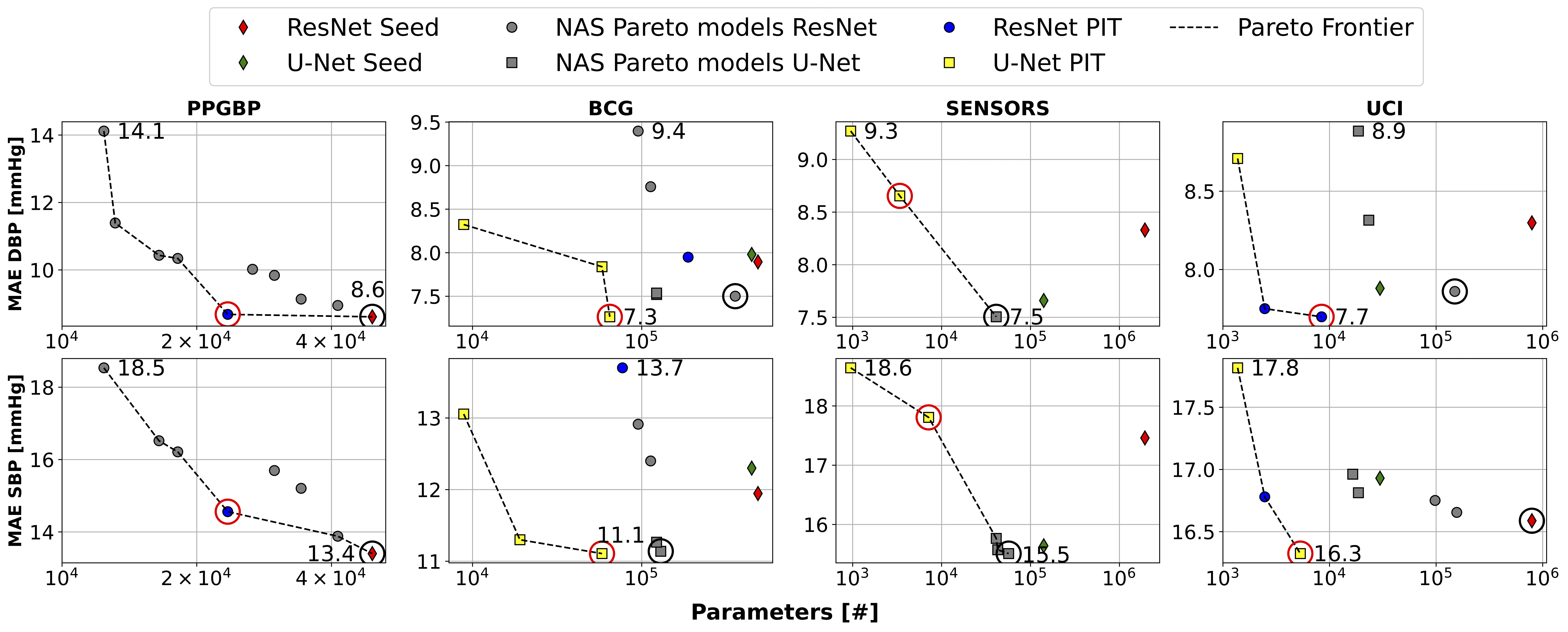
This new approach compresses the neural network to the size of a matchbox. A special algorithm automatically explores architecture options, prunes unnecessary connections, and tunes the precision of numbers — like an editor cutting everything unnecessary from a draft. The resulting model takes up less than 55 kilobytes — ten times smaller than a photo on your phone. Meanwhile, the error in blood pressure estimation dropped by 8%, and if you fine-tune the model for a specific person, accuracy improves by another 64%.
This approach paves the way for fully autonomous wearable devices. Watches could monitor blood pressure around the clock without contacting a server or draining the battery in a couple of hours. Personalization for the wearer makes readings more accurate, and privacy stays on your wrist.
Original abstract
as written by the authors arXiv:2604.10117
Photoplethysmography (PPG)-based blood pressure (BP) estimation is a challenging task, particularly on resource-constrained wearable devices. However, fully on-board processing is desirable to ensure user data confidentiality. Recent deep neural networks (DNNs) have achieved high BP estimation accuracy by reconstructing BP waveforms or directly regressing BP values, but their large memory, computation, and energy requirements hinder deployment on wearables. This work introduces a fully automated DNN design pipeline that combines hardware-aware neural architecture search (NAS), pruning, and mixed-precision search (MPS) to generate accurate yet compact BP prediction models optimized for ultra-low-power multicore systems-on-chip (SoCs). Starting from state-of-the-art baseline models on four public datasets, our optimized networks achieve up to 7.99% lower error with a 7.5x parameter reduction, or up to 83x fewer parameters with negligible accuracy loss. All models fit within 512 kB of memory on our target SoC (GreenWaves' GAP8), requiring less than 55 kB and achieving an average inference latency of 142 ms and energy consumption of 7.25 mJ. Patient-specific fine-tuning further improves accuracy by up to 64%, enabling fully autonomous, low-cost BP monitoring on wearables.
The model fits in 512 kilobytes of memory — about half the capacity of a 1980s floppy disk, which stored a single text document.
In the series "Black Mirror," there's an episode where an implant continuously monitors health and streams data to a doctor — a similar technology, but without the cloud and with data protection.