Catcher of Invisible Forces express
On the table sits a sensitive instrument — a torsion balance. Two heavy masses rotate near a suspended rod, and their attraction tends to twist the rod. But the masses are arranged so that their ordinary Newtonian attraction cancels out: one pulls one way, the other the opposite. Only a weak residual remains, which the instrument captures.
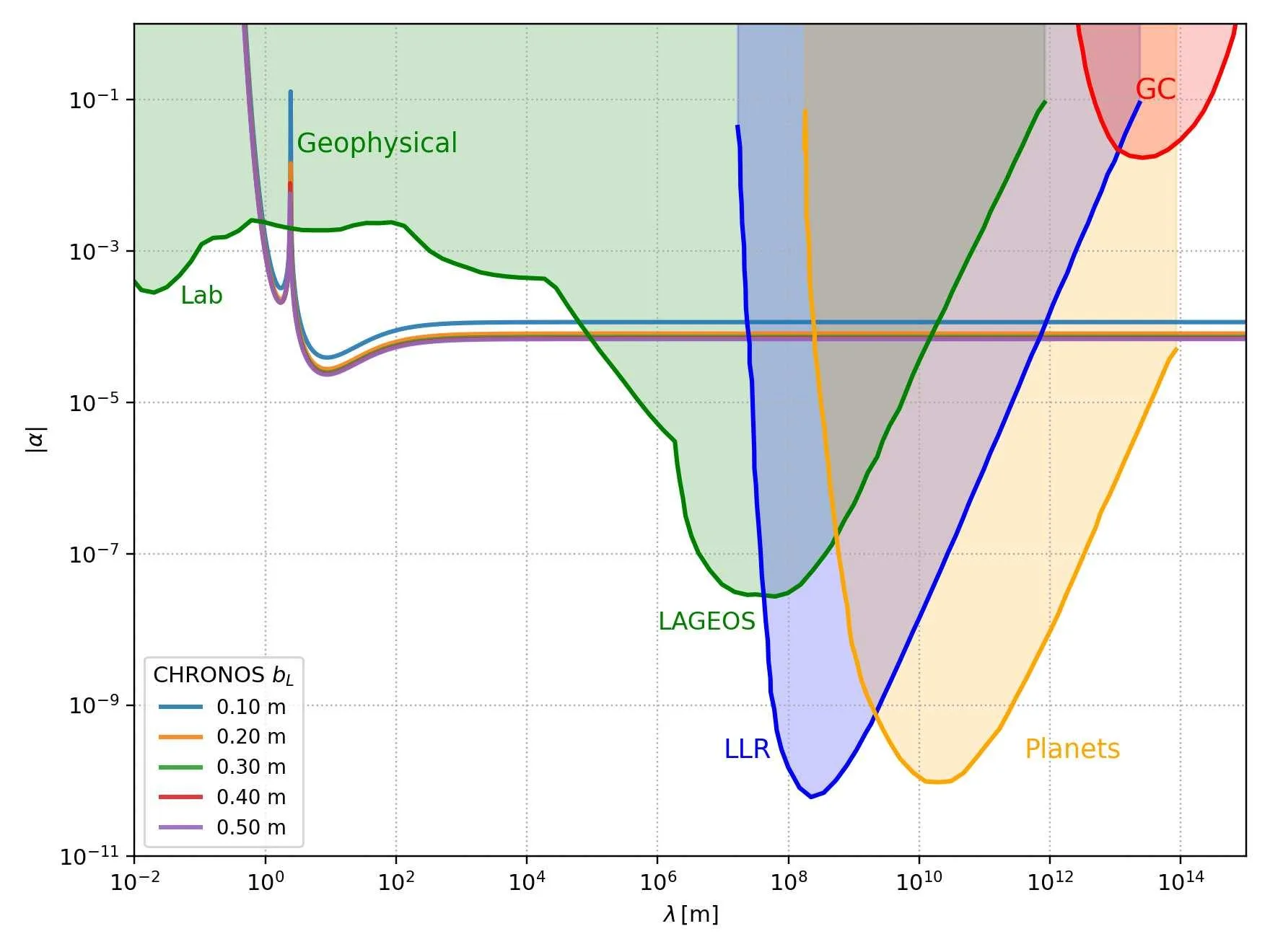
If gravity at short distances does not behave exactly according to Newton, but, for example, decays slightly differently (a so-called Yukawa addition), the residual attraction will show up. The authors calculated how strong such a signal could be and found that the instrument could detect a deviation one hundred thousand times weaker than ordinary attraction at a distance of eight meters. That's like hearing a whisper on a noisy street.
The main limitation is not electronic noise but the precision with which the shape and position of the masses are known. If they are made perfectly, sensitivity will hit this systematic error after about 26 hours of signal accumulation. Beyond that, accuracy does not improve no matter how long you wait. This scheme retains sensitivity even for forces with a long range, allowing tests of gravity theories at distances from centimeters to meters — where ordinary astronomical observations are powerless.
The torsion balance was first used by Henry Cavendish in 1798 to 'weigh the Earth'—measure the gravitational constant. His setup was so sensitive that it responded to the attraction of two lead spheres weighing just 158 kg each.