Distance is a fundamental measure of spatial separation between two points, and in physics it underpins the inverse-square law, which dictates that the intensity of a signal (light, sound, gravity) decreases with the square of the distance from its source. This principle is crucial for astronomical measurements, where determining how far away an object is allows scientists to infer its intrinsic luminosity, mass, or velocity. In quantum sensing, distance affects the coupling strength between a sensor and the target signal, with closer proximity yielding stronger interactions and better sensitivity.
History
The concept of distance has been central to physics since antiquity, but its precise astronomical measurement began with the first stellar parallax in 1838 by Friedrich Bessel. The inverse-square law for light was formulated by Johannes Kepler in the 17th century and later refined by Isaac Newton.
How it works
In practice, distance is often measured indirectly through observable effects. For example, the apparent brightness of a known light source (a 'standard candle') reveals its distance via the inverse-square law. Alternatively, parallax — the apparent shift in position of a nearby object against distant background stars as the Earth orbits the Sun — provides a geometric distance. In quantum sensors, the distance to a target is encoded in the strength of the interaction, such as the magnetic dipole coupling, which falls off as the cube of the distance, allowing precise localization of nearby objects.
In practice
Distance measurement is used in LIDAR for autonomous vehicles, in astronomical surveys to map the universe, and in quantum sensing to localize single spins or nanoparticles with nanometer resolution.
Fun fact
The human eye can detect a single photon, but the distance to a star is so vast that the light arriving from it is often less than one photon per second per square centimeter of telescope aperture.
Units by system: SI: meter · CGS: centimeter · Planck: plancklength · natural: electronvolt
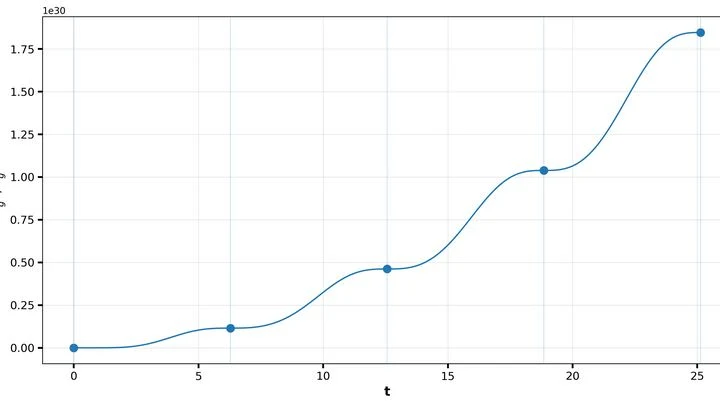
Two massive bodies frozen in a quantum superposition resemble a pair of dancers trying to keep a single rhythm while an orchestra blares around them. Each gravitational wave is a musician throwing them off beat.
Six runners sprint down the track, and officials time their speed without noticing a tailwind. The wind blows at their backs, and the stopwatches show a better result than the truth. Roughly this is how six megamasers — natural cosmic lasers in distant galaxies — misled astronomers measuring the expansion rate of the universe.
A camera looks at two distant sparks. They're so close together that they merge into a single fuzzy blob. It seems impossible to tell them apart — the classic limit of optical microscopy has been reached.
But quantum mechanics hints that the light field still holds a secret about where each spark sits.
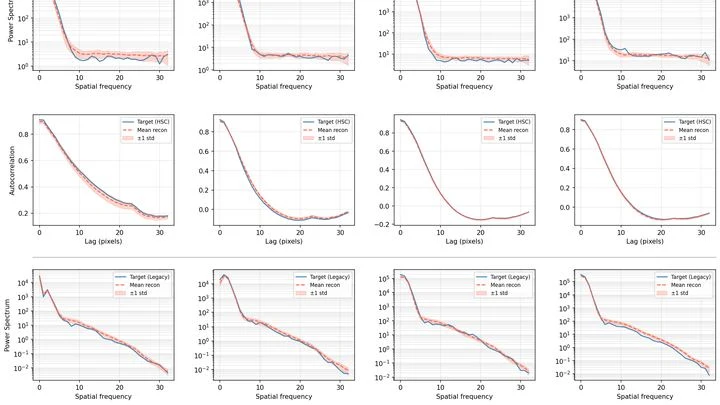
If you photograph the same mountain with a film camera and a modern smartphone, you get different images: colors are brighter in one, details are blurrier in the other. The same goes for telescopes: each instrument sees the sky in its own way, adding its own distortions to the true light of galaxies, like a filter through which we look.
Galileo, legend has it, dropped balls from the Tower of Pisa to prove that heavy and light objects fall equally. This law formed the foundation of Einstein's theory of gravity. Today, scientists have turned an entire space station into such a tower.
Ultra-precise scales that catch the slightest changes in gravity work like a keen ear: they hear even the whisper of distant underground voids or the tremors of the Earth's crust. But such instruments have a hidden enemy: their own internal clocks. Time inside the sensor also jitters, and this jitter smears the picture.
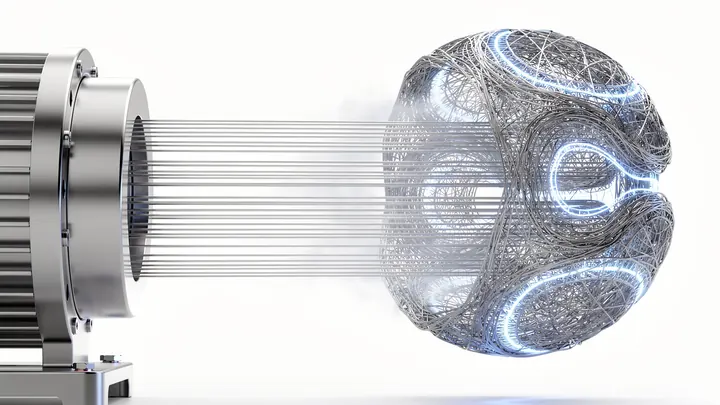
Quantum mechanics gave us a captivating image: a system’s state is not a frozen point but a wave of possibilities, dancing in an abstract space. Thanks to the work of Шрёдингера and Дирака, we represent it as vectors in Hilbert space.
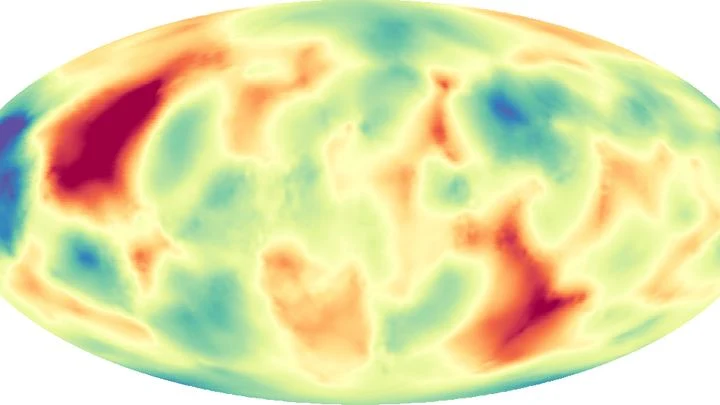
Setting up an orchestra without a conductor: the algorithm itself decides which instruments (basis functions) and at what volume (weights) should play to reproduce Earth's gravitational symphony.