The law of universal gravitation states that every particle attracts every other particle with a force proportional to their masses and inversely proportional to the square of their separation.
Isaac Newton was the first to realize that the force causing an apple to fall is the same one that keeps the Moon in orbit. This was a breakthrough that unified the physics of heaven and earth. He formulated a simple and universal law: any two particles attract each other with a force directly proportional to the product of their masses and inversely proportional to the square of the distance between them.
History
Newton built on the work of predecessors: Galileo studied free fall, Kepler derived the laws of planetary motion from Tycho Brahe's observations, and Robert Hooke suspected an inverse-square dependence. However, only Newton mathematically proved that such a law implies all three of Kepler's laws, and additionally explained tides and the precession of the equinoxes. His 'Principia' became a model for the mathematical description of nature.
How it works
The law applies to any objects with mass, from elementary particles to galaxy clusters, provided speeds are much less than the speed of light and gravitational fields are not too strong. Near neutron stars and black holes, it is superseded by Einstein's general theory of relativity. In practice, the law serves as the basis for celestial mechanics, orbit calculations, and space maneuvers.
In practice
Calculating orbits of satellites, planets, and interplanetary trajectories; GPS operation, tide prediction, determining masses of celestial bodies.
Fun fact
Newton delayed publishing the law for almost 20 years because he needed precise data on Earth's radius to make the calculations match the observed motion of the Moon.
Rotation measure, proportional to integrated electron density times magnetic field along the line of sight — rotation measure= varies (e.g., 0.812 rad m^-2 for typicalradian per metre squared
At the center of a neutron star, matter is compressed so tightly that a teaspoon weighs a billion tons. You'd think there's no better place to look for signs of quantum gravity. But between the laboratory and the fundamental scale lies a chasm of 10⁸⁰ in density.
Three doors lead into this room.
Quantum field theory is the language physicists use to describe elementary particles and their interactions. The authors of the work decided to slightly "tweak" this language: they introduced deformations, that is, small changes to the rules of the game.
Newton gave us a world where bodies move in a void and clocks tick the same for everyone. For three centuries, this picture worked flawlessly. But it relies on many invisible props: absolute position, the 'up-down' direction, and a single rhythm of time for the entire universe. We have never measured these directly — only through the relations between objects.
Two massive bodies frozen in a quantum superposition resemble a pair of dancers trying to keep a single rhythm while an orchestra blares around them. Each gravitational wave is a musician throwing them off beat.
Newton gave us a world where bodies move in a void and clocks tick the same for everyone. For three centuries, this picture worked flawlessly. But it relies on many invisible props: absolute position, the 'up-down' direction, and a single rhythm of time for the entire universe. We have never measured these directly — only through the relations between objects.
A scale that weighs not a body, but the very space around it. That's how Einstein's equations work in general relativity: they link the curvature of spacetime to what resides within it.
A translator gets distracted by every rustle in the hall, and a one-hour meeting stretches into two. A single wrong intonation changes the meaning beyond recognition. That's roughly how a particle with spin 3/2—the gravitino — behaves. It cannot exist in isolation: its "speech" must be perfectly coordinated with its surroundings, or the whole structure falls apart.
Two stars circle each other, gradually drawing closer. Their dance loses energy, and that energy escapes into space — in the form of gravitational waves, and sometimes other fields.
In 2017, detectors picked up a gravitational wave from the collision of two neutron stars. Just 1.7 seconds later, telescopes saw a flash of gamma-ray burst from the same spot. That tiny delay became a treasure for physicists.
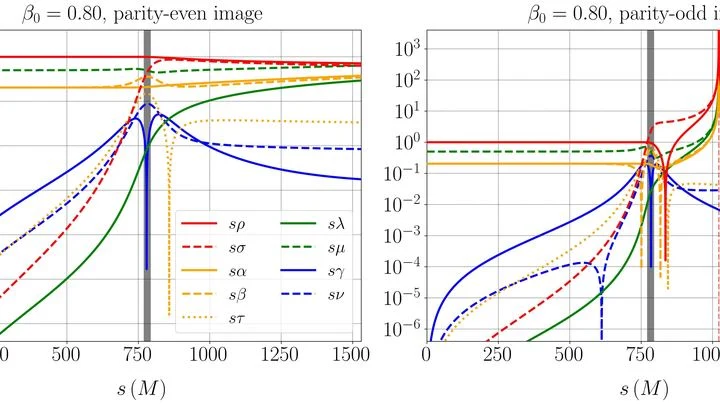
Two houses with identical facades. Windows, doors, wall color — everything matches. But inside, one is empty, while the other buzzes with life. How can you tell without stepping inside? In space, there's a similar puzzle: a black hole and a gravastar look the same from the outside, but they are built differently.
Two cities with the same average population density. In one, a neat grid of blocks; in the other, a maze of narrow alleys and unexpected squares. On a global map they look like twins, but life inside flows quite differently.
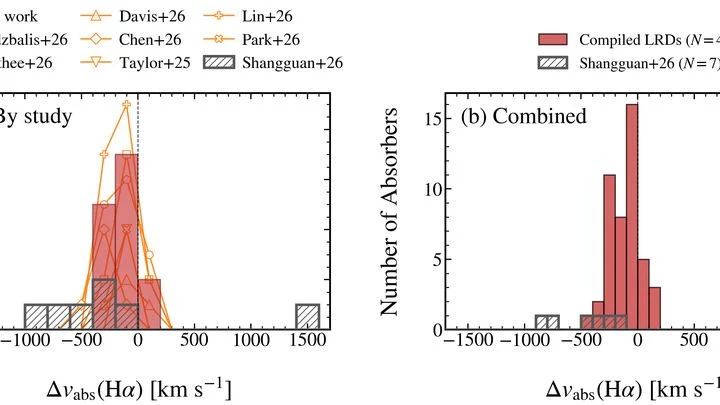
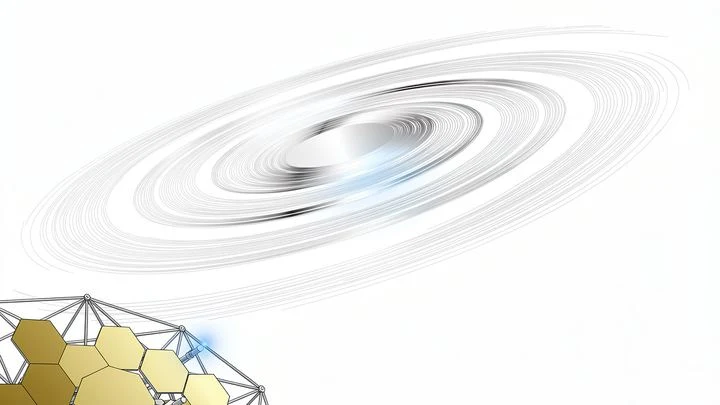
Forty reddish sparks frozen in the images from JWST. The telescope spotted them in the depths of space, at distances where the Universe was less than two billion years old. These objects are active galactic nuclei — very compact and unusually red. Their color earned them the nickname 'little red dots' (LRDs).
On September 26, 2022, the DART probe slammed into the natural satellite at a speed of 6,6 km/s. A fountain of debris burst into space. Rocks, dust, sand grains — everything erupted in a silent flash.
Two years later, a numerical simulation of 20 million trajectories revealed the fate of each particle.
Light bends in a lens — everyone knows that. Gravitational waves passing a massive body also curve their path. But the authors of this work looked further: what happens to the wave's very "color" — its polarization, that is, the direction of oscillation?
Gravitational lensing is the deflection of…
A thrown stone sends ripples across water. A gravitational wave is the same kind of ripple, but in spacetime. It is produced, for example, by the merger of two black holes. In classical physics, this ripple is eternal: once created, it travels through the Universe without fading.
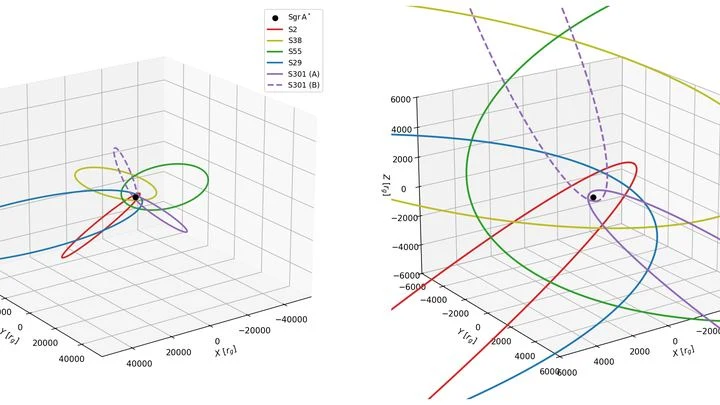
26,000 light-years from Earth, in the heart of the Milky Way, star S301 tears through space at 18,000 kilometers per second. It loops around the supermassive black hole Sgr A* on an elongated orbit. At its closest approach, just 280 gravitational radii separate the star from the black hole — roughly the distance from the Sun to Uranus.
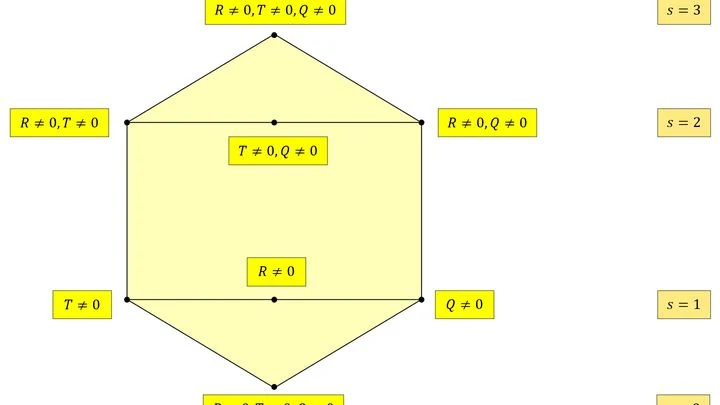
An engineering blueprint of a skyscraper always includes a number: the maximum load on the foundation — say, 500 kilopascals. Einstein's field equations in curved spacetime impose a similar limit on the 'force load' inside stars, planets, and any other clumps of matter.
Two balls dropped from different heights fall to the ground with different accelerations. In space, things are more complicated: even emptiness makes bodies move differently.
1799 kilometers per second — that's the speed at which star S5-HVS1 is permanently leaving the galaxy. 4.8 million years ago, it was ejected from the center of the Milky Way during a close encounter with the supermassive black hole Sgr A*.
The early Universe was like a rapidly cooling ocean. At colossal temperatures, everything was one — quarks, electrons, forces all blended into a symmetric 'steam.' But as it expanded and cooled, this steam condensed, phase transitions cascading one after another like water turning to ice.
Inside a supercomputer, fifteen stable wave clumps — solitons — collide to form a halo of dark matter. These waves obey an equation that Erwin Schrödinger derived for electrons at the beginning of the 20th century, but now they paint a portrait of a giant galactic cocoon.
A tiny satellite, like a swimmer, cuts through invisible layers of gas in the bloated envelope of a red giant. Each orbit excites an acoustic wake — compression waves traveling through plasma.
Two figure skaters on a lake frozen to the horizon. They are so far apart that their silhouettes turn into dots, and their mutual attraction becomes almost an article of faith. By Newton's law, they should circle in an unimaginably slow waltz. But telescopes see otherwise.
When a star ventures too close to a supermassive black hole, a cosmic requiem plays out — a tidal disruption event. Thanks to photometry and spectroscopy, astronomers discern every instrument in this orchestra.
The mystery of the radius valley — a sharp drop in the number of exoplanets with radii ~1.8 Earth — haunts astronomers. JWST, transit surveys like Kepler and TESS draw a clear gap: rocky super-Earths and gaseous sub-Neptunes are separated by almost a chasm.
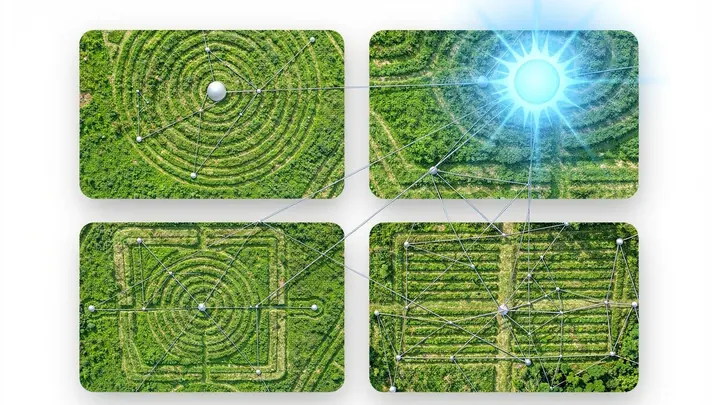
Deep in the Amazon rainforest, beneath a multi-layered canopy of leaves, lie vast earthen figures — squares, rectangles, the occasional rhombus. For decades they teased archaeologists with their silent geometry, until a researcher armed with orbital optics saw them as an astronomical instrument.
At the center of the Milky Way, shrouded in dust and glare, lurks a supermassive black hole — Sagittarius A*. Around it, like moths around a flame, swarm dozens of guide stars. Two of them, S2 and S38, with eccentric orbits and periods of just a few years, have become the protagonists in testing the fundamental laws of the cosmos.
In the quiet of cold molecular clouds, where interstellar gas under gravity condenses into dense clumps, the birth of massive stars is one of the great puzzles of astrophysics.
A snowflake grows, an oil slick spreads, a crowd moves — each case has its own equations. But the end result is often the same: shape, speed, and pattern follow a simple scheme that repeats across scales. This is universality — when a common law hides behind the details.
Dark matter — the invisible architect of the universe, holding galaxies from flying apart. Thanks to the pioneering work of Fritz Zwicky and Vera Rubin we know: ordinary matter in the cosmos is just a negligible impurity. But what lies behind this dark matter?
Gravitational waves from merging black holes sound like bass chords, pulsars tap out a rhythm, and the cosmic microwave background carries echoes of the Big Bang. But there is a silent player — dark matter, whose presence is betrayed only by gravitational effects.
The early universe at redshift z>7 was an arena of rampant growth: black holes with masses up to a billion solar masses already blazed as quasars, devouring gas at monstrous rates. How these giants managed to grow in such a short time is one of astrophysics' sharpest puzzles.
According to Einstein's general theory of relativity Albert Einstein, a massive rotating body drags the fabric of spacetime along with it, much like a spoon twirled in a jar sets thick honey flowing.
When JWST peered into the young universe at redshifts of 6–10, it revealed a scattering of mysterious 'little red dots' (LRDs). These objects combined features of galaxies and active nuclei, but their spectra refused to fit into familiar patterns.
An object cannot be a point. At least, not in Einstein's gravity. The equations of general relativity require that the source of the field, matter, be smeared out in space, not concentrated in an infinitesimal volume. Otherwise, infinities appear in the formulas, and a smooth spacetime cannot be constructed.
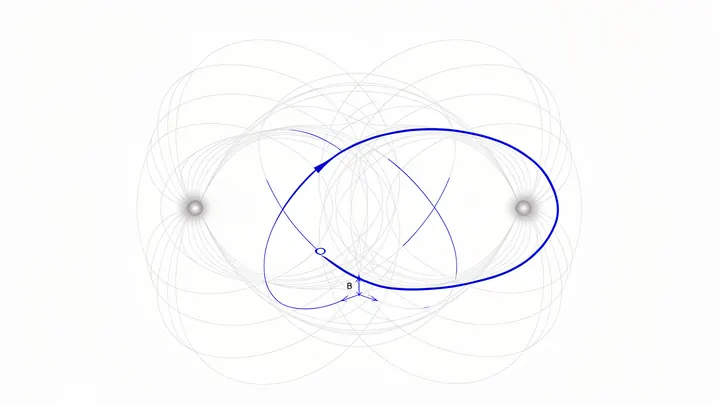
The three-body problem is the eternal stumbling block of celestial mechanics. Even Poincaré realized in the late 19th century that its chaos defies general analytical solutions. In this gravitational madness, islands of regularity appear only rarely — periodic orbits.
The early Universe is often imagined as a nursery: most galaxies there are amorphous blobs, rowdy and irregular, choking on gas and bursts of star formation.
The boundary sets the rules
Quantum gravity is like a theater where spacetime is the stage and fields are the actors. When the stage has an edge, you need to know exactly what happens at the boundary; otherwise, the play falls apart. In 2018, Edward Witten proposed an elegant recipe for such a case.
Gravity is usually explained through the curvature of spacetime. Massive bodies press it down like a bowling ball on a stretched rubber sheet. But this approach has two lesser-known twins. In one, gravity arises from torsion (twisting) of spacetime; in the other, from its non-metricity (when lengths and angles change during transport).