Astronomical observation is the practice of collecting and analyzing electromagnetic radiation or other signals from celestial objects using telescopes, detectors, and other instruments. This is the primary method by which humanity learns about the universe—from planets in our solar system to galaxies billions of light-years away. Observations can be made across the entire electromagnetic spectrum, from radio waves to gamma rays, as well as through non-electromagnetic messengers like neutrinos and gravitational waves.
History
Astronomical observation began with naked-eye observations by ancient civilizations, but the field was transformed by Galileo Galilei's use of the telescope in 1609. The development of photography in the 19th century and electronic detectors in the 20th century further revolutionized the field.
How it works
Astronomical observations rely on instruments that collect photons and focus them onto detectors. Telescopes use mirrors or lenses to gather light, while specialized instruments split light into spectra to reveal composition, temperature, and motion. Observations are often limited by Earth's atmosphere, which distorts and absorbs certain wavelengths, so many telescopes are placed in space or use adaptive optics to correct for atmospheric blur. Data from multiple observations are combined to create images, light curves, and spectra, which are then analyzed to infer physical properties of distant objects.
In practice
Astronomical observation is used to discover exoplanets, monitor near-Earthasteroids, study the expansion of the universe, and test fundamental physics, such as the behavior of matter in extreme gravitational fields near black holes.
Fun fact
The Hubble Space Telescope has observed galaxies so distant that their light has been traveling for over 13 billion years, meaning it sees them as they were shortly after the Big Bang.
A light ray passing by a massive body slightly changes its direction, like a stream of water bending around a rock in a creek. In the solar system, there are many such "rocks": planets, their moons, asteroids. And each one, with its own gravity, bends the path of light coming from distant stars.
When two neutron stars, compressed to the size of a city, approach in their final dance, the spacetime around them comes alive, emitting gravitational waves.
Tiny invisible bullets pass straight through the Sun, barely noticing its matter. These are axions — hypothetical particles so light and elusive that they are often compared to ghosts.
Just after the Big Bang, clumps weighing as much as a trillion Suns and with an electric charge of colossal strength, like trillions of electrified balloons, could have drifted through space.
An album with hundreds of family photos holds countless stories. If you look at each picture on its own, you might easily decide that Uncle is a real giant: that day he happened to stand a step higher than everyone else. But flip through the whole album, and it becomes clear — his height is perfectly ordinary; it's just that a step showed up in a couple of frames.
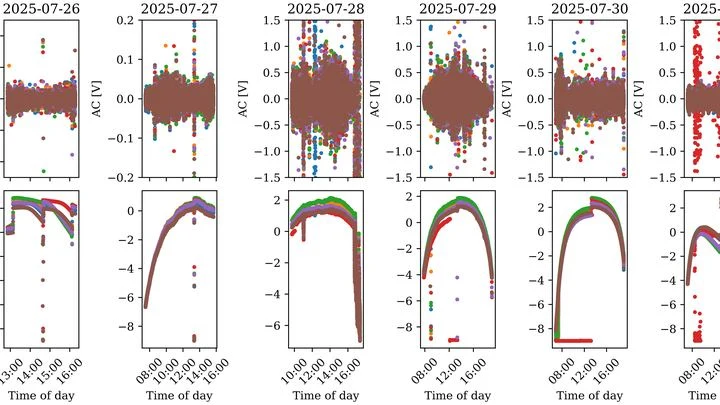
By day in Chile's Atacama Desert, the air shimmers with heat like the haze above a hot skillet. Sunlight passing through this shimmer begins to dance and flicker. Astronomers call this airy trembling "seeing" — and it keeps telescopes from getting a sharp view of the stars.
To fight this nuisance, engineers have built a special instrument — a solar seeing monitor.
The night sky is no longer as quiet as it used to be. Thousands of satellites are whizzing overhead, and each one can accidentally emit radio waves, interfering with astronomers trying to listen to distant galaxies. To make sense of this noise, scientists pointed the 21CMA radio telescope in China at Starlink satellite passes.
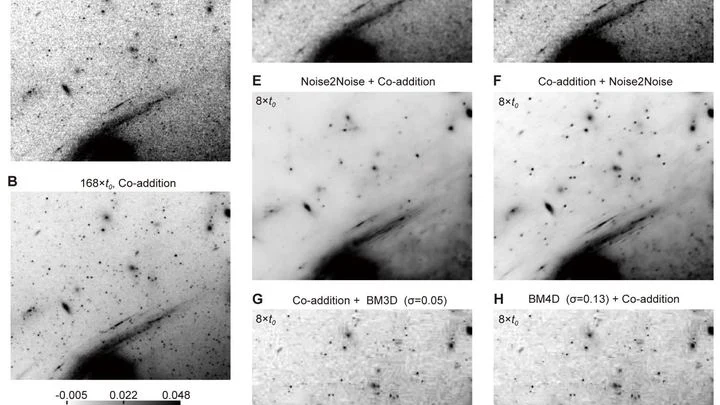
The night sky in a telescope image looks like a photo taken through a fogged-up window: bright stars are visible, but everything faint drowns in a murky haze. That haze is noise — random interference from electronics, heat, and the atmosphere itself.
The galaxy is like a city at night: most windows shine steadily, but sometimes a skyscraper lights up all its lights and then goes dark. Just like that, according to a new hypothesis about planets around alien stars (exoplanet), we might first notice another civilization — by a short but blinding flash that could mark its demise.
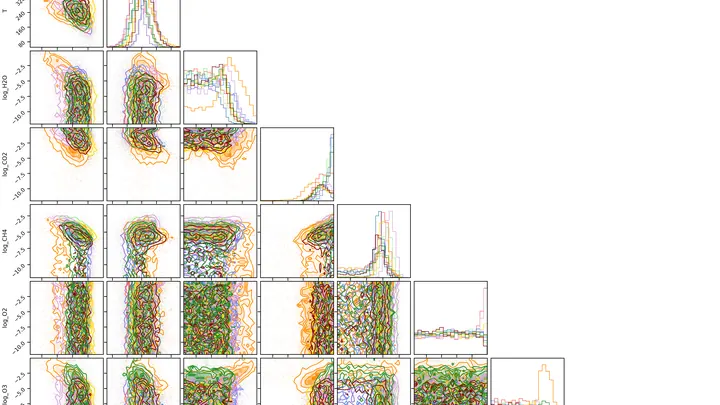
Eavesdropping on a distant planet's atmosphere is hampered by the star's noise. In the TRAPPIST-1 system, astronomers used a planet-"bug": TRAPPIST-1 b — an airless neighbor that records only the interference.
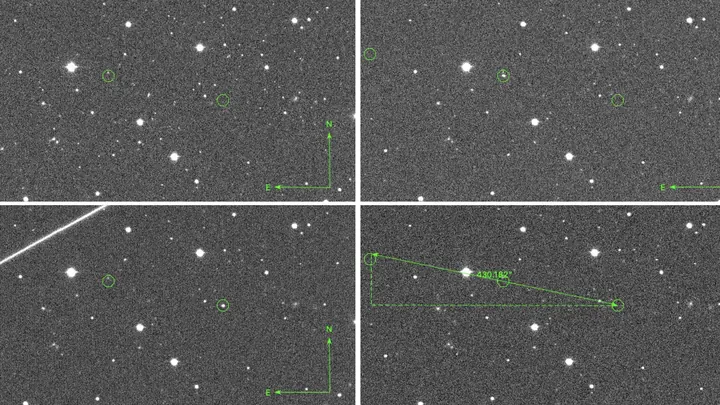
Back in the 18th century, William Herschel was searching for life on Mars. Today, astronomers are targeting not planets but artifacts — for example, alien probes lurking in the Solar System. The problem is that spotting a tiny object next to the blinding Sun is nearly impossible.
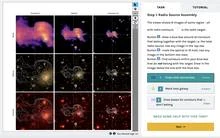
The ASKAP telescope collects data on millions of radio sources in a single night. Automated algorithms confidently identify compact points but struggle with extended structures featuring jets, bridges, and bubbles.