Gravitational wave detectors are instruments designed to measure the ripples in spacetime predicted by Einstein's general relativity. These waves are produced by massive cosmic events, such as the collision of black holes or neutron stars, and they cause tiny distortions in the distances between objects. The challenge is that these distortions are incredibly small—on the order of a thousandth of the diameter of a proton—so detectors must be extremely sensitive and isolated from all other vibrations.
History
The first direct detection of gravitational waves was made by the LIGO collaboration in 2015, confirming a prediction made by Einstein in 1916. The idea for interferometric detectors was developed in the 1960s and 1970s by researchers like Rainer Weiss.
How it works
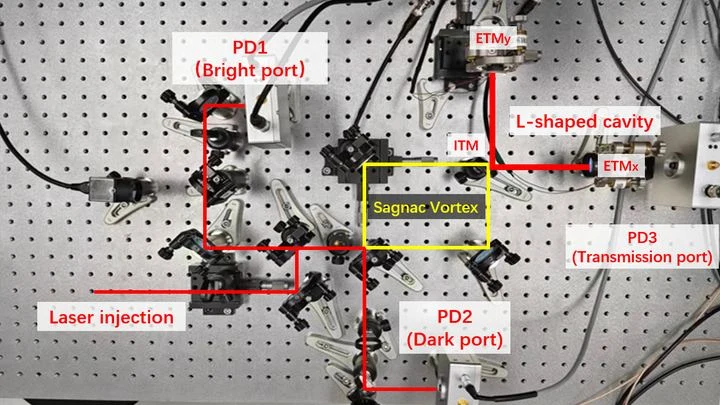
The most successful design is the laser interferometer, which uses a large L-shaped vacuum chamber with mirrors at the ends. A laser beam is split and sent down both arms, reflected back, and recombined. If a gravitational wave passes, it stretches one arm while compressing the other, causing the recombined light to interfere differently. This change in interference pattern is detected by a photodetector. To achieve the required sensitivity, the mirrors are suspended on delicate pendulums, and the entire apparatus is shielded from seismic noise. Newer concepts explore using atoms or membranes to detect higher-frequency waves that are beyond the range of current interferometers.
In practice
Gravitational wave detectors are used to observe cosmic events that are invisible to traditional telescopes, providing a new window into the universe and enabling tests of fundamental physics.
Fun fact
The LIGO detector is so sensitive that it can measure a change in distance smaller than a thousandth of the width of a proton over a four-kilometer arm.
A quantum detector is like a sensitive pendulum suspended in empty space. If a sharp gravitational wave passes by, you might expect the pendulum to swing. But the calculation shows otherwise: the wave doesn't swing it: it damps any existing oscillations.
A sculptor shapes mountains from magnetic fields and heat, but the stone resists. A neutron star, the ultra-dense remnant of a supernova explosion, in a binary system pulls matter from its companion star. This infalling matter heats the star's crust unevenly, while the magnetic field tugs from within.
A handful of pebbles drops into a pond: each one sends out ripples. If the pebbles are different, the ripples will be different too: some sharp, some smooth. But when you look at the water from a distance and see only a small part of the ripples, all those differences blur together.
The calm surface of a lake suddenly ripples — somewhere in the depths, an underwater cliff has collapsed. The water trembles almost imperceptibly, and the circles spread wider and wider until they reach a bobber near the shore.
In a dark room, a whisper is barely audible. To make out the words, you need to get close, or set up many sensitive microphones. That's roughly the reasoning behind the new work: the authors place quantum "ears" right inside a resonator, where a high-frequency gravitational wave turns into an electromagnetic echo.
A bell rings not from the strike but from a fleeting shudder of space. A gravitational wave, like ripples on a pond, passes through a massive magnet, and it deforms ever so slightly. That deformation can be turned into an electrical signal.
In 2015, detectors caught a gravitational wave for the first time — a ripple in space that traveled from merging black holes. Since then, such signals have become a new window into the universe for astrophysics. But gravitational waves can do more: they carry the imprint of the very theory of gravity.
When two neutron stars, compressed to the size of a city, approach in their final dance, the spacetime around them comes alive, emitting gravitational waves.
Gravitational waves are the trembling of spacetime itself. Usually we only catch their overall hum, but each wave also has a direction of oscillation – polarization. Old maps were built only from signal loudness, which led to errors. It's like trying to see the bottom of a pond through sun glare.
Gravitational waves are ripples in space from the mergers of black holes and neutron stars. Existing detectors, built with contributions from Kip Thorne and Rainer Weiss, work like highly sensitive microphones but only hear the highest 'notes'.
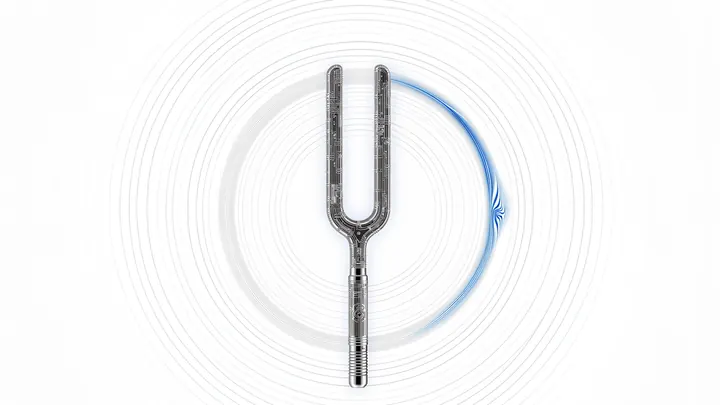
In a vast hall, a hundred tuning forks are set out. Each one is a pulsar — an ultra-dense stellar remnant spinning at a furious rate, sending out radio pulses more precisely than any clock. When a low-frequency sound wave sweeps through the hall, all the tuning forks start to go slightly out of tune at the same moment.
An ultra-sensitive microphone tries to catch the whisper of a distant galaxy. But the microphone itself trembles from heat: its atoms jitter like popcorn in a pan. Physicists call this jitter thermal noise, and it often drowns out weak signals.
On the table sits a sensitive instrument — a torsion balance. Two heavy masses rotate near a suspended rod, and their attraction tends to twist the rod. But the masses are arranged so that their ordinary Newtonian attraction cancels out: one pulls one way, the other the opposite. Only a weak residual remains, which the instrument captures.
In 2015, two giant facilities in the United States caught the shiver of space — a gravitational wave from the collision of black holes. Since then, such signals have been caught regularly, but the detectors themselves are enormous: their arms stretch for kilometers.
Gravitational waves are ripples in space itself, caused by events like colliding black holes. To hear these ripples, we build giant L-shaped facilities: a laser beam travels down two arms, bounces off mirrors, and returns. If space has been slightly squeezed or stretched, the light arrives with a difference, and we see a signal.
Imagine a membrane stretched like the skin of a drum. It picks up two signals at once: gravitational waves — the trembling of space itself — and elusive particles of dark matter. The membrane is placed between mirrors, and light presses on it like a finger on a string, keeping it under constant tension.