A torsion balance is a remarkably simple yet exquisitely sensitive instrument. It consists of a beam suspended from a thin wire or fiber. When a force acts on the beam, it twists the wire, and the amount of twist is a measure of the force. This design allows for the detection of extremely tiny forces, such as the gravitational attraction between small masses in a laboratory. It has been central to some of the most important experiments in physics, from measuring the gravitational constant to testing the equivalence principle.
History
The torsion balance was invented by John Michell, but it was Henry Cavendish who used it in 1798 to measure the gravitational constant, an experiment now known as the Cavendish experiment. Charles-Augustin de Coulomb also independently used a torsion balance to study electrostatic forces.
How it works
The beam is balanced so that the only restoring force is the torsion of the suspension wire. A small force applied at the ends of the beam causes it to rotate until the torque from the wire equals the applied torque. By measuring the angle of rotation, often with a laser and mirror, the force can be determined with incredible precision. The sensitivity is limited by thermal fluctuations in the wire, but careful design minimizes these.
In practice
Torsion balances are used in modern physics to test the equivalence principle, to measure the gravitational constant with high precision, and in some sensitiveaccelerometers.
Fun fact
The Cavendish experiment, using a torsion balance, is often called the 'weighing the Earth' experiment because it allowed the mass of the Earth to be calculated for the first time.
An electron beam is a stream of tiny particles carrying an electric charge. When such a beam hits a material, it doesn't just heat it or knock out atoms: it also gives the surface a slight push, like a jet of water pushing against your palm.
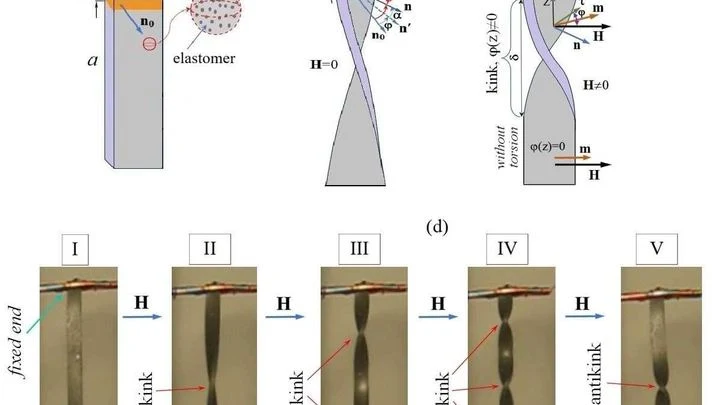
An ordinary rubber strip filled with fine iron filings doesn't just bend in a magnetic field: it ties itself into a stable knot. This effect was predicted and reproduced in experiments by physicists working with magnetoactive elastomers: a silicone base with carbonyl iron particles.
On a lab table sits an instrument that looks like a balance, but instead of pans it has two weights made of different metals — beryllium and aluminum. The balance is suspended from a thin fiber that twists if the weights are pulled differently. The whole apparatus turns to follow the Sun, like a sunflower tracking the light, but instead of light it catches the Sun's gravity.
An ordinary sensor is like a scale that always shakes a little on its own. Even in total silence and at zero temperature, every particle jitters — this is quantum jitter, and it limits the precision of any measurement.
In a quiet lab, a device the size of a microwave oven sits on a table. Inside, a coil glides smoothly up and down while a computer reads electrical signals. This is the tabletop Kibble balance — a machine that links mass to quantum constants.
Previously, such balances occupied a whole room and required a team of engineers.
Since the days of Galileo, it was believed that in a vacuum all bodies fall identically. Einstein elevated this to a principle: gravity travels at the speed of light and is the curvature of spacetime.
Two taut strings plucked at the same time sound different if they are connected by a rubber band. Energy starts to flow from one to the other, and the pitch of the combined sound shifts slightly. Two nanomechanical bridges, microscopic beams etched into a crystal, behave much the same way.
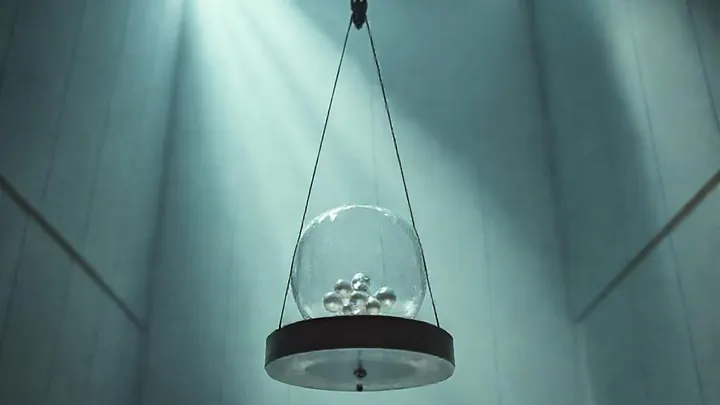
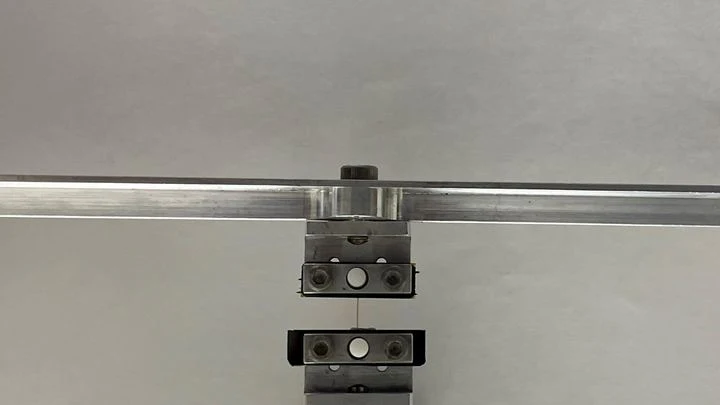
A weight about the size of a small apple hangs from a thread hundreds of times thinner than a human hair. The thread doesn't snap and barely interferes with the weight's swinging. This setup is the heart of a new lab scale for measuring gravitational attraction.
All bodies fall the same: this was first observed by Galileo. Einstein elevated the observation to the equivalence principle: gravity and acceleration are indistinguishable, giving birth to curved spacetime.