The Milky Way's Halo: Stars Dance to Different Tunes express
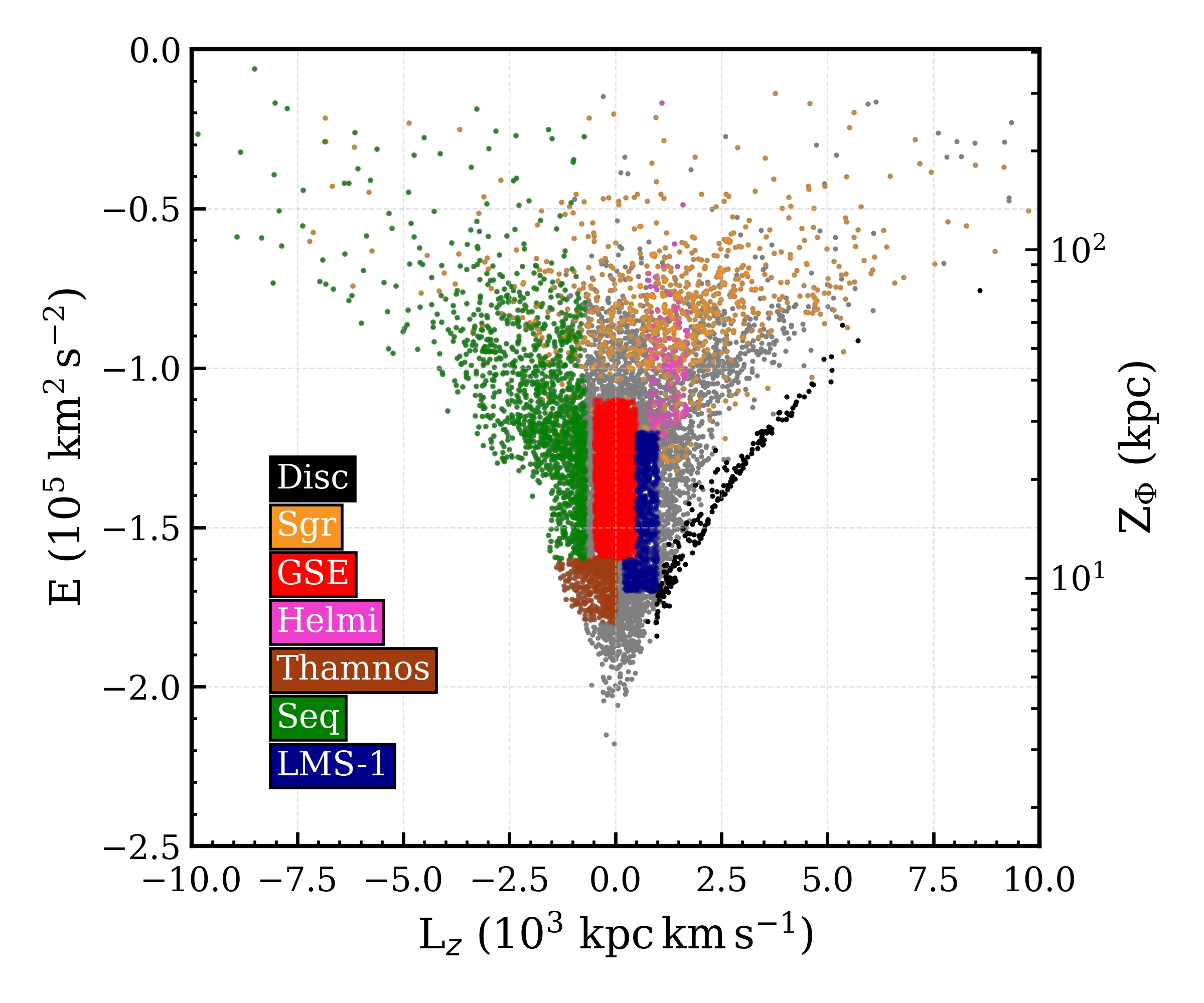
The halo of our Galaxy is a huge, sparse cloud of old stars that envelops the familiar disk. It holds the story of how the Milky Way grew by gobbling up neighboring dwarf galaxies. To read that story, astronomers measured the motions of more than 10,000 stars out to a distance of 50 kiloparsecs from the center — one and a half times farther out than the edge of the visible disk.
It turns out that in the inner halo (within 30 kiloparsecs), stars more often travel on elongated orbits, like comets around the Sun. Farther out, orbits become more and more circular, and at the halo's outskirts, stars move predominantly in circles. But when the scientists excluded from their calculations the stars that entered the Milky Way from outside during mergers with other galaxies, the picture changed: the entire halo is filled with stars on elongated orbits.
This work is like a census for the halo. It shows that the character of stellar motion is strongly influenced by events in the Galaxy's past, not just by its current shape. The older the stars, the more calmly they move: in the inner halo, old stars are less likely to be on elongated orbits than younger ones.
Original abstract
as written by the authors arXiv:2604.18278
Modeling the Milky Way stellar halo requires well-determined density and velocity anisotropy profiles. However, it has been challenging to gather a large sample of stars with six-dimensional data that extend beyond 40 kpc to map the outer halo. Our work investigates the velocity anisotropy in the Milky Way stellar halo with more than 10,000 blue horizontal-branch stars, combining Gaia astrometric data and spectroscopic data from SEGUE, DESI and LAMOST. This large sample allows us to obtain a detailed profile of up to $$\sim 50$$ kpc. Radial velocities are predominant in the inner halo ($$< 30$$ kpc), and the anisotropy presents a smooth decrease before rapidly dropping to negative values, becoming dominated by tangential dispersion velocities. Removing the main known accreted structures of the Milky Way, makes the anisotropy profile radially-dominated at all radii. Our profile clearly shows an increase in the anisotropy from the center of the Galaxy, in accordance to the simulations. We also investigate the correlation of anisotropy with metallicity and with color. The lack of correlation between metallicity and anisotropy in our clean sample reinforces that this relation is driven by merger events. The initial exploration with color indicates a relation between kinematics and age, showing that older stars are dynamically colder and present less radial orbits than younger stars in the inner halo.
A distance of 50 kiloparsecs is roughly 163,000 light-years. For comparison, we are about 26,000 light-years from the Galactic center, and the nearest major galaxy, Andromeda, is 2.5 million light-years away.
In the series 'Star Trek', the galactic halo is often depicted as a place where ancient civilizations hide, and indeed, the stars there remember the earliest times.