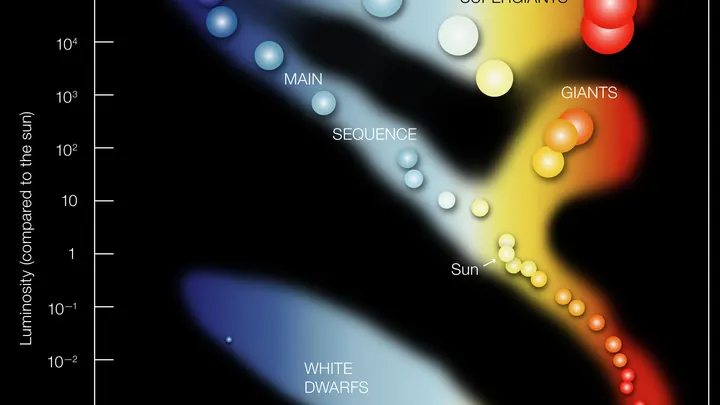
The main sequence is the most prominent feature of the Hertzsprung-Russell (HR) diagram, a plot of stellar luminosity against surface temperature. It is a continuous, roughly diagonal band running from hot, bright stars in the upper left to cool, dim stars in the lower right. About 90% of all stars in the Milky Way, including the Sun, lie on this band at any given time. These stars are in the longest and most stable phase of their lives: they are fusing hydrogen into helium in their cores, generating enough outward pressure to balance the inward pull of gravity.
History
The concept was developed independently in the early 20th century by Ejnar Hertzsprung and Henry Norris Russell, who plotted stellar properties and noticed the prominent diagonal band. The term 'main sequence' was coined by Russell in 1914.
How it works
Stars on the main sequence are in hydrostatic equilibrium. The energy released by nuclear fusion in the core creates thermal pressure that pushes outward, exactly counteracting the gravitational force pulling inward. The position of a star on the main sequence is determined primarily by its mass: more massive stars are hotter, brighter, and bluer, while less massive stars are cooler, dimmer, and redder. During this phase, a star's luminosity and temperature change very slowly, so it remains at a nearly fixed point on the diagram for millions to trillions of years, depending on its mass.
In practice
The main sequence is a fundamental tool in astrophysics for estimating stellar distances (via spectroscopic parallax), ages of star clusters, and the evolution of galaxies.
Fun fact
The Sun has been on the main sequence for about 4.6 billion years and will remain there for roughly another 5 billion years before evolving into a red giant.
Two spinning tops whirl so close they nearly touch. One is scorching blue, the other dim white. Together they complete a full orbit in twenty hours. This is the pair Feige 64: a blue star with a mass of just a third of the Sun's, and a white dwarf, the cooled core of a former star, one and a half times heavier than our Sun.
The blue star seems too hot for its mass.
Think of a merry-go-round: the farther you sit from the center, the faster you're carried around. For a long time, astronomers assumed galaxies work the same way — stars at the edges should orbit more slowly than those near the center. But back in the 1970s, it turned out that in many spiral galaxies, the speed of stars barely drops with distance from the center.
A sunspot, a dark island on the fiery surface, lives its own turbulent life. Beneath it, in invisible depths, giant magnetic loops drift like twisted cables. When such a loop emerges, it can discharge as a flare, and hurl clouds of charged particles into space.
Scientists have long tried to understand what determines the strength and suddenness of these events.
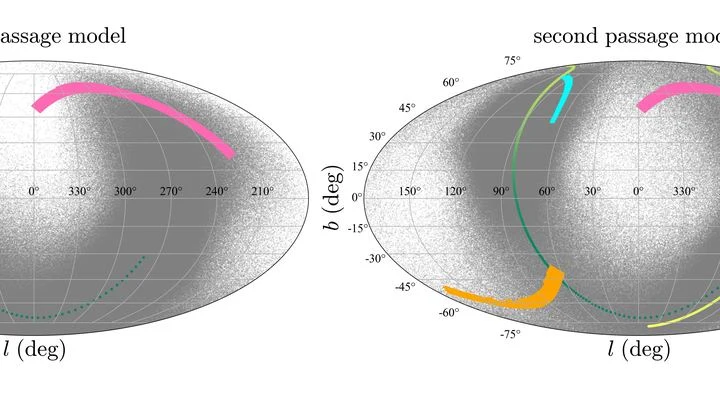
Two galaxies (our Milky Way and its satellite, the Large Magellanic Cloud) slowly circle each other. Their gravitational pull stirs the distant outskirts of the Milky Way, like a pebble thrown into a pond makes the water ripple.
A neutron star is a city squeezed to the size of a metropolis, where matter is packed to the limit. At the very center of such a city, a redevelopment may begin: familiar neutrons and protons give way to quark plasma — free quarks, the building blocks of almost everything around us.
Deep inside a star compressed to its limit, particles behave like the strings of an unusual musical instrument. Their oscillations obey a complex equation that for nearly a century no one could solve exactly.
A handful of matches falls on the table. Each lies however it lands, but in our minds we turn each into an arrow — from one end to the other. Now ask: can you get from one point to another by moving only in the direction of the arrows? A group of points where you can reach any one from any other is called a strongly connected cluster.
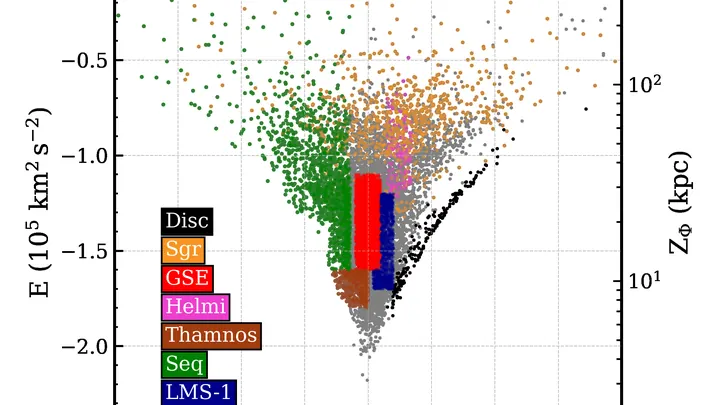
The halo of our Galaxy is a huge, sparse cloud of old stars that envelops the familiar disk. It holds the story of how the Milky Way grew by gobbling up neighboring dwarf galaxies.
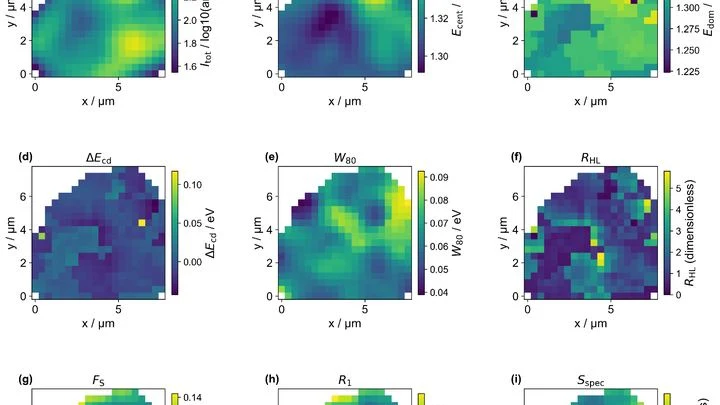
The glow of an ultrathin sandwich made of two semiconductor layers, molybdenum selenide and tungsten selenide, resembles a tangled musical score: many narrow colored lines that merge into a general background. Figuring out which line comes from where is nearly impossible.
The authors did not try to disentangle the lines one by one.
On the outskirts of our Galaxy, far beyond the familiar stellar disk, the Subaru Telescope has spotted something unexpected: a scattered cloud of stars spanning an area of one hundred square degrees across the sky.
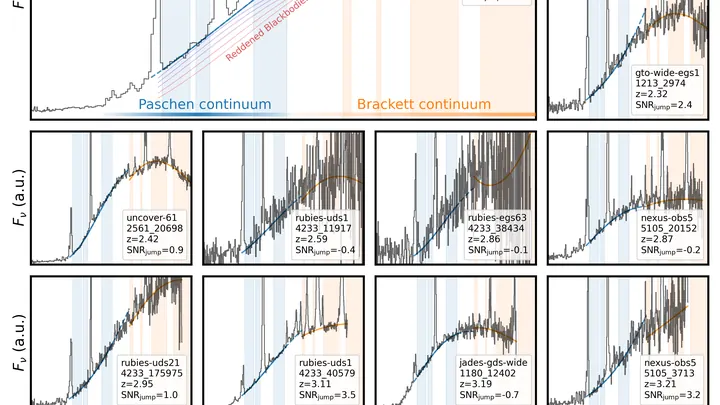
Out in the distant cosmos, there are galaxies that astronomers have nicknamed 'little red dots': in images they appear as tiny reddish specks, even though they are mind-bogglingly far away. Their light looks red not because they are cold, but because the expanding universe stretches light waves.
Some red giants (huge, old stars) change brightness very slowly: one cycle can last more than a year. Astronomers have long been puzzled about why. One idea: an invisible companion orbits nearby, periodically blocking part of the light. Another: the star itself pulsates, like a heart, but very leisurely: its outer layers alternately contract and expand.
Long before a star ignites in a gas cloud, chemical life is already bustling. In cold, dense clumps of gas, called starless cores, atoms stick together to form molecules, both simple and complex. To peer into this invisible kitchen, astronomers aimed a 40-meter radio telescope in Yebes at 23 such clouds in the Orion Nebula.
In the southern sky, the star Acrux shines brightly — the lowest point of the Southern Cross constellation. It is not a single star but a whole family. New observations revealed that it contains not five, but seven stars bound by gravity, like children holding hands in a circle dance.
If you build a giant blanket around a star, you get a Dyson sphere. It absorbs all the radiation and glows in invisible heat rays. No such sphere has been seen yet, but astronomers know: to find it, look for this thermal glow.
In the star cluster NGC 2158, which is over a billion years old, astronomers have counted how often stars live in pairs. The Hubble telescope stared at the cluster for a long time to catch even the faintest stars: those lighter than one-third of the Sun.
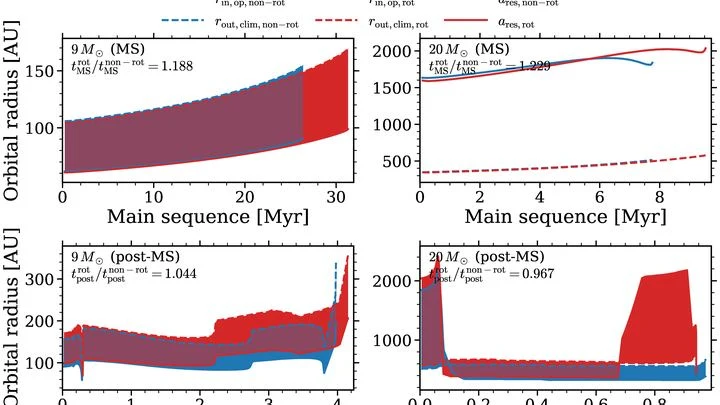
A star nine times heavier than the Sun ignites a zone around it where liquid water could slosh on a planet's surface. But this zone is like a narrow strip of beach at low tide: it will vanish in 30 million years. Such stars live bright and die young, leaving life no time for the long journey from microbes to complex beings.
Gas clouds in the Milky Way give birth to stars, and the heaviest among them are true giants. Previously, it was thought that such a star ignites almost instantly, like a light bulb. But new research shows that a star grows gradually, like a snowball rolling down a mountain: the longer it rolls, the bigger it gets.
The authors compared two catalogs: bright gas clouds around young stars and the stars themselves.