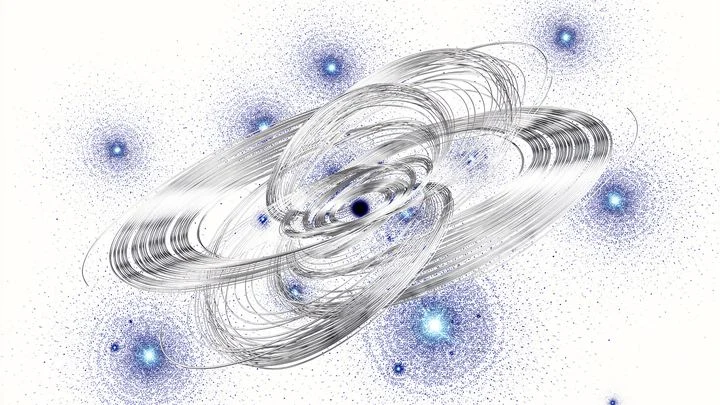
A density profile describes how density changes with distance from the center of an astronomical object, such as a galaxy, dark matter halo, or star. It is a fundamental tool for understanding the internal structure and dynamics of cosmic systems. Different profiles — like the Navarro-Frenk-White (NFW) profile for dark matter halos or the isothermal profile for galaxies — encode information about formation history, gravitational interactions, and the nature of dark matter.
History
The concept dates back to the early 20th century with studies of stellar density in globular clusters. The NFW profile was introduced in 1996 by Julio Navarro, Carlos Frenk, and Simon White, based on N-body simulations.
How it works
To measure a density profile, astronomers observe the motion of stars, gas, or gravitational lensing effects. The orbitalvelocities of objects at different radii reveal the enclosed mass, which, when differentiated, gives the density. For dark matter halos, simulations predict a universal 'cuspy' profile (NFW) with density rising steeply toward the center, but observations of some galaxies suggest a flatter 'core' — a discrepancy that drives research into dark matter properties.
In practice
Density profiles are used to map dark matter distribution in galaxies, test modified gravity theories, and interpret gravitational lensing observations.
Fun fact
The density profile of dark matter halos is so universal across different masses and epochs that it's called 'universal' — yet the exact form at the center remains one of the biggest unsolved problems in cosmology.
A drop of ink spreads in a glass of water: its edges move faster than its center, and the drop's shape changes. Likewise, a clump of dark matter collapsing under its own gravity expands unevenly, with different shells flying apart at different speeds. Previously, astrophysicists could accurately describe only the simplest case, a uniform sphere with a sharp boundary, which has a single expansion rate.
A light ray passing near a massive body bends around it, like a runner rounding the corner of a stadium. For a neutron star, this deflection angle is usually assumed to be the same as for a point mass. But if the star is wrapped in an invisible halo of dark matter, the picture changes: light passing through the halo is deflected less than the total mass would predict.
A galaxy is like a city: bright lights and dense buildings at the center, sparse lights and emptiness toward the outskirts. But if you watch how gas rotates in a galaxy's disk, you see that its speed barely drops at the edges. As if invisible neighborhoods keep the motion going. Astronomers have found a way to map this invisible city.
A neutron star is the ultra-dense remnant of a supernova: the mass of the Sun packed into a sphere the size of a city. For billions of years, it travels through space, gathering around itself invisible matter, dark matter, which emits no light but pulls with gravity.
Three invisible strings oscillate in the intergalactic void. This is not poetry, but a hypothesis about the nature of dark matter — an ultralight quantum field with spin 1, carrying three polarizations.
A heaping teaspoon, and the scale reads a billion tons. That's roughly what a teaspoon of neutron star matter would weigh if you could scoop it up and put it on a scale. Such objects are born after a supernova explosion: the star's core collapses into a sphere the size of a city, and the density exceeds that of an atomic nucleus.
Dark matter is invisible to telescopes, but its gravity was revealed half a century ago by Vera Rubin. Since then, physicists have explored dozens of hypotheses, and one of the most elegant is primordial black holes, formed in the first moments after the Big Bang.
For almost a century, seismology has been the planet’s chief X-ray, probing the interior through elastic waves. But neutrinos, ghost particles predicted by Wolfgang Pauli, offer a different perspective.
A stone falls into water, and ripples spread in all directions. Throw a handful of stones at once, and the ripples overlap: you can no longer tell which ripple came from which stone. A neutron beam hitting a detector looks much the same: a bright spot blurred by many causes.
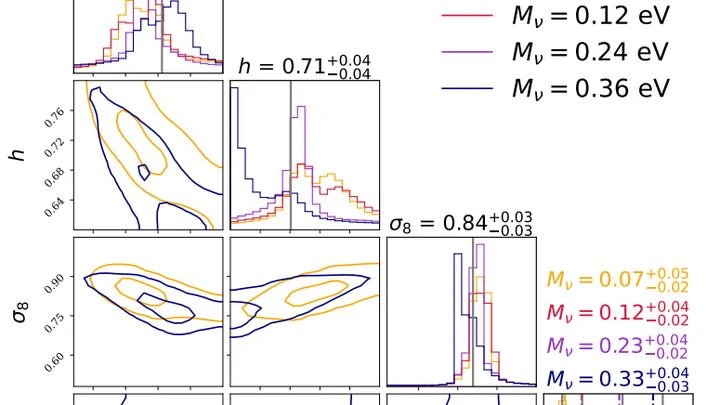
The universe is like a vast warehouse where a strict inventory was taken long ago. The cosmic microwave background is an ancient record of everything in stock 380,000 years after the big bang. According to it, the fraction of matter in the cosmic 'budget' (the parameter Omega_m) is known with high precision.
A giant cloud of invisible matter acts like a funhouse mirror — distorting the light from a distant galaxy. From these distortions, astronomers can weigh the cloud and peer into its depths.
At the center of the Milky Way, like a matryoshka doll within a matryoshka doll, lies a supermassive black hole, surrounded by a swarm of stars and an invisible shell of dark matter. This shell, or "spike," is expected to be extremely dense right at the horizon.
The Universe grows like a metropolis: galaxies skyscrapers are erected on an invisible scaffold of dark matter: its gravity pulling in construction material. Meanwhile, dark energy makes the city itself continuously expand.
In the 1930s, Fritz Zwicky first noticed that galaxies in clusters were moving too fast — something invisible was holding them. Later, Vera Rubin measured the rotation of spiral galaxies, confirming that space is permeated by dark matter.
A fluffy ball of invisible web envelops a black hole. This web is dark matter, which doesn't shine but, through its weight, governs the motion of stars on the outskirts of galaxies. Astrophysicists have long seen such 'fluffy' clouds around cosmic objects and have mapped their profiles — how density falls from the center to the edge.
Imagine a huge layered cake, where the layers of dough are space and the filling is a special region resembling an invisible wall. This wall is not made of bricks but of energy, and it could be as thick as the entire universe. If such a wall exists, it should stretch the dough layers differently: those lying along it spread apart faster, while those across it spread slower.
When a massive star exhausts its fuel, the core collapse can spawn a supernova and a neutron star, but with enough mass, nothing halts the crush — a black hole is born.
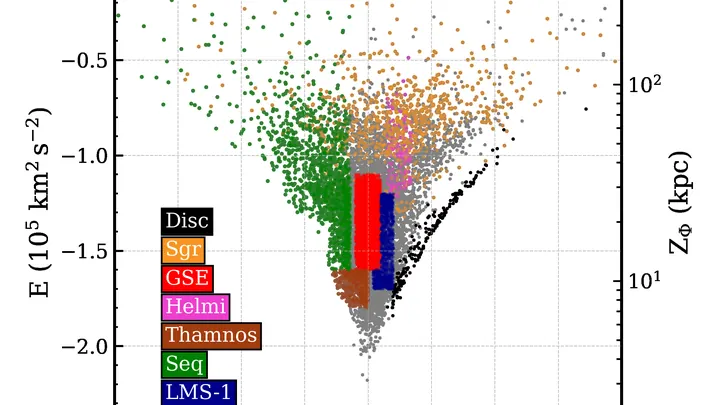
The halo of our Galaxy is a huge, sparse cloud of old stars that envelops the familiar disk. It holds the story of how the Milky Way grew by gobbling up neighboring dwarf galaxies.
The universe keeps a tally of every newborn star. Over 13.8 billion years, galaxies have ignited so many stars that their 'census' can reveal the nature of the cosmos itself, just as tree rings reveal past climates.
The cosmic web resembles a giant three-dimensional network: galaxies and clusters are connected by filaments of dark matter. These filaments act as invisible bridges along which matter flows toward major nodes. For a long time, scientists struggled to understand the density structure of these filaments, but results were contradictory.
The Universe is a colossal web of invisible dark matter and galaxies, stretched by the expansion of space. Neutrinos, nearly intangible ghost particles, barely cling to the threads, but their collective mass subtly shifts the tension of the entire network.
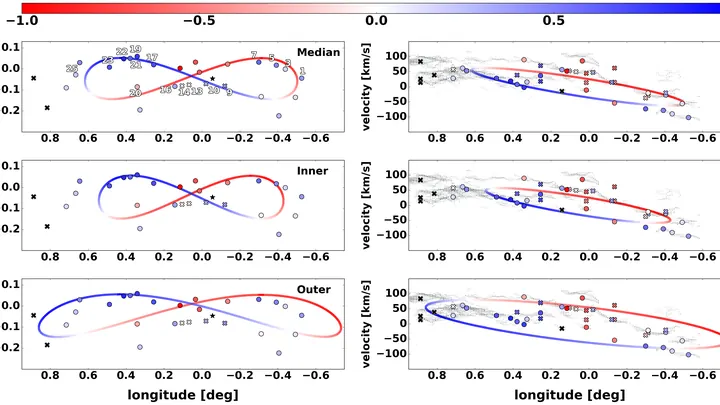
In the very center of the Milky Way, hidden behind a thick veil of dust, lies a giant accumulation of gas — the Central Molecular Zone. You can't see it with the naked eye: dust absorbs visible light, much like dense fog hides the lights of a city.
A galaxy is like a giant merry-go-round: stars and gas whirl around the center, and their speeds reveal how much stuff is on the ride. If we only saw the luminous matter, the outer parts would spin slower than observations show. So there must be invisible mass, dark matter, that holds the galaxy together.
At the heart of the Milky Way spins a stellar bar — an elongated cluster, like a rotating paddle. Its gravity creates a rhythmic field around it, like waves from a speedboat.
At the center of our Galaxy lies a supermassive black hole, with stars orbiting around it. Their motion resembles a cosmic dance: some race along elongated orbits, others follow nearly circular paths. If invisible dark matter exists near the black hole, it slightly distorts these orbits, like an unseen hand nudging a star off course.
Dark matter is like an invisible glue that holds galaxies together. It emits no light, but if its particles collide, gamma rays can flash. Scientists hunted for such flashes in dwarf galaxies — small stellar clusters with lots of dark matter and almost no ordinary matter.
Dark matter may not be particles but black holes from the Big Bang era. In the early Universe, which was like a swirling batter, they were like heavy lumps — barely moving, they gathered surrounding matter and spun it into the swift galaxy flows astronomers observe today.
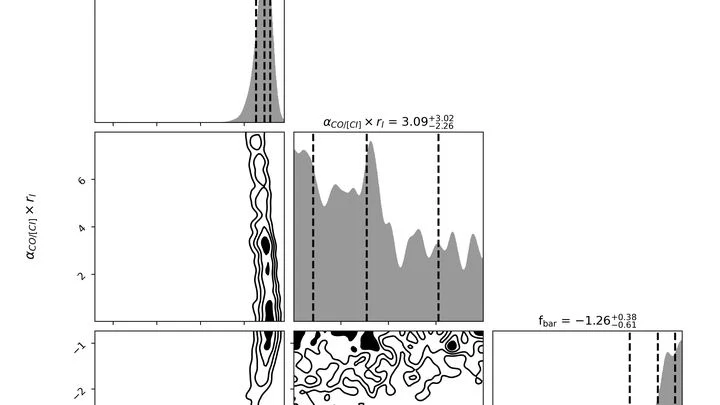
Three distant galaxies spin like giant carousels. Their stars and gas move along spiral arms, and from the speed of this motion you can calculate how much total matter the galaxy contains — visible and invisible.
Astronomers combined two views: radio telescopes revealed cold gas, while the James Webb Space Telescope showed the stars.
Supermassive bodies warp space, turning into a lens that bends light from distant objects. Such spacetime curvature allows astronomers to see the invisible. Recently, this method helped detect a hidden clump with the mass of a million Suns.
The enigma of dark matter was already studied by Fritz Zwicky and Vera Rubin. For decades, it was depicted as a cold, listless skeleton that only draws galaxies together.
Astronomers read the history of galaxies by their portraits. Previously, they used either lengthy analysis of light by colors or quick filtered snapshots, losing the details of shape.
The galaxy NGC 1560 is a modest island of stars and gas ten million light-years away. Its rotation curve, first measured in 1991, became an icon for those seeking an alternative to dark matter. The plot of rotation speed versus radius shows bends that seem to exactly mirror the bends in the distribution of ordinary matter.