A dark matter subhalo is a small, self-gravitating clump of dark matter that orbits within a larger dark matter halo. In the standard cosmological model, dark matter halos form hierarchically: large halos grow by merging with smaller ones, and some of these smaller clumps survive as subhalos. They are important because they can host satellite galaxies or star clusters, and their gravitational effects can be observed through tidal streams, gravitational lensing, or the dynamics of stars in the Milky Way's halo.
History
The concept of dark matter subhalos emerged from N-body simulations in the 1990s, particularly the work of Julio Navarro, Carlos Frenk, and Simon White, who studied halo structure. The 'missing satellite problem'—the discrepancy between predicted and observed subhalo counts—was highlighted in the early 2000s.
How it works
Subhalos are predicted by simulations of structure formation, where dark matter particles cluster under gravity. They are denser in their centers and become tidally stripped as they orbit the host halo, losing mass over time. Observations of stellar streams—long trails of stars torn from disrupted satellites—can reveal the presence of subhalos through gaps or wiggles in the stream, since a passing subhalo perturbs the orbits of the stream stars.
Some dark matter subhalos may contain no stars at all, making them completely invisible except through their gravitational effects on surrounding matter.
A river drawn on a map is always a single line. But stand on the bank, and you will see that within the channel there are faster currents, eddies, and branches that merge and split. The cosmic web is like that river, but made of dark matter, and until recently astronomers drew it as a single line.
A million orbits: the same score. Nine dark matter halos: nine orchestras without a conductor. All musicians play from the same notes, but in each hall the music sounds different: sometimes in tune, sometimes out of sync. Likewise, satellite galaxies falling into a host halo follow orbits that depend not only on mass but also on the shape of the invisible stage.
The galaxy cluster RXC J0528.9−3927 is like a city shrouded in fog: at its center, a radio halo shines brightly, but farther out, beyond the usual boundaries, astronomers have spotted a barely visible glow. It stretches for two million light-years — three times farther than the halo itself.
A black hole with a mass of 35,000 Suns drifts through a galaxy's gas like a barge through fog. Its gravity rakes the material ahead of it, leaving a dense trail behind — a wake of gas. Some of that gas gets pulled into the black hole, and it grows.
A dance floor where couples whirl. At the center, an invisible master of ceremonies sets the rhythm. This is the supermassive black hole at the heart of the Milky Way, and the couples are stars whose orbits astronomers have tracked for years. But what if the master himself is wrapped in a fluffy fur coat of tenuous matter?
Somewhere in the center of a galaxy, a black hole is spinning. It doesn't hang in a void — around it swirls an invisible swarm of dark matter particles. Until now, this swarm was described for non-rotating holes, but in reality, holes always rotate.
In a distant galaxy about 290 million light-years away, the object HLX-1 lies hidden. It once flared brighter than hundreds of billions of suns, but now it has quieted down. From 2018 to 2022, the Hubble, Chandra, and Swift space telescopes tracked its fading.
At the center of a galaxy sits a supermassive black hole, surrounded by a vast, tenuous cloud of dark matter. It doesn't shine or heat, but its gravity warps space and changes the rules of the game for everything orbiting nearby.
Layer by layer, artifact by artifact — an archaeologist reconstructs the history of an ancient settlement. Similarly, astrophysicists sifting through 259 records from LIGO–Virgo–KAGRA saw a clear layered structure among merging black holes.
Three invisible strings oscillate in the intergalactic void. This is not poetry, but a hypothesis about the nature of dark matter — an ultralight quantum field with spin 1, carrying three polarizations.
At the center of many galaxies lurks a black hole, wrapped in an invisible cloud — the halo of dark matter. This is not just a featureless mass: its density changes from the edge to the center, and the degree of this "compression" is called compactness.
The formation of the Milky Way is a grand cosmic performance, in which mergers of satellite galaxies were woven into a single score. Each event left a trace in the dynamics and chemical composition of stars, much like notes capture the composer's intent.
A cosmic detective story spanning a decade and a half has turned up an unexpected clue. The Fermi telescope, which scans the sky in gamma rays, has detected a steady, faint glow enveloping the entire Milky Way. It looks nothing like the light from stars or hot gas — more like a dim, all-pervasive haze.
Dwarf galaxies orbiting the Milky Way look as if they’ve survived a gravitational storm. Their stellar bodies are stretched, scattered by tidal tails, and heated from within.
Dark matter — the invisible foundation of cosmic architecture — makes up 85% of all mass, yet eludes direct observation. In the 1920s, Edwin Hubble discovered the expansion of the universe and the realm of galaxies; by the 1930s, Fritz Zwicky suspected hidden mass in their clusters.
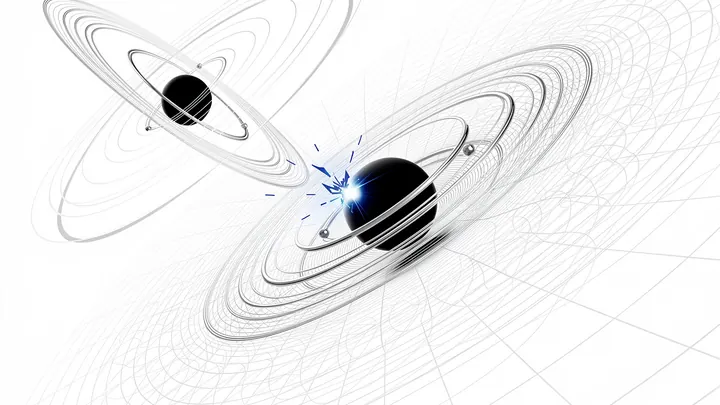
At the heart of almost every galaxy slumbers a supermassive black hole — the invisible conductor of a stellar orchestra. When galaxies collide, their central monsters draw closer, entwining in a gravitational dance. Sometimes a third partner joins the duo, and then a triple waltz begins, its outcome unpredictable.
Almost a century after Фриц Цвикки suspected something was amiss in the motion of galaxies in the Coma cluster, and Вера Рубин measured stellar velocities in spiral arms, the nature of тёмной материи remains one of the most vexing mysteries.
A detective story unfolded in the GWTC-5 catalog. Hundreds of signals from merging black holes, captured by the detectors of Rainer Weiss and his colleagues, held the secret to the origin of the most massive and rapidly spinning stellar-scale objects.
At the center of attention are tiny stellar cities: ultra-faint dwarf galaxies. They resemble sparse swarms of fireflies circling within a vast invisible cloud. This cloud is a halo of ultralight dark matter. Its particles are so light that they behave not like billiard balls but like waves.
In the search for the nature of dark matter, one of the most intriguing hypotheses traces back to the first moments after the Big Bang. Back then, quantum fluctuations of the inflation field gave rise to clumps of matter that could collapse into primordial black holes.
A black hole is not just a dark spot in the sky. Its shadow falls on the glowing backdrop of infalling matter and carries the imprint of spacetime geometry itself. If gravity works even slightly differently than we think, the shadow will give it away.
In a new study, physicists traced light rays around a rotating black hole in so-called Rastall gravity.
A swarm of tiny ice balls is scattered across a warm room. Some melt faster, others slower, but when only wet spots remain, they all vanish in the same way: the last drop evaporates according to the same law. This is roughly how primordial black holes behave — hypothetical objects born in the first moments after the big bang.
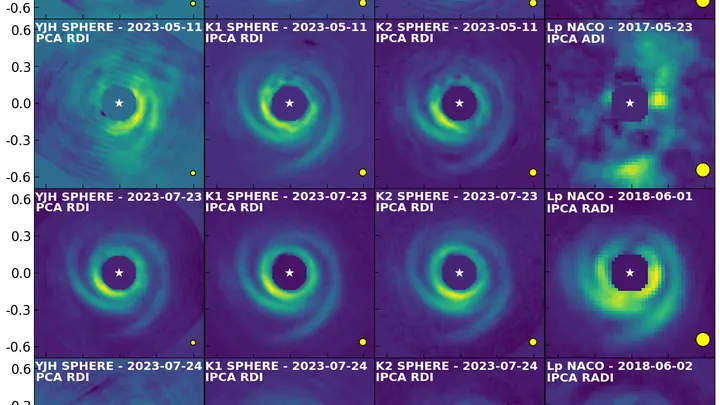
460 light-years away, around the star HD 135344B, a dense disk of gas and dust is swirling. It looks like a giant vinyl record that someone has cracked: a gap yawns in the disk, and across it, like a slender bridge, stretches a dust filament.
On May 14, 2019, LIGO detectors registered a gravitational burst that didn't fit the usual mold. Event GW190521 appeared as a collision of two black holes weighing 85 and 66 solar masses. The resulting hole of 142 solar masses landed right in the "forbidden" range — where stellar collapses leave almost no trace.
In the 1930s, Fritz Zwicky first noticed that galaxies in clusters were moving too fast — something invisible was holding them. Later, Vera Rubin measured the rotation of spiral galaxies, confirming that space is permeated by dark matter.
In the silent theater of the cosmos, a star’s life plays out over billions of years. But sometimes an invisible director sneaks onto the stage — a primordial black hole.
Among the precious scatterings of the early Universe captured by James Webb, there are objects that resemble ruby beads scattered on black velvet. These are the 'little red dots' (LRDs) — compact sources with steep red spectra, inside which lurk supermassive black holes up to a hundred million solar masses.
Dark matter is the invisible scaffold of the universe. It doesn't shine, but its gravity holds stars in galaxies. In some models, dark matter particles can collide and exchange energy, like molecules in warm air.
The universe is filled with invisible dark matter. Just as a drop of water, as it evaporates, leaves behind a tiny salt crystal, so too can a black hole evaporate, leaving behind a minuscule stable remnant.
The gravity of a black hole creates a curvature of spacetime, acting like a lens: light from a distant galaxy splits in two, stretching into arcs. Dark matter around the hole barely changes the picture, as if a transparent curtain was added to a window pane.
Pairs of black holes dance in three different styles before merging. The first is a neat waltz: the objects swirl in the same direction, like partners facing the same way. Such pairs are born from binary stars and often have unequal masses. The second is chaotic disco: spins are scattered, masses nearly equal.
At the heart of our stellar metropolis — the Galaxy — lurks the supermassive black hole Sagittarius A*. Around it, star S2 whirls in a swift dance. But its movements reveal more than just the hole's pull: an invisible partner joins the dance — dark matter.
A magnifying glass focuses sunlight into a bright point. If the glass has a tiny flaw, the spot of light becomes distorted. Gravitational lensing works in a similar way: a massive galaxy bends light rays from a more distant source, creating an enlarged and sometimes distorted image.
A spotlight shines through a dark hall. Between the lamp and the wall, an invisible lens drifts by, and the spot of light briefly brightens and shifts. That is exactly what the DECam telescope, aimed at the Large Magellanic Cloud, a satellite galaxy of our Milky Way, was watching for five consecutive nights.
A whirlpool in a river sucks everything in. Now imagine adding an invisible jelly to the water that thickens near the vortex and suddenly vanishes at its edge: that's roughly what a black hole looks like in a new mathematical model.
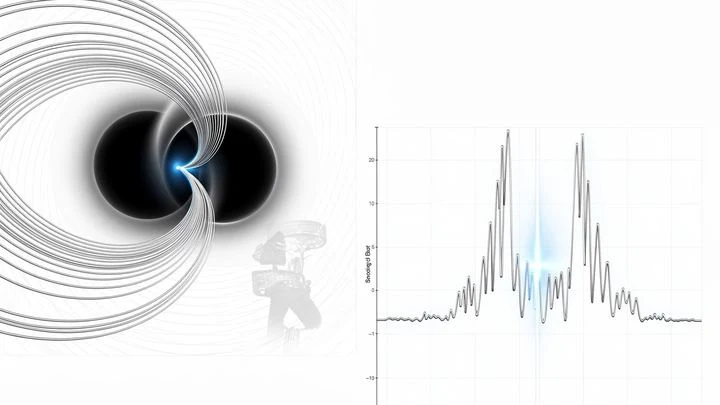
Two black holes fly toward each other and collide head-on. In the familiar picture, their horizons (the surfaces from which not even light can escape) stretch toward each other like water droplets and merge into one smooth shape. But calculations show otherwise: before merging, a sharp beak, a cusp, extends from each horizon.
A stellar river winds around the center of a distant galaxy like a glowing ribbon on an invisible frame. That frame is the dark halo: a vast cloud of invisible dark matter whose gravity holds stars and gas in place. If the halo is squashed like a pumpkin or stretched like a melon, the stellar stream will bend differently.
Astrophysicists have conducted a census of invisible objects that betray their presence only through the trembling of space. They studied the fresh catalog GWTC-4 — a list of dozens of black hole mergers recorded by the gravitational wave detectors LIGO, Virgo, and KAGRA.
Right after the Big Bang, space rippled with gravitational waves, like those from a thrown stone. These tremors in the very fabric of the cosmos, predicted by Alan Guth, stretched across the entire universe. The ripples slightly compressed primordial matter in some places and thinned it out in others.