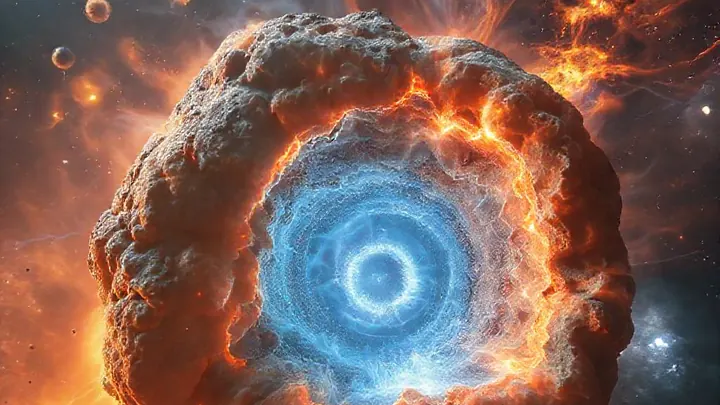
Compactness is a dimensionless parameter that measures how tightly mass is packed within a star, typically defined as the ratio of the gravitational radius (GM/c²) to the actual radius of the star. For a neutron star, compactness is extremely high, often around 0.1 to 0.2, meaning that the star's radius is only a few times larger than its Schwarzschild radius. This parameter is crucial because it determines many observable properties of neutron stars, including their maximum mass, their moment of inertia, and the behavior of their oscillations.
History
The concept of compactness has been used in astrophysics since the mid-20th century, but it gainedprominence in the 1960s and 1970s with the discovery of neutron stars and the development of relativistic stellar structure theory. The term 'compactness' became standard in the context of neutron star research.
How it works
The compactness of a star is determined by its equation of state, which relates pressure and density in its interior. A stiffer equation of state (more pressure for a given density) supports a larger radius for a given mass, leading to lower compactness, while a softer equation of state leads to higher compactness. The compactness directly affects the gravitational redshift of light emitted from the star's surface, the orbital frequency of matter in its accretion disk, and the amplitude of gravitational waves emitted during oscillations or mergers.
A neutron star with a mass of 1.4 solar masses has a radius of only about 10-12 kilometers, giving it a compactness so high that a teaspoon of its material would weigh billions of tons on Earth.
Pulsar PSR J0614-3329 spins 318 times per second. A point on its equator moves at about 10% of the speed of light. From a distance, the star looks like a lighthouse spinning so fast that its beam blurs into a continuous ring.
A light ray passing near a massive body bends around it, like a runner rounding the corner of a stadium. For a neutron star, this deflection angle is usually assumed to be the same as for a point mass. But if the star is wrapped in an invisible halo of dark matter, the picture changes: light passing through the halo is deflected less than the total mass would predict.
In the dark kitchen of the Taurus molecular cloud, 450 light-years away, dozens of planetary systems are being prepared. Each young star is a chef, and its protoplanetary disk is a counter piled with flour-like dust and steam-like gas.
A white dwarf is the former core of a star like the Sun, squeezed down to the size of Earth. A teaspoon of its material would weigh several tons. A neutron star is an even denser remnant: a city the size of Manhattan, but with more mass than the Sun.
A cosmic "caliper" will soon measure a neutron star to within a hundred meters. For an object a couple dozen kilometers across, that's like measuring the thickness of a human hair from a kilometer away.
A neutron star is the remnant of an exploded supernova.
A swarm of tiny invisible particles, like a cloud of pollen, drifts through space. A black hole sits in its path. Some particles fall in and vanish forever; others swing around the trap and fly away. The physicists built a map showing exactly how much matter gets swallowed and how much survives.
In August 2019, the LIGO and Virgo detectors picked up gravitational waves from the merger of two compact objects in a binary star. One weighed 23 solar masses — a standard black hole. The other came in at 2.5–2.67 M⊙.
A neutron star is the collapsed core of a massive star, squeezed to the size of a city. A teaspoon of its material weighs as much as a mountain. But inside this superdense sphere, a surprise may lurk: under unimaginable pressure, neutrons break apart into quarks, giving the star a new, more compact core.
In May 2020, the LIGO and Virgo detectors picked up a gravitational-wave burst known as GW200105. Among the many similar gravitational waves recorded, this one stood out for an oddity: the orbit of the colliding neutron star and black hole was not a perfect circle, but a stretched ellipse.
Two figure skaters on a lake frozen to the horizon. They are so far apart that their silhouettes turn into dots, and their mutual attraction becomes almost an article of faith. By Newton's law, they should circle in an unimaginably slow waltz. But telescopes see otherwise.
Neutron stars — remnants of supernovae — are among the densest objects in the Universe. Their central density exceeds nuclear density many times over, and gravity is surpassed only by black holes.
Look at an equilateral triangle — the probability simplex for three assets. Each interior point is a portfolio: non-negative shares summing to one. The triangle's center, the barycenter, corresponds to an equal-weight allocation (1/3, 1/3, 1/3). It seems that by moving toward this point, you lower risk and avoid dangerous edges.
Think of a merry-go-round: it's easier to spin a light one, harder to spin a heavy one. Neutron stars, the ultra-dense remnants of exploded stars, behave in a similar way. Astronomers looked at fifty binary systems where one neutron star orbits another and noticed: the heavier the star, the longer its spin period. The link isn't strict, but it's statistically noticeable.
A hot infant and a cold adult — the same neutron star looks different. Just born in a supernova explosion, it is scorching hot at tens of billions of degrees. But as time passes, it cools, contracting like cooling metal. For the star PSR J1012+5307, this transition means an almost twofold reduction in radius.
Neutron stars are the final chord in the evolution of massive suns. Born in the cataclysm of a supernova, they pack a mass comparable to the Sun's into a sphere the size of an earthly metropolis.
A neutron star is the core left behind after a massive star explodes. Its matter is so compressed that a teaspoonful would weigh billions of tons. But the exact size and mass of such objects remain debated. A team of astronomers studied the system EXO 0748-676, where a neutron star pulls matter from a normal companion star. It occasionally flares up and then quiets down.
Deep inside a star compressed to its limit, particles behave like the strings of an unusual musical instrument. Their oscillations obey a complex equation that for nearly a century no one could solve exactly.
When two superdense stars circle in a tight dance, the space around them shudders. This shudder, gravitational waves, is caught by giant detectors on Earth. But deciphering the signal is tricky: you need to figure out what exactly you're dealing with — a pair of black holes or neutron stars.
A neutron star is the leftover core of an exploded giant, compressed to the size of a city. A teaspoon of its matter weighs a billion tons. Inside such a star, particles are packed so tightly that quantum effects start to show. One of them is the intrinsic rotation of particles, or spin.
A neutron star is a gravitational lens that focuses our attempts to glimpse dark matter. Through its ultra-dense matter, like exotic glass, we search for the axion — an elusive particle that could explain the hidden mass of the universe.
Neutron stars are cosmic 'ice cubes' of unimaginable density: a tablespoon of their material would outweigh Mount Everest. It was a mystery what lay in their cores: ordinary neutron matter (a giant atomic nucleus) or exotic quark matter, where particles are not bound into neutrons.
If you turn on a lamp in a room, it illuminates the walls. But if you place the same lamp in a vast hall, the light barely reaches the corners. Similarly, radiation from young stars affects gas in a galaxy: it knocks electrons out of hydrogen atoms, making the gas glow.
At the heart of our stellar metropolis — the Galaxy — lurks the supermassive black hole Sagittarius A*. Around it, star S2 whirls in a swift dance. But its movements reveal more than just the hole's pull: an invisible partner joins the dance — dark matter.
For a long time, a void yawned in the family of ultra-dense remnants of dead stars. Neutron stars, swift city-sized tops, rarely weigh more than two Suns. Black holes start at about five solar masses. Between them lies a 'gap' where for decades no object could be found.
In the standard picture, black holes are the undisputed density champions: all their matter is squeezed into a single point. Imagine the entire mass of Mount Everest packed into a grain of salt. But physicists have found a theoretical trick.
Just after the Big Bang, clumps weighing as much as a trillion Suns and with an electric charge of colossal strength, like trillions of electrified balloons, could have drifted through space.
In the searing plasma of the newborn Universe, when space itself still rang with the echo of the Big Bang, objects may have emerged that challenge gravity itself. Not ordinary black holes — but electrically charged giants, astrons.
The cosmos is full of mimicry. The clearwing moth wears a wasp's mask, a harmless fly buzzes like a bee. And in the world of gravity, the role of impersonator is perhaps played by boson stars — colossal clumps of scalar field, indistinguishable from black holes.
When a massive star exhausts its fuel, the core collapse can spawn a supernova and a neutron star, but with enough mass, nothing halts the crush — a black hole is born.
Strike a bell, and it hums at a single pitch. But if you place a second clapper inside, and they ring without touching each other, the sound becomes more complex. That's roughly how the neutron star from the new study is built. It's not just a hot sphere: inside, two immiscible fluids can flow — for instance, superfluid neutrons and ordinary plasma.
A neutron star is the dead core of a massive star, crushed to the size of a city. A teaspoon of its material weighs as much as a mountain. Dark matter particles fly through such a dense medium almost unimpeded, but occasionally they do hit neutrons and get stuck, like bullets bogging down in deep sand.
A balloon in your hand springs back equally in all directions. But a bottle of soda behaves differently: along the neck it is stiff, while across it is easily squeezed. This is roughly how pressure works inside some stars: it can be unequal in different directions. Such stars are called anisotropic, and their behavior has so far been described by disparate methods.
Neutrinos are the most abundant massive particles in the universe. Trillions of them pass through us every second, yet they leave barely a trace. Their collective gravity, though tiny, can influence the motion of entire galaxies. Think of two people approaching each other on a busy street; invisible passersby alter their speed.
The halo of our Galaxy is a huge, sparse cloud of old stars that envelops the familiar disk. It holds the story of how the Milky Way grew by gobbling up neighboring dwarf galaxies.
In the first few hundred million years after the Big Bang, the cosmos was like a noisy teen club: galaxies flared up, collided, and churned out stars by the hundreds.
The density at the center of a neutron star is so extreme that a teaspoon of its material would weigh as much as a mountain. Physicists have long tried to figure out how massive such a star can get before it collapses into a black hole.
A galaxy is like a giant merry-go-round: stars and gas whirl around the center, and their speeds reveal how much stuff is on the ride. If we only saw the luminous matter, the outer parts would spin slower than observations show. So there must be invisible mass, dark matter, that holds the galaxy together.
Neutrinos are tiny particles that barely interact with matter. They pass straight through a star like bullets through fog. When a massive star is gearing up to explode, its core contracts, temperatures soar, and neutrinos start streaming out.
In 2019, gravitational-wave detectors caught a signal from the merger of distant objects. One was a black hole of 23 solar masses. The other weighed just 2.5 solar masses — and that's weird.
Usually, neutron stars don't get heavier than two solar masses: beyond that, they collapse into a black hole.
Long before that, Fritz Zwicky predicted that a supernova explosion gives birth to a tiny neutron star. Years later, Jocelyn Bell Burnell caught its pulses, discovering pulsars.