A galaxy merger is a process of gravitational interaction in which two or more galaxies collide and rearrange into a new system. During the merger, the structure, stellar composition, and star formation rates change. Major mergers (of equal masses) and minor mergers (absorption of a dwarf galaxy) are distinguished. Such interactions are the most important mechanism of galaxy evolution in hierarchical cosmology, where small objects gradually assemble into larger ones.
History
In the 1920s, Edwin Hubble established the extragalactic nature of nebulae and created a galaxy classification, later supplemented by the idea of collisions. Fritz Zwicky in the 1930s, studying galaxy clusters, noted interactions and the need for dark matter to hold systems together. In the 1970s, Vera Rubin obtained galaxy rotation curves, proving the dominance of dark halos, which became the foundation for modern understanding of merger dynamics. Modern supercomputer simulations like Illustris trace mergers from the early Universe to the present day.
How it works
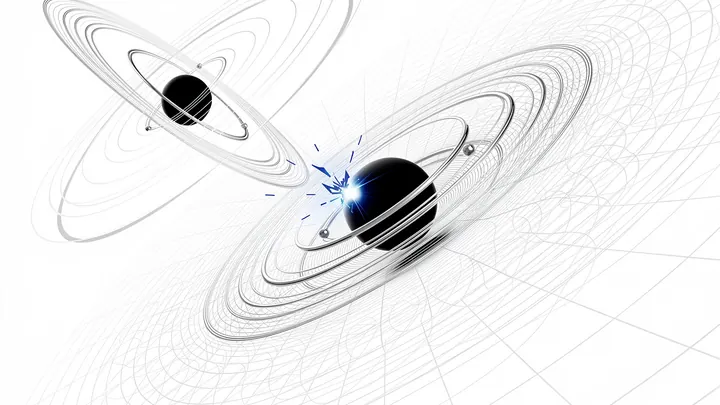
As they approach, two galaxies experience gravitational interaction according to the law of universal gravitation. Tidal forces pull long tails from them, dynamical friction slows their orbital motion, and the components merge after several passes. Gas, unlike stars, undergoes hydrodynamic shocks, cools, and compresses, forming dense clouds from which new stars are born. Central supermassive black holes approach each other to distances where gravitational wave emission (per general relativity) dominates and they coalesce. The process is described by equations of motion of matter in an expanding Universe, with dark matter playing a key role via the gravitational potential of halos.
In practice
Understanding mergers helps predict the future of our Galaxy, which will collide with the Andromeda Nebula in 4 billion years, and explains the diversity of galaxy shapes.
Fun fact
When two spiral galaxies merge, an elliptical galaxy is often born, and the central supermassive black holes also merge, emitting powerful gravitational waves.
An old city gains new suburbs. In the center, narrow streets where life has nearly stopped, while on the outskirts construction is booming. That is what a spiral galaxy looks like when its core stars have long aged and new stars are still being born in the outer disk.
The night sky seems unchanging, but galaxies constantly exchange matter. The Milky Way, like a great river, absorbs smaller streams — dwarf galaxies. Along with their stars, planets may also come to us.
Two black holes circle in a cosmic dance, spiraling closer together. In the end, they merge into one, and that moment unleashes a powerful burst of gravitational waves, ripples in spacetime itself. But what remains after the merger?
A galaxy collision is like a slow dance in which two partners gradually draw closer. Hidden at the center of each is a supermassive black hole — an invisible flywheel with a mass of millions or billions of suns.
In the galaxy NGC 1052 DF2, stars move at only 8 kilometers per second, as if there were no invisible mass around. For comparison: in our Milky Way, outlying stars accelerate to 200 kilometers per second, held by a massive dark matter halo.
Layer by layer, artifact by artifact — an archaeologist reconstructs the history of an ancient settlement. Similarly, astrophysicists sifting through 259 records from LIGO–Virgo–KAGRA saw a clear layered structure among merging black holes.
Two cities endure a series of fires. In one, the wind carries ash far beyond the outskirts, leaving the sky clear. In the other, ash settles as a dense veil, painting sunsets crimson. Roughly the same thing, just on a galactic scale, happens with supernova explosions, the final flares of massive stars.
A galactic disk is like a frozen ripple on water: every disturbance leaves a trace that can be read billions of years later. When a dwarf satellite galaxy flies past or a head-on merger occurs, stars in the disk start to oscillate, like bobbers rocked by a wave.
In a single star system, two teams of planets orbit. Some follow neat paths, like figure skaters on an ice rink, avoiding collisions. Others crowd together, their trajectories cross, and sooner or later a cosmic accident occurs — a giant impact.
It takes the stellar pair J05+50 nearly two months to complete one orbit around their common center. From Earth, it appears as a faint point in the constellation Hercules — 4625 parsecs away. Photometry of the binary star only captures a steady flicker of brightness, like the pulse of a giant heart.
It takes the stellar pair J05+50 nearly two months to complete one orbit around their common center. From Earth, it appears as a faint point in the constellation Hercules — 4625 parsecs away. Photometry of the binary star only captures a steady flicker of brightness, like the pulse of a giant heart.
The formation of the Milky Way is a grand cosmic performance, in which mergers of satellite galaxies were woven into a single score. Each event left a trace in the dynamics and chemical composition of stars, much like notes capture the composer's intent.
The universe rewrites its history again and again. Where ordinary astronomy sees only a point, a black hole, gravitational waves peel back thin layers of the past, like an ancient palimpsest. The idea that black holes can grow by devouring each other, and their offspring can enter new unions, has been discussed by astrophysicists for half a century.
Imagine an ancient manuscript, where a new story is written over an old text. Over time, the upper layer wears thin, and lines of the past show through. That’s exactly how globular clusters, the oldest stellar systems in the Universe, are structured, like a palimpsest.
At the heart of almost every galaxy slumbers a supermassive black hole — the invisible conductor of a stellar orchestra. When galaxies collide, their central monsters draw closer, entwining in a gravitational dance. Sometimes a third partner joins the duo, and then a triple waltz begins, its outcome unpredictable.
The cosmos sets its own lenses in the path of gravitational waves. When two black holes merge, the resulting ripple travels through the universe. If it encounters a massive galaxy cluster along the way, its gravity bends the path of the waves — much like glass focuses light.
At the center of a tiny galaxy lies a dense clump of stars and dark matter. This clump, called a soliton, is not frozen in place: it quivers and oscillates like jelly on a plate.
Gravitational-wave detectors picked up a strange burst — the signal GW241011. Two black holes merged, but the pair looked unusual: one hole was about three times lighter than the other, and the system as a whole was spinning rapidly. Such a combination is a rare guest in the catalogs.
The birth of planets resembles the workings of a cosmic forge. Rocky blocks collide and fuse together. A powerful impact strikes a spark — material heats to white-hot and glows like cooling metal. Computer simulations show: the flash is visible from days to years, peaking at a tenth of the sun's light.
In the boundless night of space, galaxies come together in a slow gravitational dance, merging into one. Such collisions are not head-on impacts but rather like fingers moving slowly through water, leaving swirls and tails behind.
Lenticular galaxies are the cosmic quiet types: they have a disk but no bright spiral arms. For a long time, their origin remained a mystery. A team of scientists ran the Hydrangea computer simulation and traced the fate of each galaxy from its youth to the present day.
On the mass–size diagram, these galaxies line up in a V shape.
LIGO and Virgo detectors catch ripples in spacetime, but some signals force us to rewrite the scripts of stellar death. GW190814 — the merger of a black hole of 23 solar masses with a compact object of 2.6 solar masses — is a discordant chord in the symphony of standard models.
A vast city lights new streetlamps every night. But then a hurricane sweeps in, rips all the fuel from the warehouses, and the lamps go out one by one. Something similar has been spotted by astronomers in a galaxy whose light has traveled 12.5 billion years to reach us.
The stellar halo of the Milky Way is a galactic palimpsest: an ancient manuscript where earlier layers lie hidden beneath the visible text. For a long time, the Gaia-Sausage-Enceladus (GSE) structure was thought to be the final entry in this manuscript, the scar of a single catastrophic merger.
Detectors pick up the “ripples” of gravitational waves from mergers of black holes or neutron stars — like an echo from the kitchen where a cosmic dish was being prepared. Astronomers are trying to reconstruct the recipe: how two massive stars turned into an exotic pair and collided.
The stellar halo of the Milky Way is a galactic palimpsest: an ancient manuscript where earlier layers lie hidden beneath the visible text. For a long time, the Gaia-Sausage-Enceladus (GSE) structure was thought to be the final entry in this manuscript, the scar of a single catastrophic merger.
A street where houses have just been built. Some shine with clean windows, others are covered in construction dust. That's roughly what galaxies looked like when the universe was only a few hundred million years old. The new James Webb telescope peered into that era and saw dozens of bright star islands.
A distant galaxy always looks redder than it really is. That's the work of cosmic dust — tiny solid particles that scatter blue light more than red, like haze at sunset. Astronomers measured this effect for tens of thousands of galaxies using two powerful instruments.
Usually, black holes inch closer gradually, circling in a tightening spiral. This dance births a long ripple of gravitational waves — a tremor in the very fabric of spacetime. Detectors LIGO and Virgo routinely catch such mergers.
But GW190521 is the exception.
Two black holes smash head-on at full speed — while a third one circles nearby. In ordinary life, such a crash would produce a burst of gravitational waves (ripples in space, like the ripples from a stone thrown into a pond). But here, part of the ripple passes by the massive neighbor, and changes, like light in a funhouse mirror.
An artist paints a portrait stroke by stroke, and then someone offers them a flash camera — one click, and it's done. That's roughly the shift from multi-step models to one-step models in generating images of galaxies.
Typical neural networks for image synthesis work like a watercolorist: they apply a layer, blur it, add details.
Two stars circle each other like dancers in a slow waltz. This dance is not eternal: the partners gradually draw closer until they collide and merge into a single entity. At that very moment, a red nova is born — a flash that lights up the sky for a few weeks, then slowly fades, enveloped in a dense cloud of dust.
When a neutron star and a black hole merge, they send out gravitational waves — ripples in spacetime that reach Earth. These ripples carry the imprint of their final dance: the orbit before the collision is often elongated, like an ellipse.
Giant galaxy clusters are cities of thousands of star islands, held together by gravity. Inside them, hot gas churns and glows in X-rays. If a cluster has recently collided with another, it develops clumps of galaxies and distortions in the gas, like ripples on water after a stone is thrown.
Two neutron stars spiral closer together, about to merge in an instant. Their dance lasts fractions of a second, but just before the finale, one star plows into the other's magnetic envelope, like a swimmer cutting through water, kicking up waves. At that moment, a complex system of currents is born, carrying energy away.
There is something wildly generous about a garden where the first flowers don't just bloom but immediately scatter their seeds far beyond the fence. Something similar was happening in the young universe.
A galaxy is like a glowing pancake studded with stars. If you look at it face-on, you see everything at once — both the bright spiral arms and the dark dust lanes. But tilt the pancake, and the picture changes: layers overlap, light blends together. This very effect, it turns out, creates the illusion of a tight link between radio and gamma-ray emission in distant star systems.
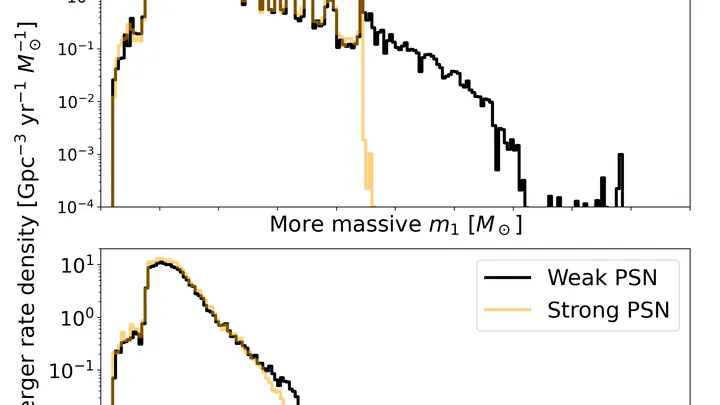
The latest crop of gravitational waves brought a puzzle. The LIGO, Virgo, and KAGRA detectors caught dozens of signals from merging black holes, and the mass plot shows a glaring gap: objects heavier than 45 Suns are almost absent, and the few that exist spin suspiciously fast. Some say giant stars explode too 'cleanly,' leaving nothing behind.
A fisherman's net is stretched across the depths of space. When a massive star dies, it leaves behind a black hole — a sinker in this net. Usually, such sinkers weigh from a few to tens of suns.
In the distant universe, when it was just a couple of billion years old, many galaxies resembled boiling cauldrons: gas clumped so quickly that stars ignited one after another, and dust heated up and shone brightly in the submillimeter range.