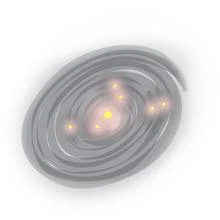
A galactic disk is the flattened, rotating region of a spiral galaxy where most of its gas, dust, and stars reside. This structure is a defining feature of spiral galaxies like the Milky Way, containing the spiral arms, star-forming regions, and the majority of the galaxy's luminous matter. The disk is not a solid object but a dynamic system of stars and interstellar matter orbiting the galactic center, with the Sun located within one of its spiral arms.
History
The recognition of the galactic disk as a distinct structure dates back to the 18th century, when astronomers like William Herschel mapped the Milky Way and noted its flattened shape. The modern understanding of disk dynamics and spiral structure developed in the 20th century with the work of Bertil Lindblad and others.
How it works
The disk forms from the collapse of a large cloud of gas and dust, which conserves angular momentum, causing it to flatten into a rotating plane. Within this disk, gravitational instabilities and density waves trigger star formation, creating the spiral arms. The disk's structure is influenced by the gravitational pull of the dark matter halo, which surrounds the galaxy and affects the rotation curve — the speed at which stars orbit the center. Recent studies suggest that the shape and thickness of the disk can also influence the distribution of dark matter, potentially explaining some observed discrepancies in its density.
In practice
Understanding galactic disks is crucial for studying galaxy formation and evolution, as well as for interpreting observations of distant galaxies, which often appear as disks in high-resolution images.
Fun fact
The Sun takes about 230 million years to complete one orbit around the center of the Milky Way, a period known as a galactic year.
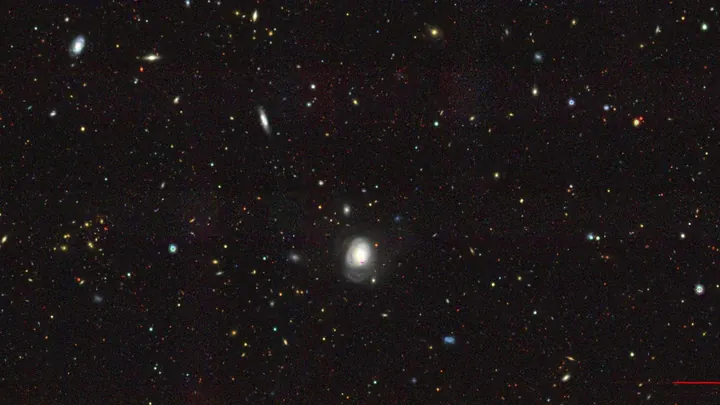
Faint galaxies scattered across the Perseus cluster are like ghosts among their bright neighbors. They are so diffuse that distant objects shine through them, and they contain hundreds of times fewer stars than our Milky Way.
A galaxy is like a city: bright lights and dense buildings at the center, sparse lights and emptiness toward the outskirts. But if you watch how gas rotates in a galaxy's disk, you see that its speed barely drops at the edges. As if invisible neighborhoods keep the motion going. Astronomers have found a way to map this invisible city.
A galactic disk is like a frozen ripple on water: every disturbance leaves a trace that can be read billions of years later. When a dwarf satellite galaxy flies past or a head-on merger occurs, stars in the disk start to oscillate, like bobbers rocked by a wave.
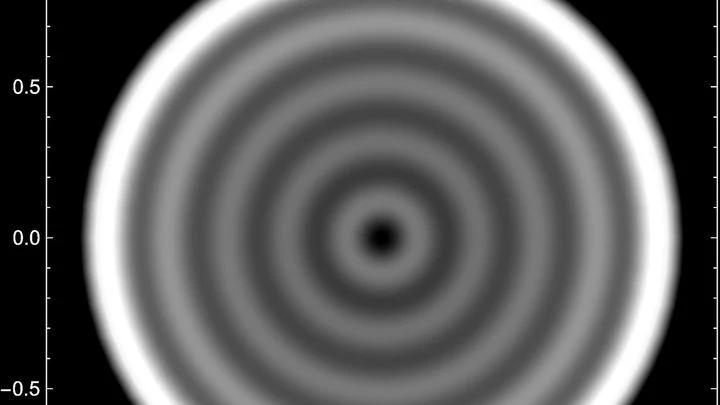
Dim the lights. The stage belongs to a shadow theater, with just r puppeteers, but the screen obeys the laws of hyperbolic geometry. Every wave of the hand births a pattern that mathematicians call a discrete group of isometries.
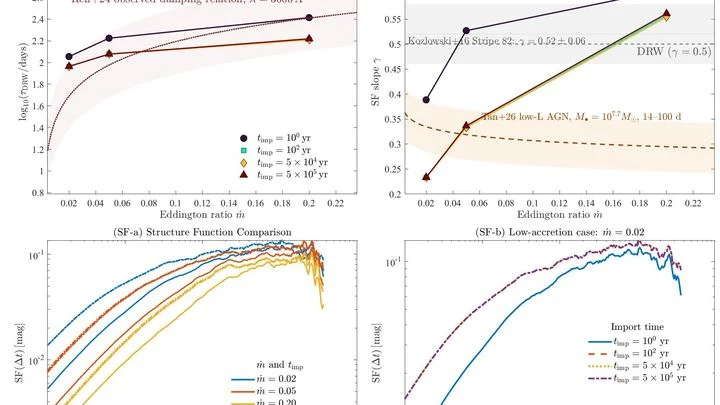
At the heart of nearly every large galaxy shines an active nucleus — a supermassive black hole surrounded by a flat, rotating disk of incandescent gas. The disk itself flickers, but astrophysicists suspect that within it lurks a whole swarm of small, stellar-mass black holes.
At the center of almost every large galaxy lurks something supermassive and dark. Most often, that something is thought to be a black hole — a region where gravity is so strong that even light cannot escape. But what if it's not a black hole, but a dense ball of ultralight particles — a boson star?
A distant city seen through a fogged-up window: bright lights blur, details are lost. That's roughly how astronomers see gas with magnesium ions (magnesium) in our galaxy — the strongest spectral lines "peg the needle," preventing us from knowing how much material is really there.
On a playground, a merry-go-round has just been set spinning. In the first moments, kids are still crowding, grabbing the rails, and the overall picture is chaos. But a couple of seconds later, centrifugal force lines them up in a circle, giving the motion a clear shape.
A guitar string only sounds at certain notes, when pressed at the frets. So it is with the gas-dust disk around a young star: it's shot through with standing waves, but only chosen oscillations survive. Where the wave crests, cosmic dust and hydrogen collect, and later exoplanets are born.
Previously, astronomers calculated galaxy mass as if they were perfect spheres. But a galaxy is a flat pancake. The new 'Lost and Found' model takes the actual shape into account: it sums up the gravitational pull from all parts of the disk, not just the central bulge. The result is stunning: many galaxies need a third less invisible dark matter than previously thought.
Through a telescope, you can see a galaxy that looks like a giant glowing pinwheel. Its disk stretches thirty thousand light-years across — a third of the diameter of our Milky Way. But the most astonishing part: this pinwheel already existed just two billion years after the birth of the universe.
In a constellation where new stars are born, one of them behaves like a faulty lightbulb: sometimes shining steadily, sometimes dimming by a factor of several. Astronomers have been monitoring the star Gaia-GIC-1 for several years and now understand that its blinking is the shadow of a huge dust cloud that periodically passes in front of it.
For a long time, astrophysics was dominated by the belief that giant jets of radio emission, radio outbursts blasting from central regions, were the exclusive privilege of elliptical galaxies. It was thought that only their calm, featureless internal environment could allow such colossal fountains of energy, powered by supermassive black holes, to form.
In the dense core of the globular cluster NGC 6397, where stars jostle like commuters at rush hour, astronomers have spotted a peculiar pair. One star is a white dwarf with a surface temperature of 16,000 K, the scorched remnant of a star that has been cooling for billions of years, and circling it is an unseen companion.
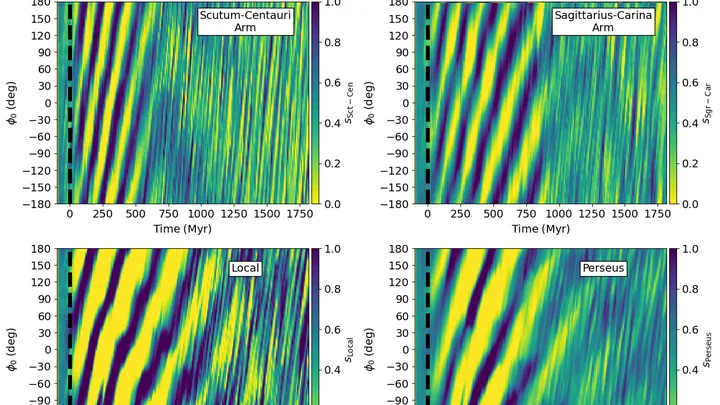
The Sagittarius galaxy plunged into the disk of the Milky Way and passed through again and again, like a stone thrown into a still pond. Each strike left ripples: waves and warps in the star field.
Around young stars, disks of gas and dust swirl: these are the construction sites for future planets. In the binary system HD 142527, such a disk is especially intriguing. Astronomers aimed three instruments working in the infrared range (thermal emission from dust) at it and saw a surprising picture.
Imagine a city map where streets are replaced by car speeds and buildings by the metal content of stars. Such a map can tell you where the center is and where the outskirts are, even without knowing exact distances. This is precisely the approach astronomers took with our Galaxy, using longitude–velocity (ℓ–v) diagrams.
The Sun doesn't rotate as a solid body: its equator spins faster than its poles. This difference in rotation speed creates layers that move at different speeds, like ocean currents at different depths.
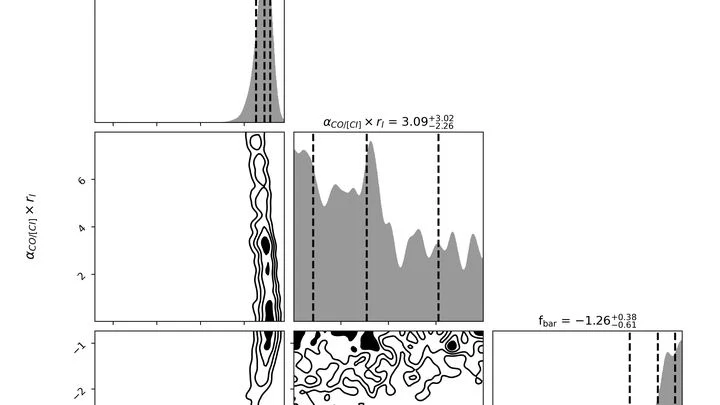
Three distant galaxies spin like giant carousels. Their stars and gas move along spiral arms, and from the speed of this motion you can calculate how much total matter the galaxy contains — visible and invisible.
Astronomers combined two views: radio telescopes revealed cold gas, while the James Webb Space Telescope showed the stars.
In the dark cloud NGC 6334I-North, 5500 light-years from Earth, the ALMA radio interferometer spotted something unexpected: around a young massive star, a disk of gas and dust is swirling, and inside it are seven dense clumps. Each one could become a star. This is what the birth of a stellar family looks like, and an unusually large one at that.