Metallicity — the fraction of a star's mass that is made of elements heavier than hydrogen and helium — is a master variable in astrophysics. It controls how efficiently gas cools, how easily magnetic fields couple to matter, and how massive stars can become. Low-metallicity gas is less able to radiate away heat, so it tends to form fewer but more massive stars, while metal-rich gas fragments more readily into smaller stars. This is why metallicity is central to understanding star formation, the initial mass function, and the chemical enrichment of galaxies over cosmic time.
History
The concept of metallicity in stars was established in the mid-20th century, notably by Walter Baade who distinguished Population I (metal-rich) and Population II (metal-poor) stars. The quantitative study of how metallicity affects star formation gained momentum in the 1980s and 1990s with theoretical work by researchers like Bruce Elmegreen and later with large surveys.
How it works
Metals act as coolants: they have many atomic transitions at low temperatures, so when a gas cloud is compressed, metals radiate away the heat, allowing the cloud to collapse further and fragment. In metal-poor environments, the gas stays hotter and more turbulent, suppressing fragmentation and leading to a top-heavy stellar population. Conversely, in metal-rich regions like the present-day Milky Way disk, the gas cools efficiently and produces a normal mix of stars. Observations of dwarf galaxies with extremely low metallicity, as in the title about 'fossil stars', show that star formation proceeds differently there, often producing very massive stars that end their lives as pair-instability supernovae.
In practice
Metallicity measurements are used to date stellar populations, to trace the chemical evolution of galaxies, and to identify prime targets for exoplanet searches, since metal-rich stars are more likely to host giant planets.
Fun fact
The title about 'dwarf stars disappearing in metal-poor clouds' refers to a real puzzle: in very low-metallicity environments, low-mass stars are so rare that they seem to vanish, suggesting that the first generations of stars were almost all extremely massive.
A thin film of neodymium nickelate, fifteen nanometers thick, sits on a neodymium gallate substrate. Below one hundred eighty kelvin it behaves as an insulator: electrons are locked inside their atomic cells and cannot move freely.
A harbor lives by the tide schedule. Water rises and falls, and with it everything changes: the level at the dock, the composition of the sediment on the bottom, even the salinity in the far corners. A galaxy works similarly, except instead of water it has gas, and instead of the Moon, it has its own stars and neighboring clouds.
In a distant galaxy, light from hot gas should reveal its composition. The James Webb Telescope split that light into a spectrum, and astronomers saw: oxygen lines too weak.
In 1,433 pairs of galaxies scattered across the sky, astronomers noticed an unusual pattern. Neighbors located 'above' or 'below' a massive stellar system contain up to a quarter more oxygen than those lying in the plane of its disk.
Two hundred and eighty-nine days: that's how long one rotation of the white dwarf white dwarf WD 1532+129 takes. This is not just a record: on its surface, near the magnetic poles, scars of iron and other metals appear — silent testimony to planets it has devoured.
Boiling water in a pot is a good place to start. Bubbles of steam rise, pop, and the surface settles down. Something similar might have happened in the first moments of the universe's life with a special field filling space: bubbles of a new phase inflated and collided, like islands of steam in liquid.
For thirteen billion years, light battled through cosmic emptiness. It bent around massive galaxy clusters that, as Einstein predicted, acted as giant lenses — amplifying and distorting the distant glow. In 2023, the NIRSpec instrument on the James Webb Space Telescope captured this light and spread it into spectra.
A star's age is the key to the galaxy's history. But prying that key from nature is no simple task: unlike a tree, a star doesn't grow annual rings. Yet, its atmosphere holds a chemical code — the ratio of elements that slowly shifted as generations of stars died and new ones were born.
The Orion Nebula is a showcase of astrophysics, a laboratory for studying star formation right in our backyard. For over a century, its light has been split into spectra, and each forbidden line whispers its own version of how many electrons per cubic centimeter.
Neutron stars — remnants of supernovae — are among the densest objects in the Universe. Their central density exceeds nuclear density many times over, and gravity is surpassed only by black holes.
A sub-Neptune is a planet that falls between Earth and Neptune in size. These worlds are abundant in our galaxy, but their internal structure has been hotly debated. New research shows that in their youth, these planets behave like a sponge soaked with water.
At the center of attention are tiny stellar cities: ultra-faint dwarf galaxies. They resemble sparse swarms of fireflies circling within a vast invisible cloud. This cloud is a halo of ultralight dark matter. Its particles are so light that they behave not like billiard balls but like waves.
A planet the size of Neptune, but glowing white-hot. Beneath the clouds lies an ocean of magma capable of absorbing an entire hydrogen atmosphere. The new SEAMIST model is the first to trace how such dissolution changes a planet's fate from birth to old age.
The big surprise is the mechanism of catastrophic boiling.
Elliptical galaxies are quiet stellar metropolises in retirement. By all rights, their light should be calm, reddish, like a sunset. But their spectra scream otherwise: in the far ultraviolet, these old-timers blaze like holiday lights. For three decades, astronomers have puzzled over this 'ultraviolet upturn' (UV upturn).
A galaxy is like a cosmic highway where stars, like cars, race along circular orbits. Their speed is set by the invisible "cargo" of mass enclosed within the orbit: the more massive the central region, the faster the stars at the periphery.
A chef pours hot sugar syrup onto a cold table, and it sets into crystals. That's roughly how engineers pictured metal solidification: the liquid instantly becomes a scatter of crystalline grains. But close-up imaging revealed an extra stage wedged between liquid and solid.
There is something wildly generous about a garden where the first flowers don't just bloom but immediately scatter their seeds far beyond the fence. Something similar was happening in the young universe.
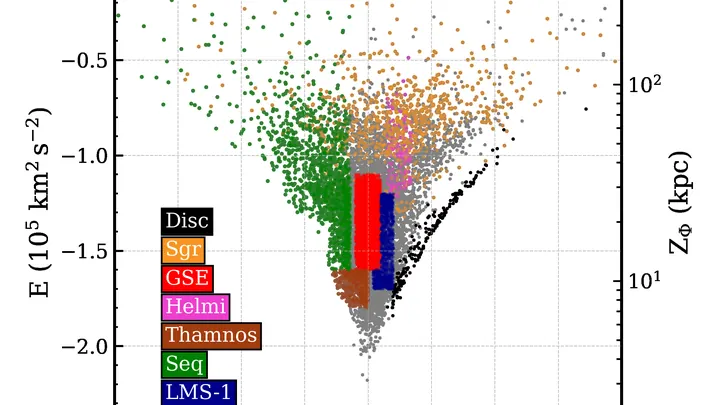
The halo of our Galaxy is a huge, sparse cloud of old stars that envelops the familiar disk. It holds the story of how the Milky Way grew by gobbling up neighboring dwarf galaxies.
The Red Planet is surrounded by the rubble of failed worlds — rocky boulders stuffed with metal. Shipping a kilogram of steel from Earth to Mars costs as much as several cars. It's far cheaper to pick up space junk right in orbit.
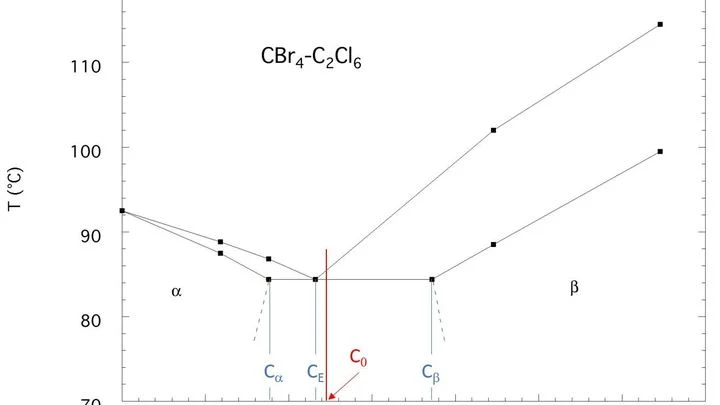
In a solid piece of tin-lead alloy, the layers of the two metals lie like pages in a book. When heated from one side, the layers don't melt uniformly but in whimsical tongues and fingers. Scientists studied this process using a transparent alloy that can be seen through under a microscope and compared it with a computer model.
Lithium is like a thermometer dipped into a star's interior. This light element is destroyed at temperatures around 2.5 million degrees, so its abundance on the surface tells us how deeply the star's material has been mixed.
Two very small, cool stars, similar to the famous TRAPPIST-1, reside in the young Upper Scorpius star cluster. They are only 5–10 million years old — by cosmic standards, mere infants. Each is surrounded by a disk of gas and dust from which planets may eventually assemble.
Ancient stars, nearly devoid of heavy elements, are like fossilized remnants of the first cosmic flashes. For a long time, the odd ratio of carbon, hydrogen, and helium in three such stars was thought to require a hypernova — an ultra-bright supernova with hundreds of times more energy than a regular one.
In the mid-20th century, astronomer Vera Rubin discovered that stars on the outskirts of galaxies were moving too fast — held by an invisible mass. Thus the mystery of dark matter was born. It doesn’t emit light but reveals itself through gravity. The big question: why is there exactly as much as we see?
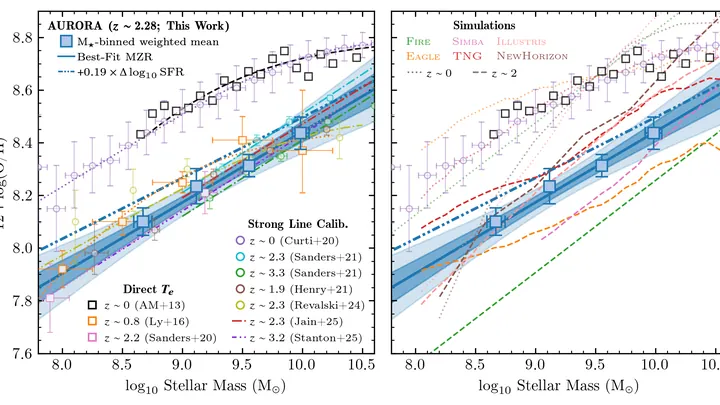
The gas in a galaxy glows like a neon sign, and by the color of that glow, astronomers can tell how hot it is. The logic is simple: the more heavy elements (which astronomers call metals) in the gas, the better it cools. So galaxies rich in metals should have cooler gas. But new observations show the opposite.
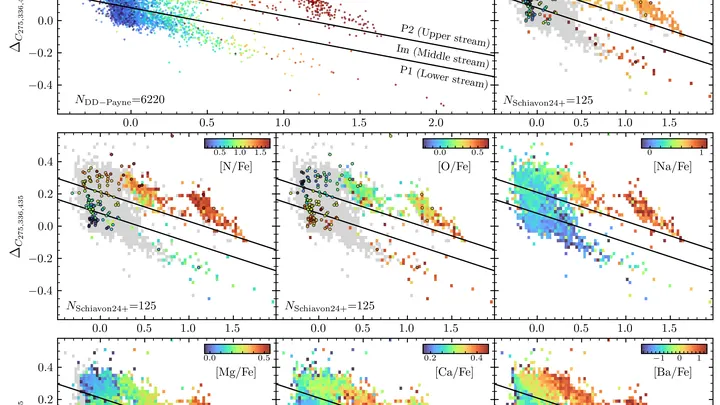
At the heart of Omega Centauri, the most massive globular cluster in our Galaxy, thousands of stars are packed so tightly that their light merges into a single glowing blob when seen from Earth. Separating this swarm into individual stars and determining the composition of each is a task akin to sorting through an overfilled anthill.
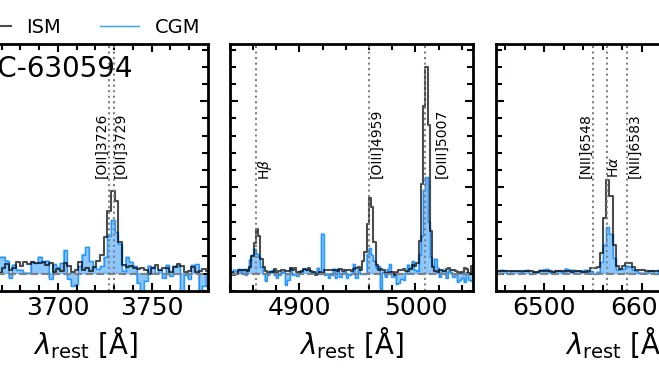
The kitchen of a distant galaxy isn't limited to its bright disk. Around every star system, there's an invisible cloud of gas, like steam above a pot of soup. Astronomers peeked into this steam around galaxies that appear as they were just one and a half billion years after the Big Bang.
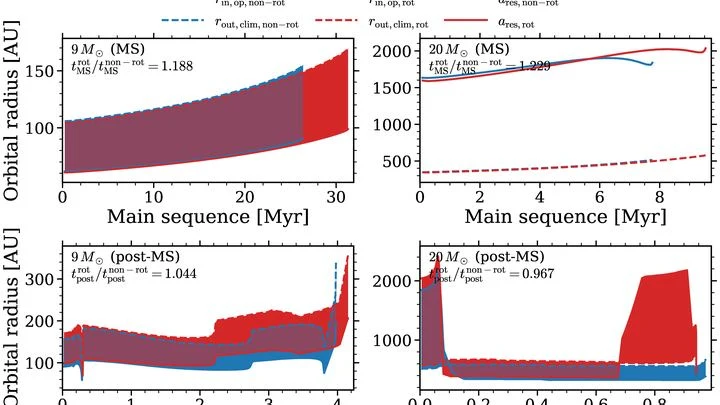
A star nine times heavier than the Sun ignites a zone around it where liquid water could slosh on a planet's surface. But this zone is like a narrow strip of beach at low tide: it will vanish in 30 million years. Such stars live bright and die young, leaving life no time for the long journey from microbes to complex beings.
Young stars are surrounded by disks of gas and dust, like construction sites for future planets. From this material, rocky worlds and gas giants will eventually assemble. So the chemical composition of the disk directly determines what the planets will be like.
Imagine a city map where streets are replaced by car speeds and buildings by the metal content of stars. Such a map can tell you where the center is and where the outskirts are, even without knowing exact distances. This is precisely the approach astronomers took with our Galaxy, using longitude–velocity (ℓ–v) diagrams.
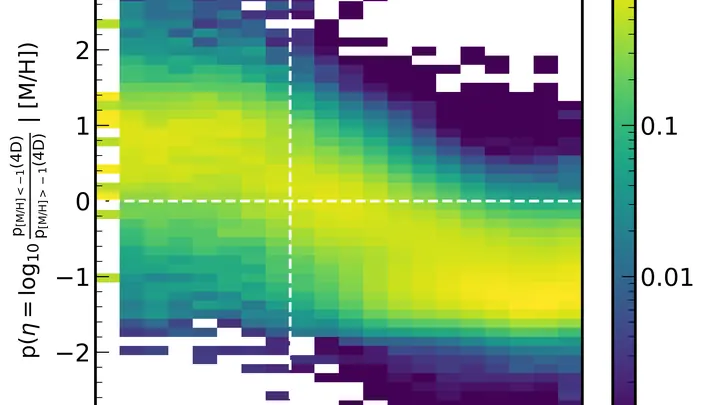
The galaxy's kitchen has a recipe for stellar soup. The main ingredient is hydrogen, but the flavor depends on a pinch of metals. Astronomers have now peered into the pots where that pinch is almost absent, and found that the smallest stars are missing.
The classic BCS theory of superconductivity, developed by John Bardeen, Leon Cooper, and Robert Schrieffer, describes the mechanism by which electrons pair up into Cooper pairs and move without resistance.
In the Large Magellanic Cloud, a galaxy that orbits our Milky Way, astronomers have caught five stars that look like fossils from the very distant past. They contain almost no metals, only one-hundredth to one-thousandth of what the Sun has, but they have tens of times more carbon.
A red giant is like a balloon slowly letting out gas. The star swells, its outer layers weaken, and stellar wind carries mass into space. But exactly how much does a star lose? This is a crucial question: the answer determines what kind of remnant it will leave behind — a white dwarf, a neutron star, or a black hole.
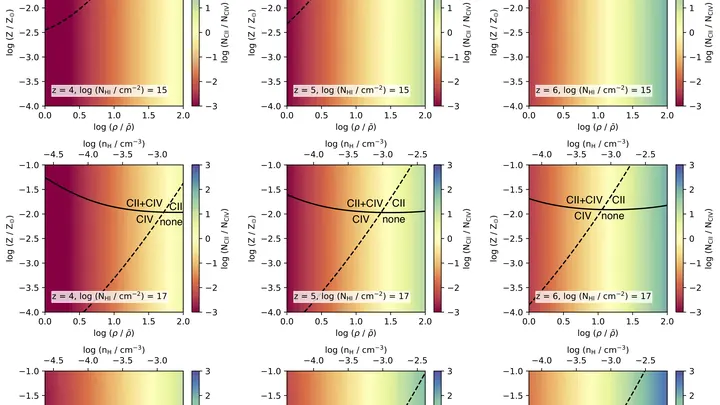
When the universe was less than a billion years old, it resembled a thick fog: ultraviolet light could not travel far because interstellar gas absorbed it. But gradually, as the first stars and galaxies were born, the fog lifted — a process known as the epoch of reionization. Astronomers want to understand exactly how this happened.
The James Webb Space Telescope is watching TRAPPIST-1—a tiny red dwarf with seven Earth-sized planets in orbit. And it sees something unusual: bright flares on this star barely reach 3500–4000 degrees. For comparison, a typical solar flare heats up to 9000–10000 degrees.
Galaxies are like giant kitchens where, in stellar cores, light atoms are fused into heavy ones — much like flour and water becoming bread. When a star dies, it spills its accumulated riches into the interstellar gas, seasoning it with 'spices': oxygen, carbon, iron.
Lunar rocks brought a puzzle: their age is 4.35 billion years, but the Moon itself should have appeared 150 million years earlier. The missing time is hidden in tidal heating. When the Moon hung closer to Earth, Earth's gravity acted like tireless hands: it constantly kneaded and bent the satellite.
In the stream of cosmic rays, particles flying toward us from the depths of the Galaxy, titanium is rare. Its nuclei are almost indistinguishable from iron: both are heavy, and both leave similar tracks in detectors.