Stellar motion refers to the movement of stars within a galaxy, which can be broadly classified as ordered or chaotic. Ordered motion includes the coherent rotation of disk stars around the galactic center, while chaotic motion arises from gravitational interactions with other stars, gas clouds, or the galaxy's non-axisymmetric potential. The study of stellar kinematics — the distribution of velocities and orbits — reveals the mass distribution of a galaxy, including the presence of dark matter, and the dynamical history of galactic structures.
History
The systematic study of stellar motion began in the early 20th century with the work of Jacobus Kapteyn and James Jeans, who developed the statistical methods for analyzing stellar velocities. The concept of dark matter emerged from Fritz Zwicky's 1933 observations of galaxy cluster motions, later reinforced by Vera Rubin's rotation curve measurements in the 1970s.
How it works
Stars move under the influence of the galaxy's gravitational potential, which is set by all matter — visible and dark. By measuring the positions and velocities of many stars (via astrometry and spectroscopy), astronomers construct velocity dispersion profiles and rotation curves. Deviations from expected Keplerian motion indicate unseen mass, such as dark matter halos. Chaotic motion, on the other hand, arises from resonances and perturbations, and can be studied using orbital dynamics and phase-space analysis.
In practice
Stellar motion is used to map the Milky Way's structure, trace the distribution of dark matter, and detect the gravitational influence of supermassive black holes at galactic centers.
Fun fact
The Sun orbits the Milky Way at about 230 kilometers per second, yet it takes roughly 230 million years to complete one full revolution — meaning the Sun has made about 20 orbits since its birth.
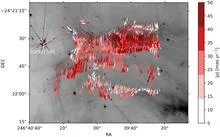
The cloud L1688 in the constellation Ophiuchus resembles a dance floor where partners don't always hold hands. Astronomers have long assumed that gas in molecular clouds moves together with the young stars born within them.
A galaxy is like a city: bright lights and dense buildings at the center, sparse lights and emptiness toward the outskirts. But if you watch how gas rotates in a galaxy's disk, you see that its speed barely drops at the edges. As if invisible neighborhoods keep the motion going. Astronomers have found a way to map this invisible city.
A sunspot, a dark island on the fiery surface, lives its own turbulent life. Beneath it, in invisible depths, giant magnetic loops drift like twisted cables. When such a loop emerges, it can discharge as a flare, and hurl clouds of charged particles into space.
Scientists have long tried to understand what determines the strength and suddenness of these events.
A weather forecaster draws a thick black line across Europe: north of it, frost; south, a thaw. That boundary, the zero isotherm, won't tell you the temperature in Stockholm or Rome, but it honestly marks where winter ends. In recent cosmology, a map has emerged where a similar frontier can be drawn.
Cosmic rays do not travel in straight lines. Charged particles accelerated to enormous speeds loop through the Galaxy's magnetic field like dust motes in a gust of wind. It's usually assumed that they simply scatter along and across field lines.
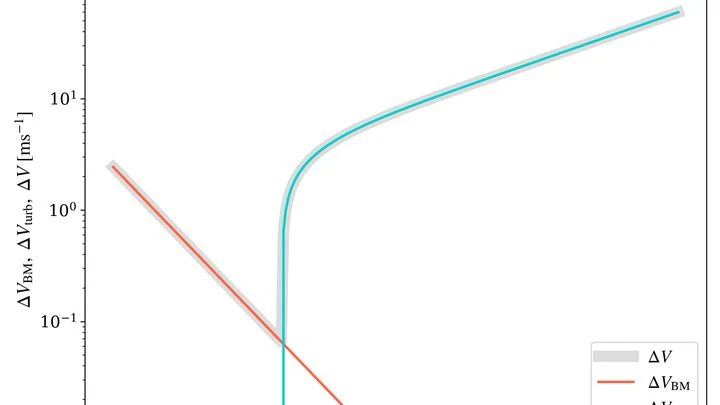
Interstellar space is not a cosmic desert, but a super-fast highway. Trillions of asteroids and comets from other systems race past us, yet camera-telescopes only catch a few. Imagine a night highway: the headlights of a distant car flash brightly, but if it zooms by too fast, the camera shutter can't click in time.
In an orchestra, each musician plays their own part, but at a certain moment all instruments pause on a single note. Cosmic rays behave somewhat like this — particles flying toward us from distant stars.
A galaxy is like a cosmic highway where stars, like cars, race along circular orbits. Their speed is set by the invisible "cargo" of mass enclosed within the orbit: the more massive the central region, the faster the stars at the periphery.
Previously, astronomers calculated galaxy mass as if they were perfect spheres. But a galaxy is a flat pancake. The new 'Lost and Found' model takes the actual shape into account: it sums up the gravitational pull from all parts of the disk, not just the central bulge. The result is stunning: many galaxies need a third less invisible dark matter than previously thought.
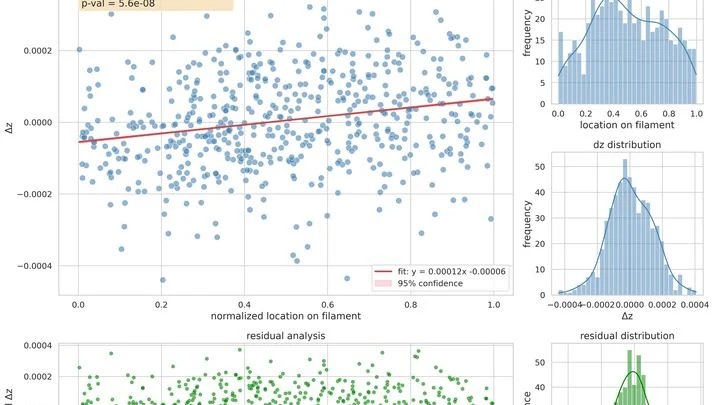
In cold clouds of interstellar gas, long, dense filaments stretch out. Inside them, like overcrowded incubators, future stars are maturing. For a long time, it was thought that within such filaments, everything was governed by gravity: matter smoothly flows toward the centers, where density increases and eventually a star ignites.
At the center of our Galaxy lies a supermassive black hole, with stars orbiting around it. Their motion resembles a cosmic dance: some race along elongated orbits, others follow nearly circular paths. If invisible dark matter exists near the black hole, it slightly distorts these orbits, like an unseen hand nudging a star off course.
In the cold clouds of gas and dust where stars will one day ignite, some atoms have lost electrons and become charged. Charged particles feel the magnetic field, while neutral ones do not, so the charged ones slip through the neutral ones like water through a sieve. Astronomers have measured this drift speed: about a hundred meters per second.
On large scales, the universe resembles a giant spiderweb: bright galaxy clusters are connected by long filaments of galaxies, gas, and dark matter. Previously, it was thought that matter flows along these filaments like water through pipes, heading toward the clusters.
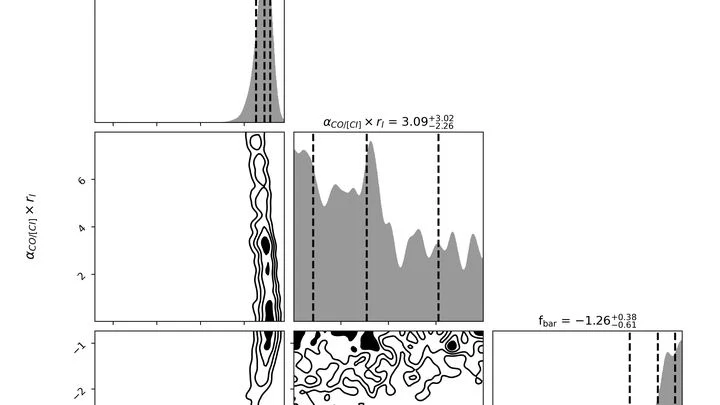
Three distant galaxies spin like giant carousels. Their stars and gas move along spiral arms, and from the speed of this motion you can calculate how much total matter the galaxy contains — visible and invisible.
Astronomers combined two views: radio telescopes revealed cold gas, while the James Webb Space Telescope showed the stars.
Vortons are invisible cosmic hoops, closed loops of curved spacetime. Thinner than an atom but heavier than stars, these Big Bang relics spin like giant carousels, churning everything around them. Einstein's equations describe how particles dance near such a hoop: paths twist into spirals or dart chaotically.
The Milky Way's stellar disk is like a glowing pinwheel, and тёмное вещество is an invisible cloud around it. For the first time, its shape has been precisely measured. Astronomers tracked the motions of millions of stars and built a 3D map of the тёмное гало out to 160,000 light-years.
In 2019, the Event Horizon Telescope gave humanity the first image of a black hole's shadow. Since then, astrophysicists have dreamed of more: seeing how matter moves in the very funnel of spacetime. One of the mysteries is chaos.
The Solar System takes 210 million years to complete one orbit around the center of the Milky Way. The last time we were on this same side of the Galaxy, early dinosaurs were roaming the Earth. That number, 243.72 km/s, has now been refined thanks to rare stars that streak through the Galaxy like cannonballs.