Halos Around Galaxies: Where Is the Missing Oxygen Hiding? express
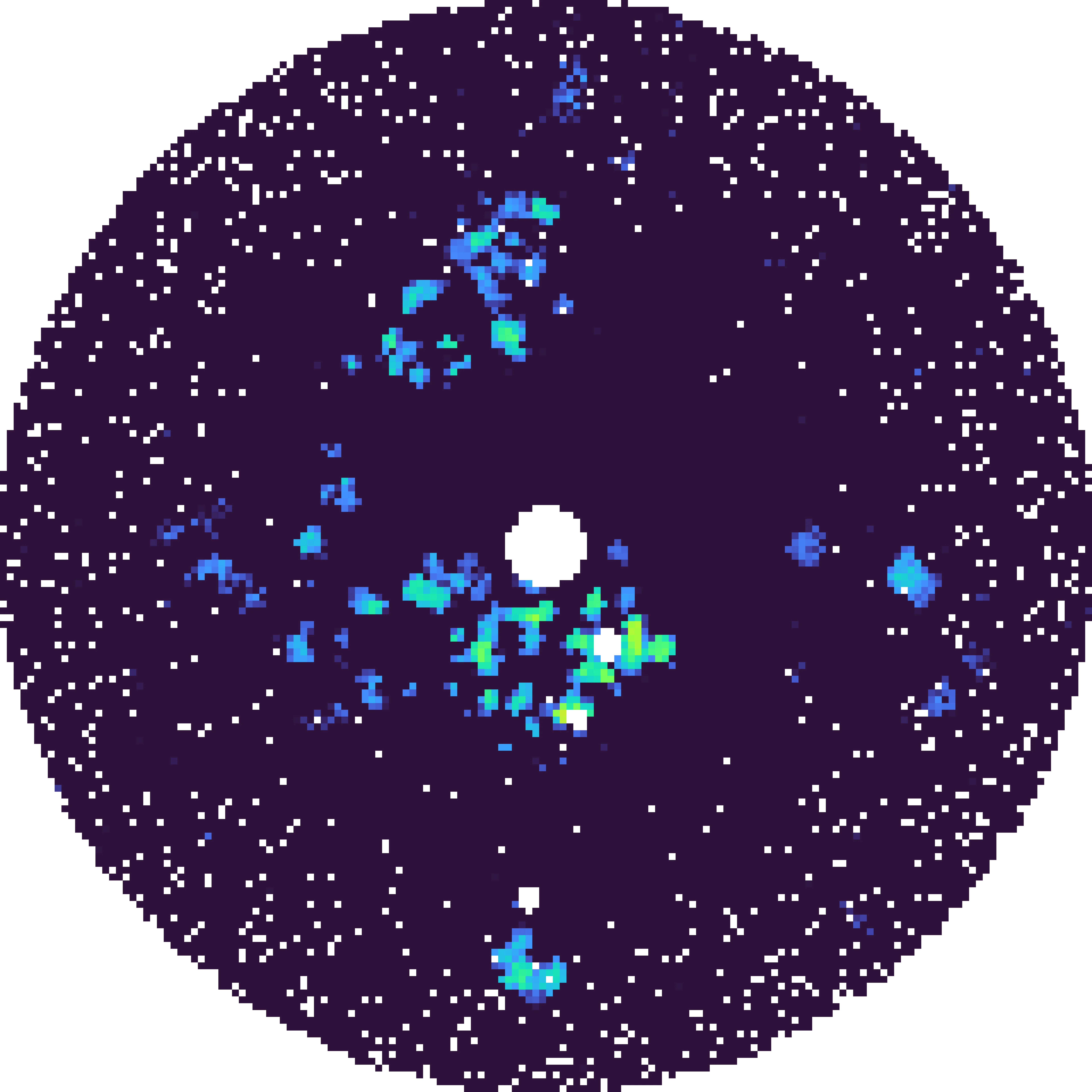
Galaxies don't hang in a void: they're surrounded by tenuous gas, like invisible steam over a pot of soup. This gas contains oxygen ejected by stellar explosions. Astronomers detect it via dark lines in the spectra of distant quasars: oxygen atoms absorb ultraviolet light, creating dips in the rainbow.
Two computer simulations, TNG50 and SIMBA, attempted to reproduce such observations. The researchers took 14 galaxy groups from each simulation, generated 90,000 synthetic spectra, and compared them with data from the COS-IGrM survey. The result: in TNG50, oxygen clouds appeared in 21% of cases, in SIMBA only 6%, but in reality 44%. The simulations clearly underproduce hot gas.
The difference between the simulations hints at where to look for the cause. In TNG50, strong oxygen clouds sit near galaxies with active star formation — meaning they were ejected by supernova explosions. In SIMBA, no such correlation exists. It seems the issue lies in how the simulations model stellar feedback: how strongly stars blow out gas and how fine the details they can resolve.
This isn't just a dispute between two programs. If simulations underestimate the amount of oxygen, then we're missing an important mechanism — how galaxies exchange matter with their environment. This affects their growth, the quenching of star formation, and the entire history of the universe. Now, knowing the discrepancy, scientists can tune the simulations more precisely, and then the steam over the pot won't be so elusive.
Original abstract
as written by the authors arXiv:2604.18808
We compare OVI absorption in synthetic spectra from galaxy groups in the SIMBA and TNG50 cosmological hydrodynamic simulations against those observed from the COS-IGrM survey. We select 14 galaxy groups from each simulation with $$12.89 \le \log(M_{\rm halo}/M_\odot) \le 13.61$$, closely matching COS-IGrM, and create 90,000 synthetic spectra per group. We demonstrate the utility of synthetic absorption spectroscopy when comparing simulations with QSO absorption-based observations. We investigate absorber properties such as radial distributions and kinematics with respect to the group and nearest galaxy. The OVI covering fraction ($$f_{\rm OVI}$$) in TNG50 ($$20.62 \pm 2.56\%$$) and SIMBA ($$5.98 \pm 0.82\%$$) are both systematically lower than COS-IGrM ($$44 \pm 5\%$$). Kinematic analysis reveals that vast majority ($$\sim 95\%$$) of absorbers in both the simulations are gravitationally bound. In TNG50, strong absorbers ($$\log N_{\rm OVI} > 15$$) are located near star-forming galaxies ($$\log {\rm sSFR} > -11$$) within $$\sim 200$$kpc, suggesting physical connection to stellar feedback, whereas SIMBA shows no comparable trend. Furthermore, in TNG50 occurrence of OVI absorbers at small impact parameters increases with stellar mass of nearest galaxy, but shows no dependence on total stellar mass of group. In contrast, SIMBA shows no clear correlation with nearest galaxy's stellar mass, though groups with higher total stellar mass exhibit higher detection rate at larger impact parameters. Differences observed in simulations may arise from feedback models and resolution effects. Finally, we show absorber analysis methodology is important factor when comparing simulations with absorption spectroscopy observations.
Oxygen in intergalactic gas is the 'ash' from explosions of massive stars. So, looking at oxygen absorption lines, we see the traces of supernovae that exploded billions of years ago.