Stellar feedback is the collective influence that stars exert on their surrounding interstellar medium through radiation, stellar winds, and supernova explosions. This process is a fundamental driver of galaxy evolution, regulating star formation rates, shaping the structure of the interstellar medium, and enriching it with heavy elements. Without feedback, galaxies would convert all their gas into stars much faster than observed, so feedback is the key self-regulating mechanism that keeps star formation inefficient.
History
The concept was recognized in the mid-20th century, with early work by Lyman Spitzer and others on supernova remnants. The term 'stellar feedback' became widely used in the 1990s as numerical simulations of galaxy formation required a prescription for this process to match observations.
How it works
Massive stars emit intense ultraviolet radiation that ionizes and heats surrounding gas, creating expanding bubbles. Their fast stellar winds push material outward, and when they explode as supernovae, they inject enormous amounts of energy and momentum into the interstellar medium, compressing gas and triggering or suppressing star formation in different regions. The combined effect of these processes can drive galactic-scale outflows, expelling gas from the galaxy entirely.
In practice
It is essential for accurate simulations of galaxy formation and evolution, and for interpreting observations of star-forming regions and galactic winds in the context of cosmology.
Fun fact
The Lyman-alpha radiation from young stars can be so intense that it literally pushes gas clouds apart, a process that may have played a role in ending the 'cosmic dark ages' and reionizing the universe.
In the first half-billion years after the Big Bang, galaxies grew like crazy. Gas fell in rapidly and collapsed into stars without any resistance. This period is called 'unimpeded star formation.' It's like frying pancakes on a scorching skillet without a lid: splatters fly, but nothing holds them back.
A vast city lights new streetlamps every night. But then a hurricane sweeps in, rips all the fuel from the warehouses, and the lamps go out one by one. Something similar has been spotted by astronomers in a galaxy whose light has traveled 12.5 billion years to reach us.
In the heart of a molecular cloud, a massive star is born. Its ultraviolet light ionizes hydrogen, and the cloud flares in the Lyman-alpha line. But for the photon, this flare is not liberation but imprisonment in a hall of mirrors.
In the heart of the Eagle Nebula, about 7000 light-years away, three giant pillars of gas and dust rise — the Pillars of Creation. Their shape is familiar to many from Hubble Space Telescope images. Now, Webb's infrared camera has allowed us to peer inside these dense cocoons where stars are born.
Two swift streams of charged particles collide, and magnetic field lines begin to tear and reconnect. This process powers solar flares and auroras. It was usually assumed that all particles behave alike, like bullets from the same gun. But each particle has a tiny top: its intrinsic rotation, or spin.
Two neutron stars are two city-sized spheres with the mass of the Sun. As they spiral together, tidal forces stretch each one, as if a giant hand were squeezing and twisting a rugby ball. The star begins to oscillate — density waves run through it, like ripples on water from a thrown stone.
A colony of cells is like a city that grows from its outskirts: new houses appear where there's more space. Inside, it's crowded, and construction stalls. Similarly, cells divide more often at the edge, where neighbors squeeze them less. Scientists modeled this without any chemical commands — only mechanics.
In the model, each cell is a ball that presses on others.
In a blacksmith's forge, a blast of air fans the glowing coals, and shock waves blow bubbles of hot gas. In galaxy centers, a supermassive black hole drives the same process. Its narrow plasma jets, like bellows, punch through the surrounding space and create bubbles visible in X-rays.
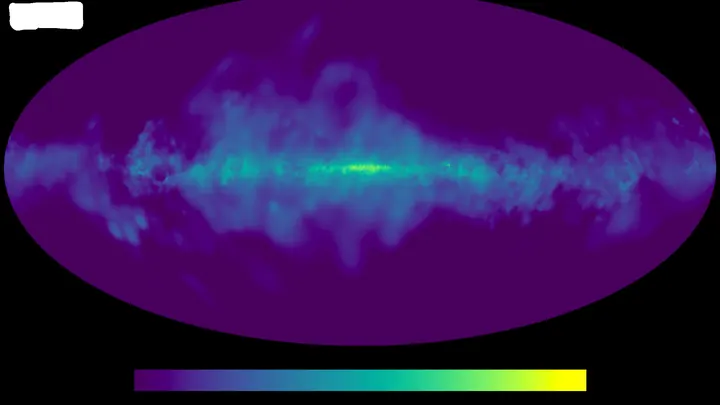
At the center of the Milky Way, a giant stellar cauldron boils. Massive stars are born and die there: each death is a supernova explosion, hurling clouds of charged particles into space.