Quenching refers to any process that reduces or suppresses luminescence, the emission of light from a material after it has absorbed energy. This can occur through various mechanisms, such as energy transfer to other molecules, structural changes in the material, or interactions with defects. Quenching is a critical phenomenon in fields ranging from materials science to biology, as it affects the efficiency of light-emitting devices, fluorescent markers, and even quantum information systems.
History
The concept of quenching has been studied since the early 20th century, with pioneering work by scientists like Francis Perrin and Theodor Förster, who developed theories for energy transfer mechanisms that lead to quenching.
How it works
When a material absorbs energy, its electrons are excited to higher energy states. Normally, they return to the ground state by emitting light (luminescence). Quenching provides alternative pathways for this energy to dissipate without emitting light. For example, in collisional quenching, an excited molecule transfers its energy to a neighboring molecule through collisions, which then releases it as heat. In other cases, structural changes or the presence of impurities can create 'dark' states that trap the energy, preventing light emission.
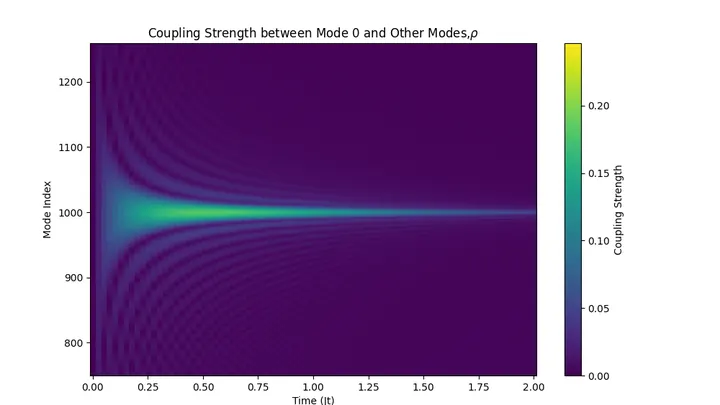
The quantum Mpemba effect, where a hotter system cools faster than a colder one, has been observed in systems where quenching plays a key role in the relaxation dynamics.
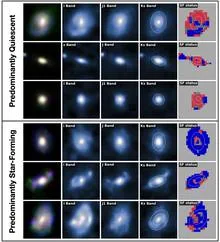
A ground-based image of a distant galaxy looks like a view through frosted glass: the atmosphere smears details, hiding the internal structure. Astronomers have long wanted to know where exactly star formation shuts off in galaxies, but ground-based telescopes could not resolve the subtle color gradients.
A spinning top whirls so fast that the air around it starts to rotate in unison. A black hole behaves in much the same way: if it spins, it can transfer its energy to particles that happen to be nearby. This process is called superradiance: it's like an echo in the mountains, but instead of sound, new particles are born.
In boiling water you can see a prototype of a quantum trick: if part of the liquid turns into long-lived vapor bubbles, the main mass cools down. This is exactly what happens when you sharply jolt a system of interacting electrons: doublons flare up — pairs of particles that absorb excess energy and don’t decay for an astonishingly long time.
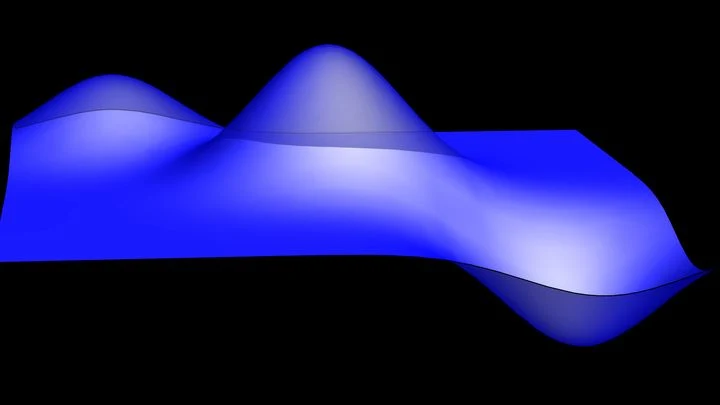
A quantum particle can be in two states at once, like a coin spinning, both heads and tails. Near a black hole, the event horizon, where spacetime curvature bends space and time to the extreme, acts as a one-way gate.
A quantum dot is like a tiny lamp that turns on and off at the command of a laser, emitting exactly one photon at a time. But this light has a quirk: the photons don't interact with each other; they fly independently, like random drops from a faucet.
A superconductor is a material that, when cooled sufficiently, conducts electricity without losses, like water flowing through a perfectly smooth pipe. But if you hit it with a brief flash of light, it quickly loses this property.
A particle trapped in a light field behaves like a ball on a spring: give it a nudge and it starts to oscillate. If you suddenly stiffen the spring, the ball freezes for an instant at the very bottom, where its position is known most precisely. That's exactly the moment physicists exploited to turn a nanoparticle into an ultrasensitive accelerometer.
Detecting a faint signal against a noise background is like trying to hear a distant bell in a storm. Ordinary amplification only makes the din more deafening. Quantum error correction solves the problem in an unexpected way.
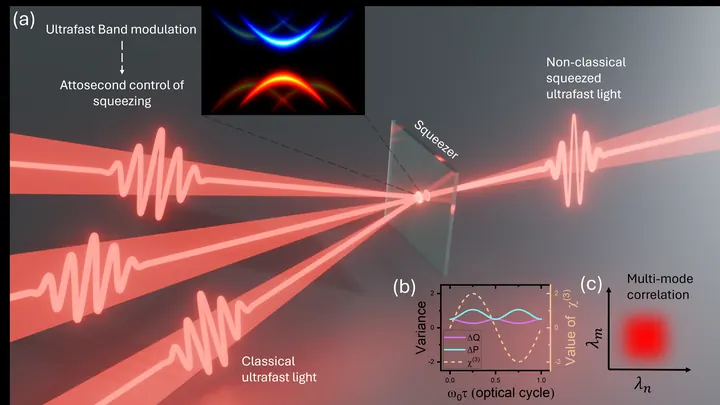
Ordinary light always jitters a bit: its brightness and color fluctuate, like the air in a balloon after a tap. In 'squeezed' light, these fluctuations are redistributed — as if you squeeze the balloon from one side, making it thinner here and thicker there, but the total volume stays the same.
Hot water sometimes freezes faster than cold — this is the Mpemba effect. In the quantum world, it’s even more astonishing: a system bubbling with disorder (with high entropy) can settle incredibly faster than one that is almost calm.
The solution lies in islands of silence within any system — regions untouched by the destructive noise of the environment.
Everything tends toward equilibrium: tea cools, a pendulum swings to rest. The measure of this movement is entropy — growing disorder. But sometimes hot water freezes before warm. The Mpemba effect isn't just a curiosity: it shows up in the quantum world too. Scientists have devised a way to control this paradox.
The early universe was far from perfect: some regions stretched faster than others, creating folds and warps. But a quantum bounce — the transition from contraction to expansion, driven by the laws of the microworld — fixes everything.
Two travelers head for the same destination. One starts closer but takes a winding country road. The other starts farther away but immediately hits the highway. The second arrives first. In quantum physics, this paradox is known as the quantum Mpemba effect: a state initially farther from equilibrium reaches it faster than one that starts closer.