Stellar explosions are catastrophic events in which a star releases an immense amount of energy, often outshining an entire galaxy for a short period. The most famous type is a supernova, which occurs when a massive star collapses at the end of its life or when a white dwarf accretes enough material to ignite thermonuclear fusion. These explosions are crucial for the universe's chemical evolution, as they synthesize and disperse heavy elements like iron, gold, and uranium into space. They also serve as cosmic distance markers and sources of gravitational waves and high-energy particles.
History
The distinction between supernova types was clarified in the 1930s–1940s by Walter Baade and Fritz Zwicky, who coined the term 'supernova' and proposed the neutron star connection. The first direct observation of a supernova in modern times was SN 1987A, which provided detailed neutrino and multi-wavelength data.
How it works
In a core-collapse supernova, the iron core of a massive star exceeds the Chandrasekhar limit and collapses under gravity within milliseconds. The collapse rebounds, producing a shock wave that propagates outward, while neutrinos carry away most of the gravitational binding energy. In a thermonuclear supernova (Type Ia), a white dwarf in a binary system accretes matter until it reaches the critical mass, igniting a runaway fusion that destroys the star. Both mechanisms release about 10^44 to 10^46 joules of energy, mostly as neutrinos and kinetic energy of the ejecta.
In practice
Stellar explosions are used as standard candles (Type Ia supernovae) to measure cosmic distances and study dark energy, and they are laboratories for nuclear astrophysics and neutrino physics.
Fun fact
The elements in your body—carbon, oxygen, iron—were forged in stellar explosions billions of years ago, making you literally made of star dust.
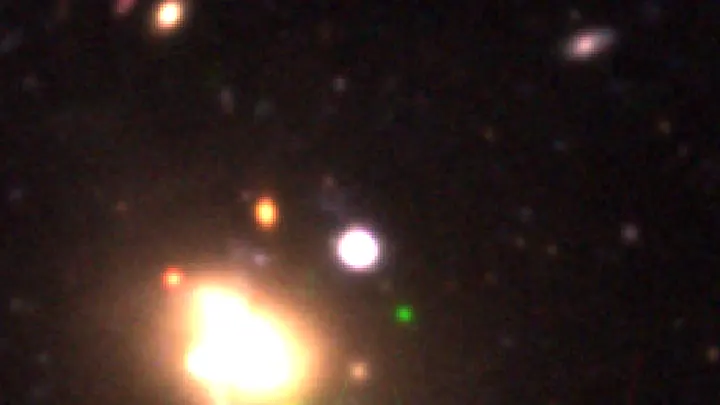
In a quiet back alley of a galaxy, where stars are rare and old, a light suddenly flares up, brighter than an entire galaxy. This is a Type Ia supernova: a thermonuclear explosion of a white dwarf that astronomers use as a standard candle to measure cosmic distances.
Cosmic rays are particles that race across our Galaxy at enormous speeds. Their energies can be millions of times higher than those of particles in the most powerful accelerator on Earth. But the higher the energy, the fewer such particles there are: the plot of their numbers shows a noticeable kink, which is called the knee.
A balloon that lets out air in bursts zips around the room — the jet blasts first one way, then another. A dying star behaves the same way as it sheds its bloated shell. Only instead of air, it's superheated gas, and instead of a balloon, it's a future white dwarf (the dense stellar remnant about the size of Earth).
17 supernovae from the ZTF DR2 sample lit up ahead of schedule. In the first hours and days after the explosion, they emitted more light than standard models predict. Astronomers compare this to a Bickford fuse: before the blinding flash tears across the sky, a precursor spark runs through the outer layers.
The collapse of a star's core is like compressing a spring: matter falls inward, and a neutron star is born at the center. But the fall is never perfectly smooth. In the boiling outer layers, random eddies transfer angular momentum to the infalling gas, and a disk swirls around the central object.
This disk is no calm river. It pulses, strengthening and fading.
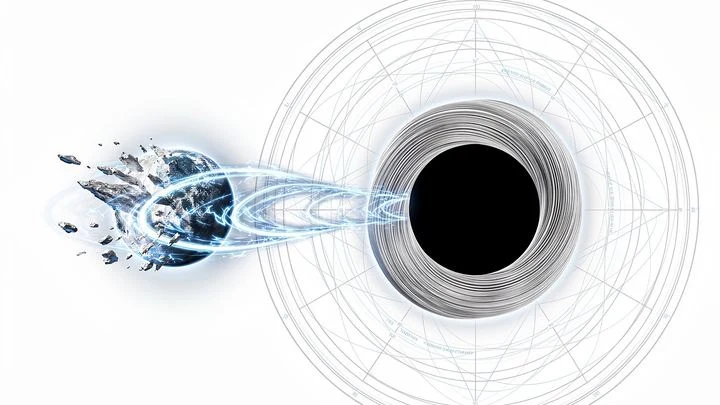
Three milliseconds before the merger. A gargantuan black hole spinning at breakneck speed drags in a neutron star — a ball the size of a city but with 1.5 times the Sun's mass. Tidal forces stretch the star into a thread as thin as a needle and fling its matter outward.
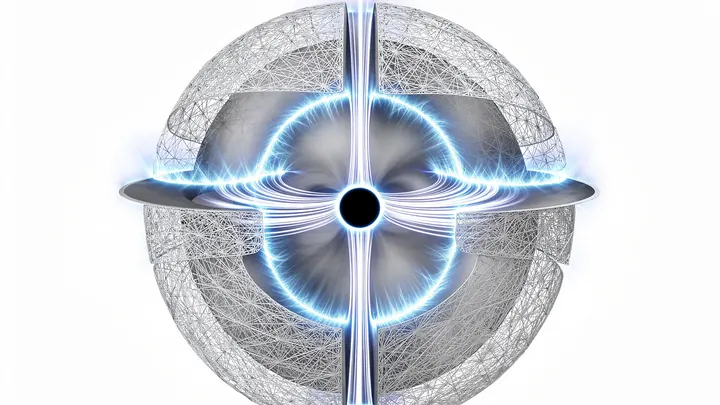
A star runs out of fuel and rapidly collapses under its own gravity. According to classical ideas, it collapses into a point of infinite density — a singularity. But what if nature abhors infinities? In models of regular black holes, instead of a singularity, a dense core of unknown matter forms at the center.
An old factory where instead of machines there are atomic nuclei, and neutrino radiation seethes all around. When a massive star exhausts its fuel, its core compresses a hundredfold, and the temperature skyrockets to billions of degrees.
In the quiet of cold molecular clouds, where interstellar gas under gravity condenses into dense clumps, the birth of massive stars is one of the great puzzles of astrophysics.
Deep space, galactic center. A supermassive black hole is surrounded by a scorching disk of gas and dust. And then, through this fiery veil, a star shoots by every few hours — like an arrow loosed from the bow of gravity. Each passage triggers a dazzling X-ray flare that for a moment outshines the entire galactic nucleus.
When two neutron stars, the ultra-dense cores of dead stars, collide, a kilonova is born: an explosion a thousand times brighter than a typical nova. This is the universe's true smelting works. In the scorching cloud racing outward at near-light speeds, a furious flux of neutrons transmutes atomic nuclei into gold, platinum, osmium.
When JWST peered into the young universe at redshifts of 6–10, it revealed a scattering of mysterious 'little red dots' (LRDs). These objects combined features of galaxies and active nuclei, but their spectra refused to fit into familiar patterns.
Somewhere deep in space, a radio beacon flashes for a fraction of a second, and then goes dark. Such signals are called fast radio bursts. They come from other galaxies and last from microseconds to milliseconds.
The birth of planets resembles the workings of a cosmic forge. Rocky blocks collide and fuse together. A powerful impact strikes a spark — material heats to white-hot and glows like cooling metal. Computer simulations show: the flash is visible from days to years, peaking at a tenth of the sun's light.
Blazars are long-lasting beams from black holes at the centers of galaxies. Gamma-ray bursts are the briefest flashes from supernova explosions or neutron star mergers. The former act like eternal spotlights, the latter like camera flashes.
A vast city lights new streetlamps every night. But then a hurricane sweeps in, rips all the fuel from the warehouses, and the lamps go out one by one. Something similar has been spotted by astronomers in a galaxy whose light has traveled 12.5 billion years to reach us.
When a massive star dies, its core collapses, and a supernova explosion occurs. The cataclysm births streams of particles — like ripples from a thrown stone. The first to arrive are swift neutrinos, which pierce the Earth, hardly interacting. Then, hours later, ghost particles with a tiny charge appear.
A shockwave erupts from the star's surface, and for a brief moment, a blinding flash of ultraviolet and X-rays is born. This very event, named EP260321a, was spotted by the Einstein space telescope in March 2026. The light took about 450 million years to reach Earth.
A massive star ends its life in a spectacular collapse: the core compresses into a neutron star or a black hole, while the outer layers fly off in a dazzling supernova.
In the accretion disks that gird the nuclei of active galaxies (quasars, discovered by Maarten Schmidt way back in the 1960s) a river of incandescent gas and dust churns. In its backwaters, where turbulent flows subside, against all odds, planets are born.
The universe is full of the invisible. We know about dark matter from galaxy rotation and gravitational lensing, but its nature has eluded us for a century.
In the constellation Scorpius, 3,000 light-years from Earth, a dead star steals matter from a living one. A white dwarf in the system IGR J17014-4306 — a superdense carbon-oxygen ball with the mass of the Sun but the size of Earth — siphons hydrogen from a normal companion star.
In April 2021, in a galaxy 35 megaparsecs away, supernova SN 2021foa erupted. It immediately puzzled astronomers: its spectrum feverishly switched between hydrogen and helium lines — as if the star, in agony, was frantically shedding its outer layers.
Somewhere in the galactic bulge, a massive star lies dormant, ready to trade quiet burning for collapse. Its core will exhaust its fuel, and in a fraction of a second, a neutron star or black hole will be born, releasing 10⁵⁸ neutrinos — almost all the energy of the explosion.
Eight hundred million years ago, in the main asteroid belt, a giant inkwell shattered. The parent body, over a hundred kilometers in diameter, made of primitive carbonaceous chondrites, suddenly broke apart near the J3:1 resonance with Jupiter.
A bonfire that no one sees, but everyone feels the warmth: that's how astronomers found a flare in a distant galaxy. Not by its light, but by the infrared radiation of heated dust. The galaxy SDSS J010320.39+140152.5 caught attention when its center suddenly blazed in the infrared, as if someone had thrown logs onto an invisible fire.
A black hole rips apart a star, and we see a dazzling flare. Then, a couple of years later, when everyone has forgotten about it, radio telescopes suddenly pick up a new signal, like an echo from the past.
A light bulb that doesn't burn out but flares brighter and brighter until it blows the whole fixture apart. That's roughly how the most massive stars in the universe die. When a star's core heats up to billions of degrees, pairs of particles (electrons and their antimatter counterparts, positrons) begin to form.
Imagine an interpreter at a crucial negotiation suddenly switching to another language, and the meaning of everything changes. That's roughly what neutrinos do in the depths of a dying star. These invisible particles are born in enormous numbers when a star's core compresses into a city-sized lump. But on their way out, neutrinos can change their type — physicists call this flavor transformation.
Two lamps in a shop window: one glows with a cool, bluish light, the other a bit warmer and yellower. That's roughly how the two types of supernovae, Ib and Ic, look when astronomers view them through a telescope.
The crust of a neutron star is not just a solid shell. Under pressures of billions of tons per square centimeter, atoms lose their electrons, and the remaining nuclei arrange into a rigid crystal lattice, reminiscent of a honeycomb, but made of matter a trillion times denser than steel.
Every second, invisible projectiles from the depths of space pierce through us. These are cosmic rays — atomic nuclei accelerated to speeds nearly indistinguishable from the speed of light. Their energy is hundreds of millions of times greater than what our most powerful accelerators can achieve. Where does this monstrous force come from?
Be stars are rapidly rotating luminaries with bright gas disks. Usually, a companion star spins them up: mass flowing from the neighbor whirls the star like a bullet in a rifled barrel. But there are also lone Be stars without a partner: their origin long remained a mystery.
New research shows that solitaries can be born from a supernova explosion.
A powerful searchlight shines through thick fog. The beam itself is invisible, but the fog begins to glow faintly, and gives away the searchlight's presence.
A massive star's explosion is bright but brief. The flash itself lasts weeks, but the dust it heats around it glows in infrared for years. It's like a camera flash illuminating a room, then hot dust particles lingering in the air — only on a cosmic scale.
In a gas cloud left after a star exploded (called a supernova remnant), astronomers noticed a giant glowing letter S. It was drawn by two jets of superheated material ejected during the cataclysm. These jets didn't just shoot straight out — they slowly spun like a top, which bent their path into curves.
Neutrinos are tiny particles that barely interact with matter. They pass straight through a star like bullets through fog. When a massive star is gearing up to explode, its core contracts, temperatures soar, and neutrinos start streaming out.
Deep in the Galaxy, runaway stars are sometimes born. A monstrous force, a supernova explosion, flings them from their usual place. One such wanderer has recently been found: a star of the LP 40-365 class, a fragment of a white dwarf that survived an incomplete explosion.