Vortices Herd Together express
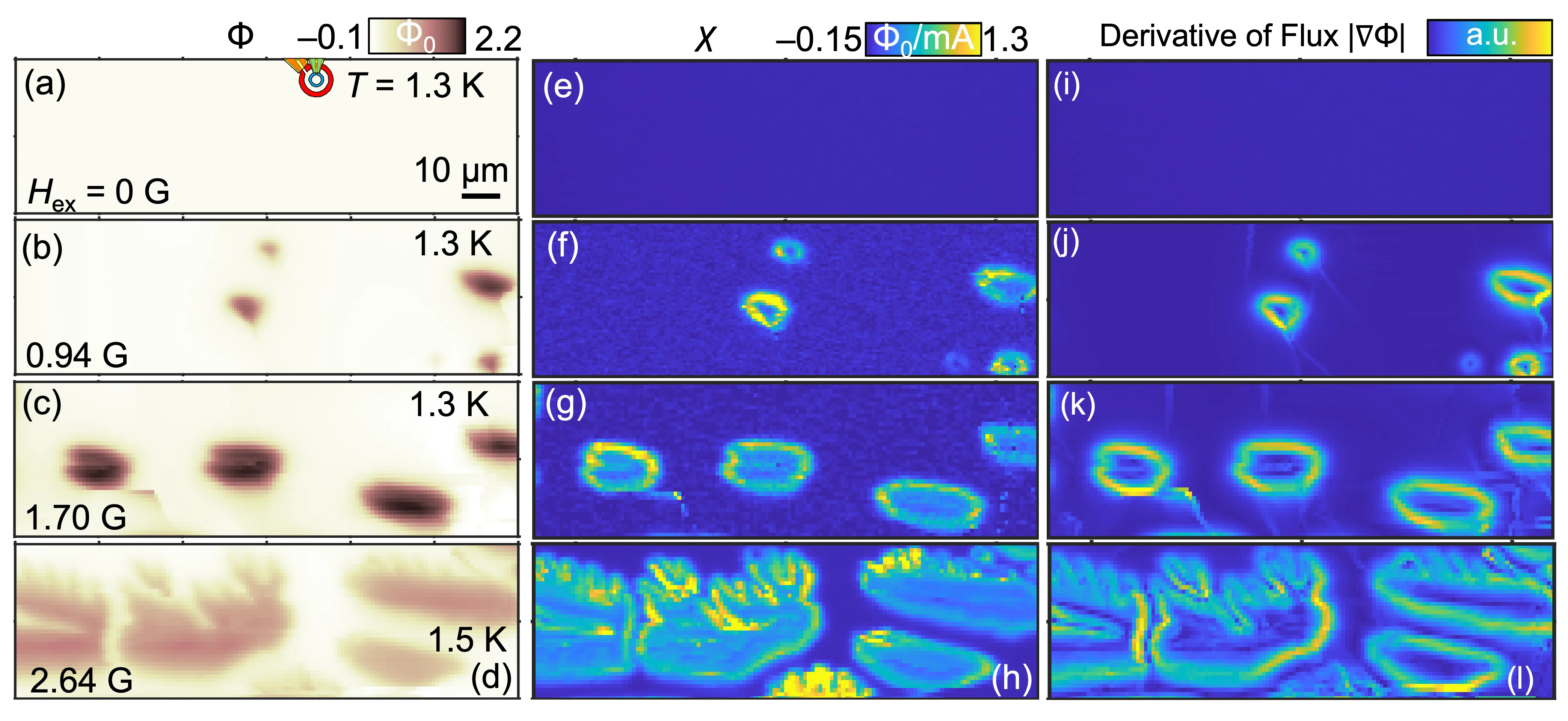
A magnetic field penetrates a superconductor not as a continuous flux but as thin filaments — vortices. Usually, they repel each other and arrange into a neat triangular lattice, like floats on water. But in CaSb₂, things went differently: vortices bunched into tight clusters, with almost empty space between them.
The researchers mapped the magnetic landscape using a scanning SQUID — an ultra-sensitive sensor that can detect the field of a single vortex the way an ear catches a whisper in a quiet room. It turned out that vortices at the cluster edges shift easily, while those in the core get stuck, like grains in an overfilled jar: the outer ones can still be nudged, but the central ones are jammed tight.
Such behavior cannot be explained by simple repulsion. It seems that in CaSb₂, vortices begin to attract at short distances — an effect previously seen only in special multiband superconductors. But here there is only one conduction band, and clusters still form. So nature has thrown us a puzzle: how does a single band give rise to such a complex dance of vortices?
Original abstract
as written by the authors arXiv:2604.23117
Scanning SQUID imaging of CaSb$$_2$$ reveals dense vortex clusters with enhanced boundary susceptibility and suppressed internal vortex motion, which features inconsistent with both isolated vortex and flux tube behaviors. These measurements provide the first local visualization of magnetic dynamics within vortex clusters in a weakly pinned superconductor, offering a new route to probe non-monotonic vortex-vortex interactions that are typically expected in single-band type-II/1 or multiband type-1.5 superconductors. Although the superfluid density follows a single-gap BCS model and the Ginzburg-Landau parameter of CaSb$$_2$$ lies slightly outside the type-II/1 regime, vortex clustering and spatially inhomogeneous dynamics are clearly observed, indicating physics beyond existing microscopic theories for single-band superconductors.
A scanning SQUID microscope is so sensitive that it can register a magnetic field a billion times weaker than Earth's.
In Peter Watts's novel Blindsight, the superconducting structures of an alien ship store information in vortex states — similar clusters could serve as memory cells.