Vortices Herd Together express
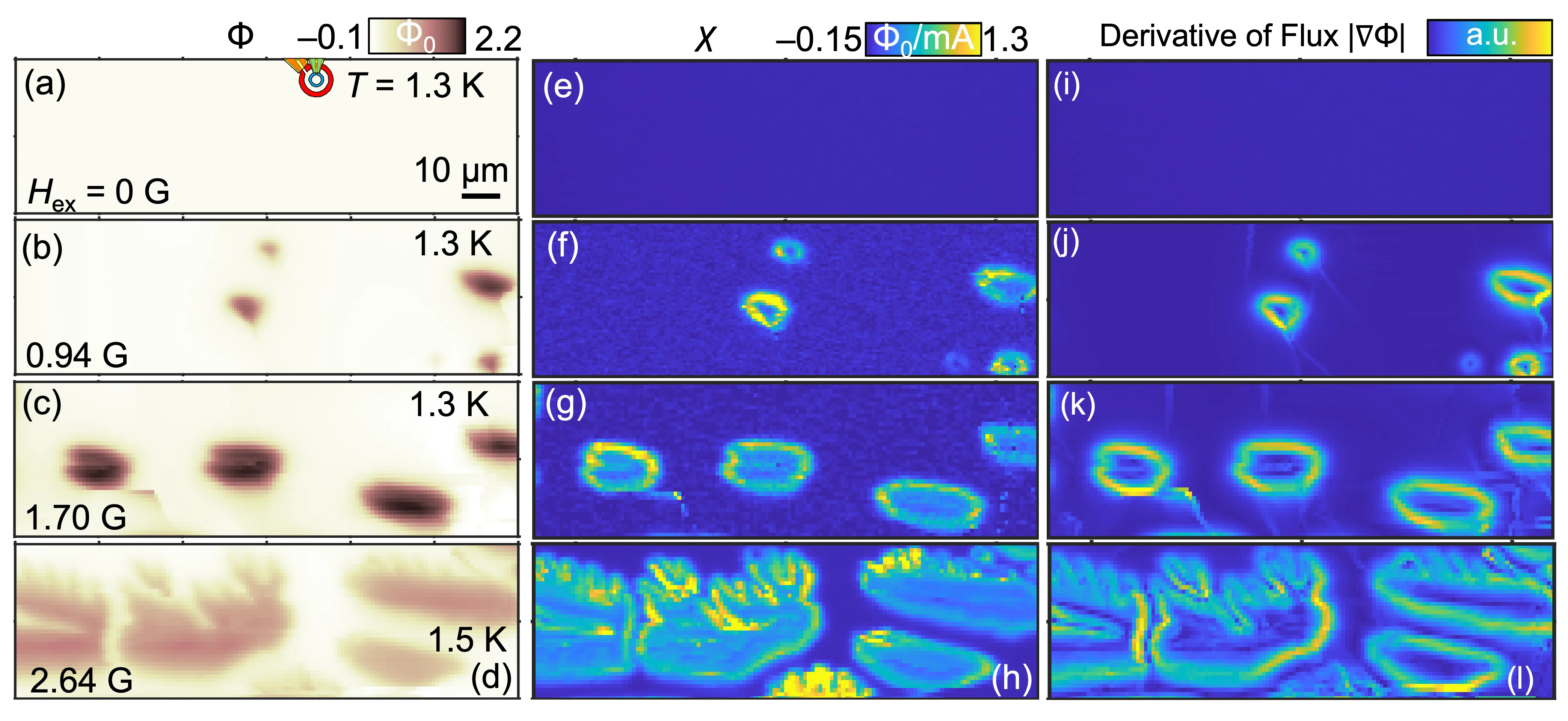
A magnetic field penetrates a superconductor not as a continuous flux but as thin filaments — vortices. Usually, they repel each other and arrange into a neat triangular lattice, like floats on water. But in CaSb₂, things went differently: vortices bunched into tight clusters, with almost empty space between them.
The researchers mapped the magnetic landscape using a scanning SQUID — an ultra-sensitive sensor that can detect the field of a single vortex the way an ear catches a whisper in a quiet room. It turned out that vortices at the cluster edges shift easily, while those in the core get stuck, like grains in an overfilled jar: the outer ones can still be nudged, but the central ones are jammed tight.
Such behavior cannot be explained by simple repulsion. It seems that in CaSb₂, vortices begin to attract at short distances — an effect previously seen only in special multiband superconductors. But here there is only one conduction band, and clusters still form. So nature has thrown us a puzzle: how does a single band give rise to such a complex dance of vortices?
A scanning SQUID microscope is so sensitive that it can register a magnetic field a billion times weaker than Earth's.
In Peter Watts's novel Blindsight, the superconducting structures of an alien ship store information in vortex states — similar clusters could serve as memory cells.