High-temperature superconductivity refers to materials that conduct electricity with zero resistance at temperatures above the conventional limit predicted by BCS theory (around 30 K). This phenomenon was discovered in 1986 in copper-oxide ceramics, which superconduct at temperatures up to 138 K at ambient pressure. These materials are called 'high-temperature' because they break the old rules, but they still require cooling, typically with liquid nitrogen.
History
High-temperature superconductivity was discovered by Georg Bednorz and Karl Müller in 1986, who were awarded the Nobel Prize in Physics the following year. The mechanism remains one of the biggest unsolved problems in condensed matter physics.
How it works
In conventional superconductors, electrons pair up through interactions with lattice vibrations (phonons). In high-temperature superconductors, the pairing mechanism is still debated, but it's believed to involve magnetic interactions. The electrons form 'Cooper pairs' that move together without scattering, allowing resistance-free current flow. The materials have a complex layered structure, and superconductivity emerges from a 'pseudogap' phase, where the electronic behavior is already unusual.
In practice
High-temperature superconductors are used in magnetic resonance imaging (MRI) magnets, particle accelerators, and experimental power cables, where they carry large currents without energy loss.
Fun fact
Some high-temperature superconductors, like UTe2, can host multiple superconducting phases simultaneously, a phenomenon that has no analogue in conventional superconductors.
Old treasure maps were drawn from hearsay: someone found gold by a river, someone else in the mountains, and each person dug in their own spot. High-temperature superconductors went the same way: cuprates were found in some compounds, iron pnictides in others, nickelates in yet others, and there was no common map.
A metal made of five different atoms is like a soup with bits of carrot, peas, potato, onion, and meat floating in it. Each bit is its own element: chromium, vanadium, titanium, niobium, and tantalum. Such an alloy is called high-entropy: there is no single order, and the atoms are mixed almost randomly.
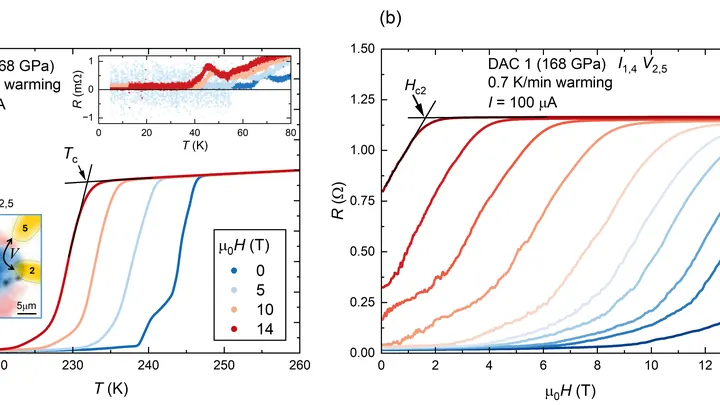
Inside a diamond anvil cell, squeezing a sample with a force millions of times greater than atmospheric pressure, a thin film of lanthanum meets hydrogen. The hydrogen comes from ammonia borane — a powder that, when heated, releases its hydrogen like a sponge releasing water.
A superconductor is a material in which electricity flows without loss, like water through a perfectly smooth pipe. But if you squeeze it slightly, like a spring, its properties change. Scientists have long wanted to measure how much heat such a compressed material absorbs, but instruments couldn't fit into the cramped setup. Now they've devised a way around this obstacle.
An ordinary wire heats up when current flows through it — some energy is wasted. A superconductor lacks this flaw: electricity flows through it without loss, like water through a perfectly smooth pipe. The trouble is that most superconductors require either very low temperatures or colossal pressures, like those found in the depths of planets.
A microchip the size of a fingernail gives off as much heat as a small light bulb. Getting rid of that heat is like trying to cool a cup of hot tea with a teaspoon: the insulating material around transistors is usually a poor heat conductor.
A film sliver thinner than a human hair was placed between diamond anvils and squeezed. The pressure climbed — a hundred thousand atmospheres, half a million, a million… Yet the material kept conducting electricity without resistance.
Many materials behave like finicky ice: at one pressure they melt, at another they turn harder. Superconductors in the cuprate family are no exception. Their ability to carry current without loss depends on how tightly the crystal lattice is squeezed. In a new study, physicists traced this dependence for the compound Bi-2223.
Superconductivity and magnetic field are age-old foes: the field barges in like a whirlwind, tearing apart the delicate pairing of Cooper pairs, destroying order.
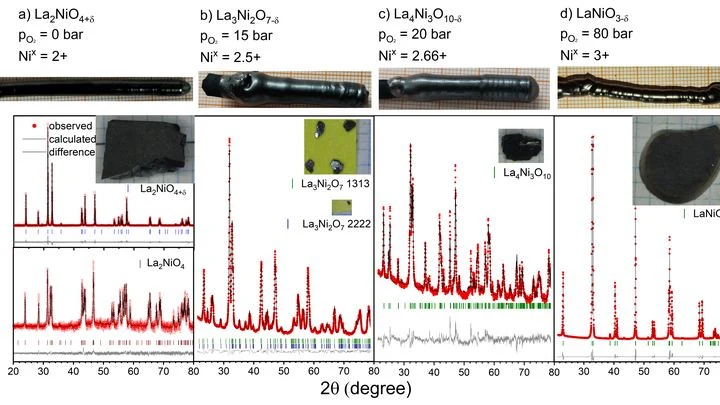
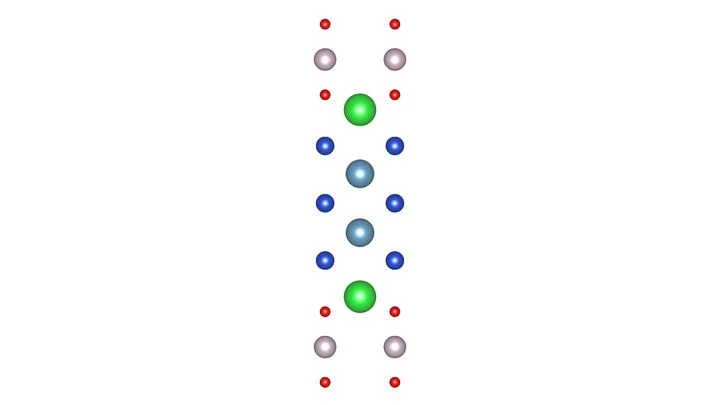
The nickelate family consists of layered crystals, like a stack of pancakes: nickel and oxygen layers alternate with lanthanum spacers. Two years ago, superconductivity was discovered in them — the ability to conduct electricity without resistance when cooled.
A thin magnetic film is like a row of toy soldiers with tiny magnetic arrows. In the flat world, thermal jostling quickly disrupts this formation — even the slightest heating destroys the order. This is the Mermin–Wagner prohibition: in two dimensions, continuous symmetry cannot survive at finite temperature.
A potter uses a sharp stylus to trace a pattern on a still-damp clay tile. One wrong move, and the line blurs, the tile cracks. Physicists work with films of the high-temperature superconductor YBCO (a compound of yttrium, barium, copper, and oxygen) in much the same way.
Superconductors conduct current without loss, but usually require extreme cold. Hg1223 — a mixture of mercury, barium, calcium, copper and oxygen — breaks the rule: it stops resisting current already at –139°C. The secret is that the strong electrical repulsion between electrons forces them to pair up.
Imagine a sandwich where the bread is made of copper oxide layers and the filling is a thin layer of strontium ions. That's the infinite-layer cuprate, the simplest version of superconducting ceramics, conceived nearly 40 years ago.
In familiar metals like copper, electrons move almost independently, like cars on an open highway. Resistance arises from rare collisions and can be described by simple formulas.
A magnetic field penetrates a superconductor not as a continuous flux but as thin filaments — vortices. Usually, they repel each other and arrange into a neat triangular lattice, like floats on water. But in CaSb₂, things went differently: vortices bunched into tight clusters, with almost empty space between them.
Picture a packed bus where every passenger is an electron. In a superconductor, passengers pair up and move in sync, losing no energy. But in high-temperature superconductors like cuprates, this idyll only works when extra passengers are added. If you drop some off, the pairs start acting strangely.
A copper crystal is squeezed in diamond anvil cells. As pressure mounts, a battle unfolds inside the material between two states: one prepares electrons for superconductivity, the other hinders their pairing. Scientists tracked this struggle using ultrashort laser pulses.
An ordinary transistor in a phone is made in a vacuum chamber, where atoms are deposited layer by layer. Expensive and slow. But indium oxide can be printed like ink — from a drop of liquid metal that, in air, coats itself with a thin oxide film.
The authors took indium, melted it, and rolled it over a substrate at 250 degrees.
Superconductivity is when electric current flows without losses, like water through a perfectly smooth pipe. It usually occurs at very low temperatures, but there are materials where it appears at higher ones.
In a pot of boiling water, bubbles of steam are born and pop, but the water itself remains a liquid. Something similar happens in an ultracold atomic gas: atoms constantly form pairs and then fly apart again, even though superfluidity has not yet set in.
A thin wire of the new material conducts electricity without loss when cooled to three degrees above absolute zero. It's like water flowing through a pipe without any friction against the walls. The material is called PtPb3Bi, and its hallmark is an internal structure resembling a bundle of threads: electrons run freely along a thread but struggle to jump between threads.
Electrons in a crystal sometimes behave like a stadium crowd doing the wave: areas of higher density alternate with nearly empty ones. This wave blocks the free flow of charges — under normal conditions, the material is not superconducting. But apply pressure, and the wave vanishes, letting electrons move without resistance.
Niobium is a metal that, when cooled to a few degrees above absolute zero, conducts electricity without resistance. In labs, it is deposited as thin strips onto a substrate, like frosting on a cake. But during deposition, oxygen from the special mask seeps into the metal, and it spoils the superconducting properties.
A film as thin as a spider's web, made of five metals, took the hit from a laser. Inside, the pressure soared to 55 gigapascals — imagine a hundred elephants balanced on your thumbnail. The alloy withstood it, compressing for a fraction of a nanosecond without breaking.
One gigapascal is a thousand megapascals.
Superconducting circuits often rely on Josephson junctions — places where current flows without resistance through a thin barrier. Typically, this barrier is an oxide layer, but its properties are hard to control at the nanoscale. In this new work, the barrier is a thin layer of niobium or titanium nitride sandwiched between niobium layers.
A piece of silver antimony telluride is like a sponge: it readily soaks up heat and turns it into electricity. Such materials are called thermoelectrics, and they already work in space probes and car refrigerators. But if you squeeze this sponge, it starts behaving like a superconductor — current flows with zero resistance.
Ice slips away from under a skate blade like a bar of soap in wet hands. For a hundred years, scientists argued about where this slipperiness comes from. Some said there is already a thin layer of water on top: it acts as a lubricant. Others countered that water only appears when you start moving, due to friction.
Superconductivity is the ability of a material to conduct electricity without losses. Ordinary wires heat up, and some energy is lost as heat, but a superconductor carries current with zero resistance.
The microchips inside smartphones and computers are getting denser: billions of transistors are packed onto a sliver of silicon the size of a fingernail. When they work, they give off heat like tiny stoves. If that heat isn't drawn away, the chip overheats, starts glitching, or fails outright.
Water in a pot, when heated, doesn't boil: it turns into ice. That's roughly how ultracold atoms behave in an optical lattice — a light-based crystalline grid that holds atoms in place. Scientists simulated this system on a computer to understand how order changes as temperature rises.
An ordinary conductor carries current equally in both directions, like a door that swings both inward and outward. A diode, by contrast, is a door with a self-closing hinge: it opens easily one way but pushes back the other.
A metal bar made of five different metals (hafnium, niobium, scandium, titanium, and zirconium) sits in a furnace. After heating to 600 degrees, regions appear inside it that look like a pattern of two mixed metals, like marble veins.
A metal alloy is like a cocktail: mix a few elements and you get a material with new properties. But while a bartender tastes the drink, engineers need to know in advance how an alloy will behave in service.
Inside a fuel cell, protons must race through a solid material like commuters through turnstiles at rush hour. If the turnstiles are sparse and narrow, the current is weak. In the past, to find a material with good proton conductivity, chemists had to screen compounds almost blindly, one by one.
An ordinary wire heats up when current flows through it. A superconductor doesn't. But almost all known superconductors require either very low temperatures or enormous pressures, like those deep inside planets. Scientists have long searched for a material that avoids these extremes.
Electronics get hot. The more powerful the processor, the more heat you need to get rid of, or it will fail. One bottleneck is the boundary between two materials: heat hits it like a seam between tiles and slows down.
An X-ray photon hits the detector like a pebble dropping into still water. The water is a thin film of aluminum and manganese, cooled to near absolute zero. The impact sends a heat wave rippling across the film, and by measuring its height, you can tell how much energy the photon carried.
In the crystal lattice of iron selenide, iron and selenium atoms alternate like bricks in a wall. But sometimes extra iron atoms sneak into the voids between them, like uninvited guests squeezing into the gaps between bricks.