Superfluid stiffness is a fundamental property of a superconductor or superfluid that quantifies how rigidly its quantum phase is locked. In a superconductor, the condensate of Cooper pairs has a well-defined quantum phase. Superfluid stiffness measures the energy cost of twisting this phase from one point to another. A high stiffness means the phase is rigid, making it difficult to create spatial variations in the phase, which is directly related to the material's ability to carry a supercurrent without resistance.
History
The concept was formalized in the context of the Ginzburg-Landau theory (1950) and later extended by the BCS theory (1957). The role of superfluid stiffness in two-dimensional phase transitions was clarified by Vadim Berezinskii (1971) and John Kosterlitz and David Thouless (1973).
How it works
The concept is rooted in the Ginzburg-Landau theory of superconductivity. The free energy of the superconductor includes a term proportional to the square of the gradient of the phase, multiplied by the superfluid stiffness. This stiffness is proportional to the superfluid density (the density of Cooper pairs) and inversely proportional to the effective mass of the pairs. In a clean, fully superconducting state, the stiffness is high. As temperature increases toward the critical temperature, the stiffness decreases, and at the transition it vanishes, allowing phase fluctuations to destroy the superconducting order. In two-dimensional systems, superfluid stiffness plays a crucial role in the Berezinskii-Kosterlitz-Thouless (BKT) transition, where the unbinding of vortex-antivortex pairs is governed by the stiffness.
In practice
Superfluid stiffness is a key parameter in designing superconducting devices, particularly thin films and Josephson junctions. It also determines the critical currentdensity of a superconductor—the maximum current it can carry without resistance—and is essential for understanding high-temperature superconductors.
Fun fact
In a superconductor, the superfluid stiffness is so high that a persistent current can flow for billions of years without decaying, as demonstrated in experiments where currents have been maintained for over a decade with no measurable loss.
Units by system: SI: jm3 · CGS: ergcm3 · Planck: e pl p3 · natural: gev4
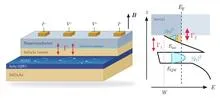
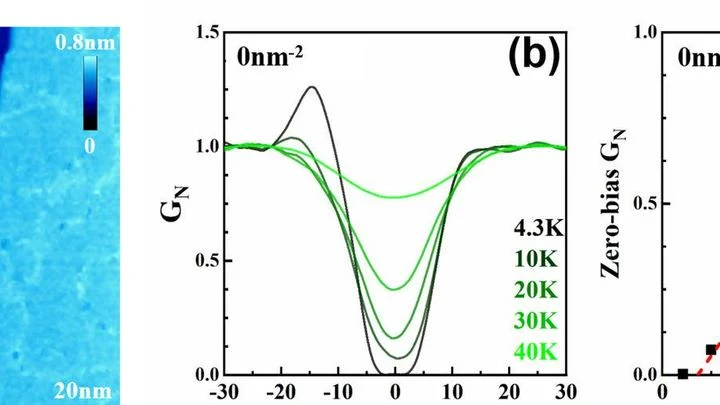
A thin layer of indium arsenide lies hidden under a superconducting film, like a voice beneath the noise of a crowd. In such a hybrid, current takes the path of least resistance and flows almost entirely through the metal, leaving the semiconductor inaudible to standard probes.
Deep inside a neutron star, where matter is compressed to the density of an atomic nucleus, neutrons form a superfluid and protons form a superconductor. A neutron vortex is a quantized vortex in the superfluid, akin to a miniature whirlpool that cannot stop spinning.
Two dancers on one stage: the triangle and the stripe. In a quantum gas of dysprosium atoms cooled to 62 nanokelvin, these two spatial structures have met for the first time in a single experiment. The gas is held in a trap shaped like a surfboard, and its atoms are among the most magnetic in the periodic table.
An ordinary wire heats up when current flows through it — some energy is wasted. A superconductor lacks this flaw: electricity flows through it without loss, like water through a perfectly smooth pipe. The trouble is that most superconductors require either very low temperatures or colossal pressures, like those found in the depths of planets.
A film sliver thinner than a human hair was placed between diamond anvils and squeezed. The pressure climbed — a hundred thousand atmospheres, half a million, a million… Yet the material kept conducting electricity without resistance.
At low temperatures, many materials become superconductors — current flows without resistance. But how exactly does this happen if electrons were initially trapped in an insulator? Half a century ago, Philip Anderson suggested that the answer lies in a special quantum dance of particles.
Many materials behave like finicky ice: at one pressure they melt, at another they turn harder. Superconductors in the cuprate family are no exception. Their ability to carry current without loss depends on how tightly the crystal lattice is squeezed. In a new study, physicists traced this dependence for the compound Bi-2223.
Drop by drop from a faucet, or a steady stream without a single splash. That's roughly what the two regimes of current in a superconducting contact look like. Only here, the role of water is played by Cooper pairs — bound electrons that move without resistance.
A layered cake where each tier conducts electricity differently: that's the structure of the crystal La3Ni2O7, a compound of nickel, lanthanum, and oxygen. Current flows differently along the layers than across them.
A piece of metal is cooled to minus two hundred degrees, and electric current begins to flow through it without the slightest friction, like water in a pipe flowing without touching the walls. This behavior is called superconductivity.
Graphene, a two-dimensional carbon crystal, has long tantalized physicists with the hope of high-temperature superconductivity. Its electrons obey the relativistic equation of Paul Dirac, racing at tremendous speed, barely noticing each other.
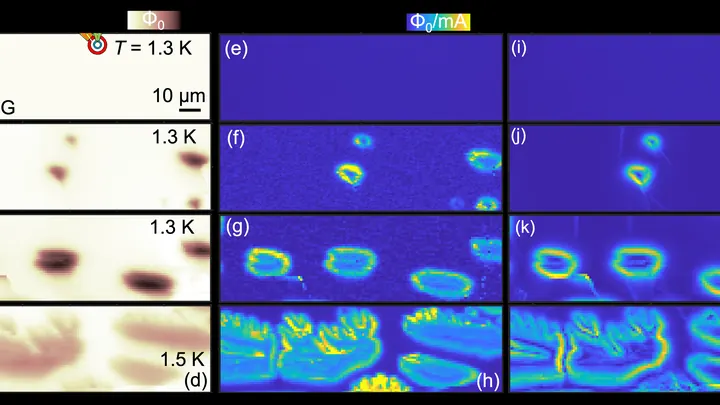
In the crystal CsV3Sb5-xSnx, which becomes a superconductor at low temperatures, current does not flow as a uniform stream but along narrow, winding paths. A scanning microscope with a sensitive magnetic field sensor helped reveal these paths: it picks up the faintest currents, much like a sonar probes the seafloor.
A thin film of yttrium barium copper oxide warms under a stream of infrared light, and suddenly stops dissipating energy. That's superconductivity: electrons pair up and move as a single quantum swarm. But in underdoped samples, the harmony breaks long before the pairs fall apart. The pairs are there, but the collective rhythm isn't.
Electrons in a conductor are like a chaotic crowd: colliding, they lose energy, and resistance arises. In a superconductor, however, they move in unison, like partners in a well-coordinated dance, without touching each other. This state has reduced энтропией — meaning disorder.
Such behavior is rare for gold and copper.
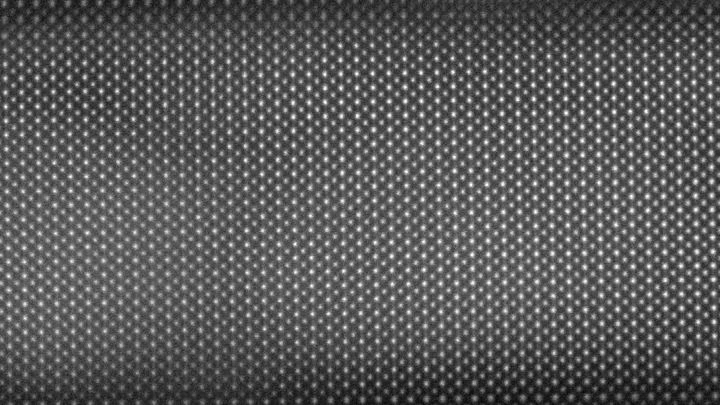
Imagine a sandwich where the bread is made of copper oxide layers and the filling is a thin layer of strontium ions. That's the infinite-layer cuprate, the simplest version of superconducting ceramics, conceived nearly 40 years ago.
A superconductor carries current without resistance, like water running through a pipe without friction. The secret lies in electron pairs: two electrons stick together as one, even though they normally repel. In an ordinary superconductor, the spins of the electrons in a pair point in opposite directions: this is the singlet state.
Imagine a packed dance floor where dancers glide without any friction — passing through each other without a touch. That's a superfluid. In a neutron star's crust, neutrons could behave this way, but a rigid lattice of ions gets in the way, like suddenly sticking the dance floor full of pillars.
In familiar metals like copper, electrons move almost independently, like cars on an open highway. Resistance arises from rare collisions and can be described by simple formulas.
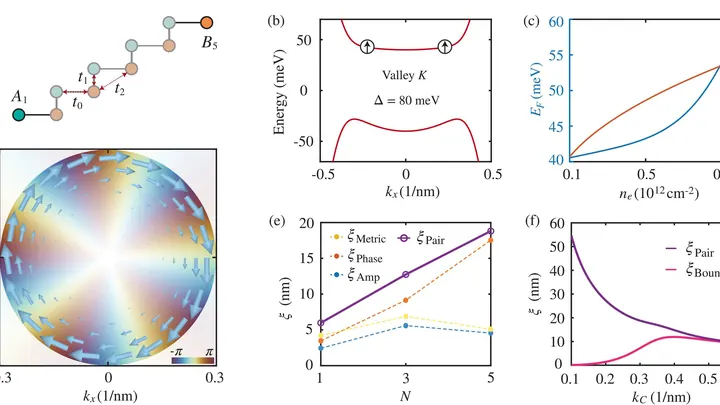
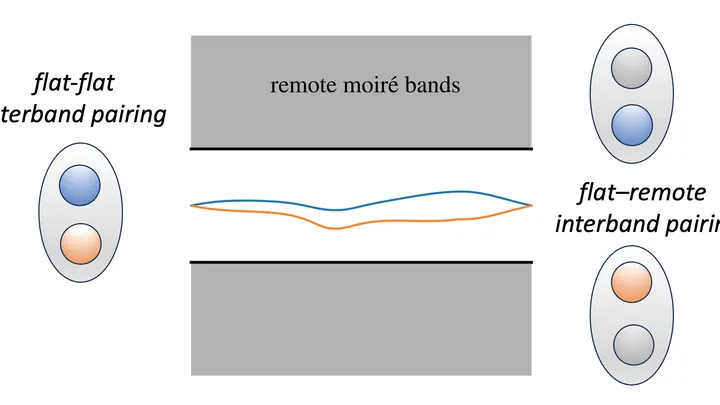
In a superconductor, electrons pair up like dancers holding hands. Usually, the distance between them, the pair size, depends on how fast they move and how strongly they are bound. But sometimes the dance floor almost disappears, and there's nowhere to move. This happens in materials with flat electronic bands: electrons nearly freeze, and the usual rules stop working.
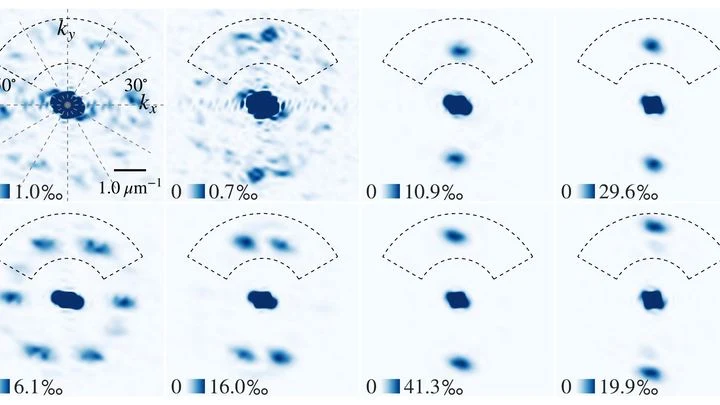
A magnetic field penetrates a superconductor not as a continuous flux but as thin filaments — vortices. Usually, they repel each other and arrange into a neat triangular lattice, like floats on water. But in CaSb₂, things went differently: vortices bunched into tight clusters, with almost empty space between them.
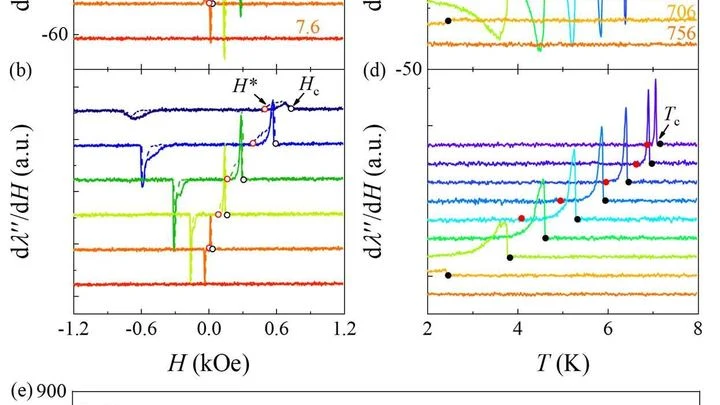
Ordinary magnetic measurements only see the surface of a superconductor, where barriers and viscous flows of magnetic field get in the way. Inside, in the so-called intermediate state, superconducting and normal domains coexist, separated by thin walls. These walls can oscillate, but hearing them directly has been difficult.
A copper crystal is squeezed in diamond anvil cells. As pressure mounts, a battle unfolds inside the material between two states: one prepares electrons for superconductivity, the other hinders their pairing. Scientists tracked this struggle using ultrashort laser pulses.
A thin wire of the new material conducts electricity without loss when cooled to three degrees above absolute zero. It's like water flowing through a pipe without any friction against the walls. The material is called PtPb3Bi, and its hallmark is an internal structure resembling a bundle of threads: electrons run freely along a thread but struggle to jump between threads.
A frictionless liquid that flows forever: that's superfluidity. Helium-3 only achieves it at thousandths of a degree above absolute zero. The theory of this state was developed by Lev Landau and Richard Feynman.
A thin sheet of graphene, just a few micrometers thick, was placed in a weak magnetic field, and it began to push the field out of itself, like a sponge squeezing out water. This effect, known as the Meissner effect, is the hallmark of a superconductor: a material that conducts electricity without loss.
A sheet of graphene one atom thick is twisted at a small angle, and it starts behaving like a layered pie with layers slightly rotated relative to each other. At a certain twist angle, this material becomes a superconductor: electrons begin to move in pairs, like dancers in a waltz, without losing energy. But what exactly happens inside has remained a mystery.
A superconductor is a material that, when cooled sufficiently, conducts electricity without losses, like water flowing through a perfectly smooth pipe. But if you hit it with a brief flash of light, it quickly loses this property.
A flexible thread, coiled into a loop, was locked in a tiny box with liquid. It can either absorb water and swell like a sponge, or expel the moisture and shrink into a tight ball. The choice between these states depends on whether the thread has a knot – and which one.
The reason lies in entropy, a measure of disorder.
A superconductor carries current without loss, like a perfectly smooth road where cars glide with no friction. But what if you scatter rocks and potholes across that road? Scientists decided to find out by adding disorder to a superconducting material just one atom thick.
The quantum Hall effect has long been suspected of superfluidity — the ability to flow without friction. Imagine a cook following a recipe: for each unit of magnetic flux, he must add exactly a certain number of electrons.
An ordinary ultra-sensitive magnetic field sensor is like a scale that starts lying when you put too heavy a weight on it. The signal becomes distorted, and you have to add complex electronics to straighten out the readings. That electronics adds noise and slows things down.
The new sensor, bi-SQUIPT, works differently.
The layered material (SnS)1.15(TaS2) resembles a stack of paper, where the sheets conduct electricity and the interlayers prevent them from sticking together. At ambient pressure, this material conducts current without resistance, making it a superconductor.
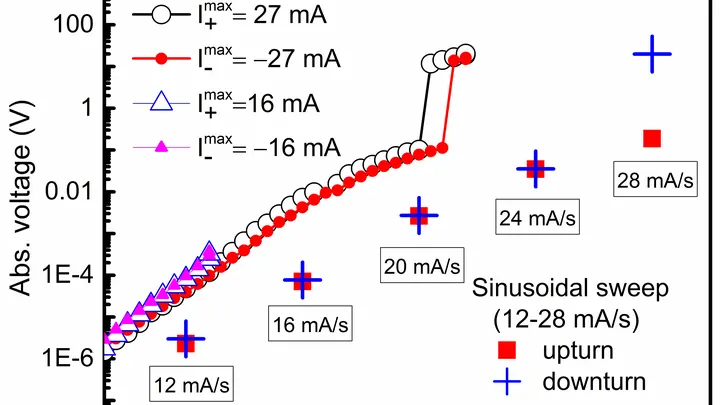
An ordinary conductor carries current equally in both directions, like a door that swings both inward and outward. A diode, by contrast, is a door with a self-closing hinge: it opens easily one way but pushes back the other.
A superfluid flows without friction, like water in a perfectly smooth pipe, but the moment it hits an obstacle, the picture changes. In a new study, researchers looked at how a superfluid stream flows around rectangular walls and pits with sharp corners.
Inside some materials, electric current flows with zero resistance. These are superconductors, and they only work when it's very cold. Copper oxides are special: they stay superconducting at somewhat higher temperatures, but why has been a puzzle for forty years.
An ordinary superconductor is like a squad of soldiers marching in pairs: electrons pair up, and their spins (internal 'tops') point in opposite directions. A magnetic field easily flips such pairs, destroying superconductivity.
In UTe₂, things are different.
In a thick metal, electrons are like a discordant orchestra: each instrument plays on its own, the overall sound is noise. But roll the metal into a film just a couple of atoms thick, and electrons suddenly begin to "play" in harmony, conducting current without dissonance. Even John Bardeen explained that in superconductors, electrons form pairs — duets that move unimpeded.
Layered cuprate crystals resemble a stack of pancakes: each pancake is a plane of copper and oxygen atoms, with spacer layers of other elements in between. Usually, superconductivity is studied in the whole stack, where layers influence each other.