A triangular lattice is a two-dimensional arrangement of points where each point has six nearest neighbors, forming a pattern of equilateral triangles. It is one of the five Bravais lattices in two dimensions, alongside square, rectangular, centered rectangular, and oblique. The structure is common in nature, appearing in layers of atoms in certain crystals, in arrays of vortices in superconductors, and in the packing of equal spheres on a flat surface.
History
The triangular lattice as a mathematical structure was studied in the 19th century in the context of crystallography, with Auguste Bravais classifying it as one of the five two-dimensional lattice types in 1850. The concept of geometric frustration in triangular lattices was introduced in the context of spinglasses and magnetic systems in the 1970s, notably by Gérard Toulouse and others.
How it works
The key feature of the triangular lattice is its geometry: each triangle is equilateral, and the lattice has sixfold rotationalsymmetry. This arrangement is the densest way to pack equal circles in a plane, with a packing fraction of about 0.9069. In magnetic systems, the triangular lattice can lead to geometric frustration: if each site carries a spin that prefers to align antiparallel to its neighbors, it is impossible to satisfy all pairwise interactions simultaneously because the three spins on a triangle cannot all be opposite to each other. This frustration can give rise to exotic states such as spin liquids, where the system does not order even at absolute zero.
In practice
Triangular lattices are used in the design of metamaterials, in the study of two-dimensional electron gases, and in the engineering of photonic crystals where the lattice geometry controls the propagation of light.
Fun fact
In a triangular lattice, the number of nearest neighbors per site is six, which is the maximum possible in two dimensions, making it the most 'connected' flat lattice.
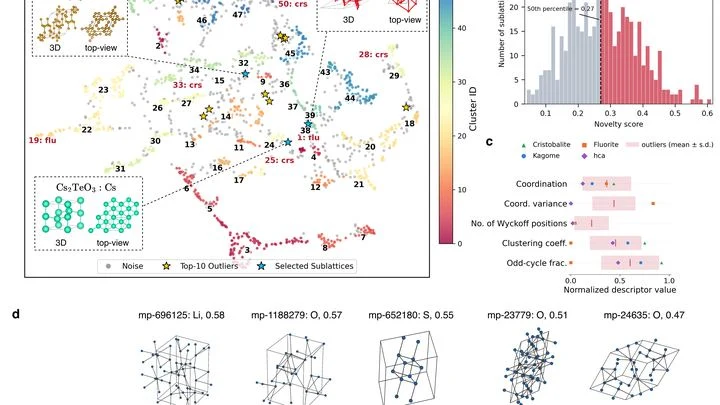
In a Japanese woven basket, triangles and hexagons combine into a pattern that physicists call a kagome lattice. This pattern turns out to be more than just pretty: electrons in such a material behave unusually because the lattice splits into three groups of nodes, three sublattices.
A deck of cards in which each card is slightly rotated cannot lie flat: the backs and faces will never align. But if the cards are flexible, they will start to adjust, shifting by fractions of a millimeter to find the perfect match. Something similar happens inside crystals when two thick layers of MoS2 or MoS2 with WS2 are stacked with a twist of 1–2 degrees.
Three voices merging into a single chord. In the physics of quantum materials, this image takes on a literal meaning: three layers of graphene, separated by thin spacers, force electrons and holes from different layers to move as a single fluid.
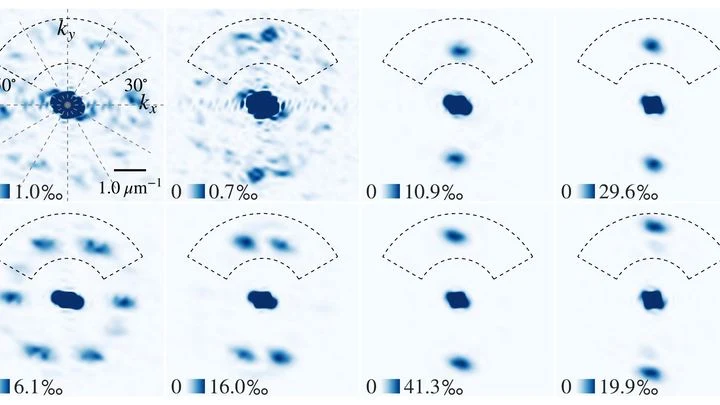
Two dancers on one stage: the triangle and the stripe. In a quantum gas of dysprosium atoms cooled to 62 nanokelvin, these two spatial structures have met for the first time in a single experiment. The gas is held in a trap shaped like a surfboard, and its atoms are among the most magnetic in the periodic table.
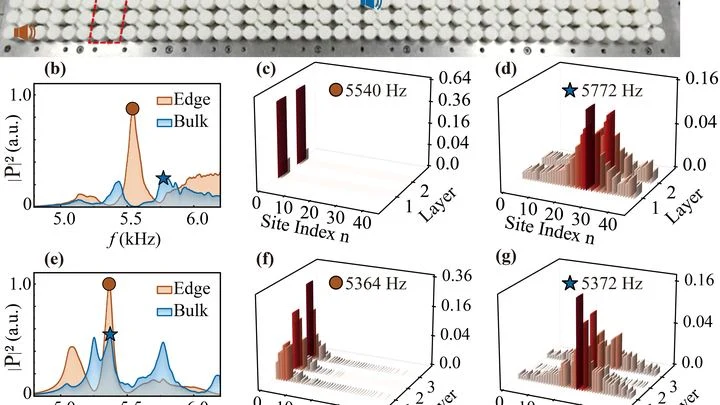
Hit a table, and the sound quickly fades. Elastic waves in solids usually behave like ripples on water: they spread from the source and die out. But there is a way to make them freeze in place — by creating a 'flat band' in the frequency spectrum. This is a range where waves lose their speed and pile up, like cars in a traffic jam.
A sheet of paper with square grid, one with diamond grid, and one with honeycomb — three different universes for an ant. Change the sheet, and the rules of movement change. That's roughly how electrons experience the crystal lattice: geometry dictates whether they become little magnets, superconductors, or something else. In ordinary materials, the lattice is as rigid as if engraved.
Electrons in a crystal are like cars on city streets: some race down avenues, others get stuck in traffic jams. In certain lattices, motion freezes entirely — velocity stops depending on energy, and electrons become "flat." This isn't a traffic jam but a special rhythm of the network where waves cancel each other out.
Three dancers move as one: each feels all the others, and the overall harmony cannot be reduced to individual interactions. This is roughly how three particles behave, born from an electron and positron collision at the speed of light. They are a top quark, its antiparticle, and a Z boson.
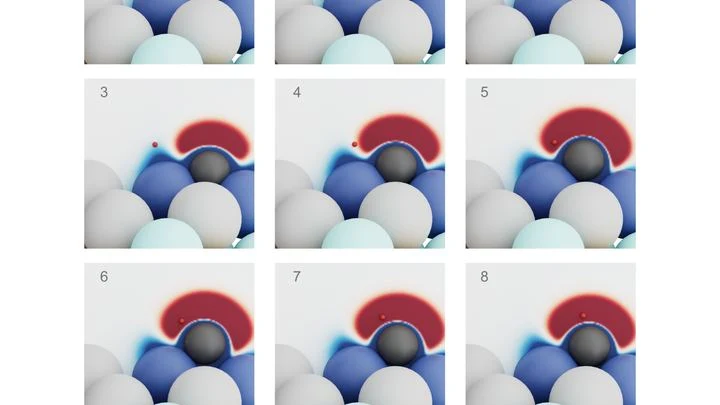
A kitchen sponge soaked in syrup: in some spots there's more syrup, and your finger sticks right away; in others, it barely touches. That's roughly how a catalyst surface works. Molecules don't react everywhere but at especially sticky points — active sites.
If you squeeze an ordinary piece of metal, it heats up — even those who have pumped a bicycle tire know that. But what happens if you squeeze a magnet in which atomic arrows refuse to freeze even at absolute zero?
Tile a floor with identical triangles, and you get a boring repeating pattern. But what if you want the pattern to never repeat, yet use just one tile? For a long time, mathematicians were sure it couldn't be done: you'd need at least two different shapes. The famous Penrose mosaic is a case in point: rhombi with acute and obtuse angles arrange into an infinitely varied but strictly ordered pattern.
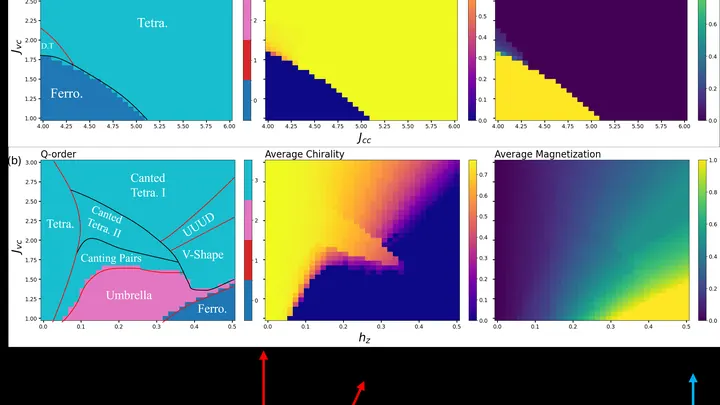
Imagine a triangular grid with tiny magnetic arrows at each node. Electrons, the charge carriers, run across this grid. Usually, the arrows align simply: all pointing the same way (ferromagnet) or alternating in the plane.
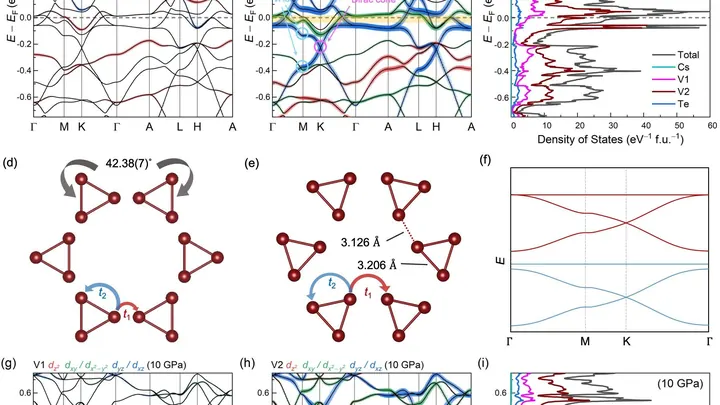
A woven basket made of willow twigs holds its shape thanks to the interweaving. A similar pattern, triangles linked into a flat network, has been found in a new crystal with the formula Cs₃V₉Te₁₃. Here, vanadium atoms form two sets of triangles that pierce each other like threads in fabric.
This pattern is not just pretty: it forces electrons to move along special "flat" energy pathways.
A crystal the size of half a matchbox was grown in a furnace, where a molten zone slowly crept along a rod, leaving perfectly ordered layers behind. Inside this crystal, copper ions sit at the nodes of a triangular lattice, but the triangles are slightly skewed, as if someone pressed on one corner. Each copper ion behaves like a tiny magnetic needle that can point up or down.
An ordinary superconductor works like a perfect conductor: electrons pair up and flow without resistance. In the new material TaPtSi, the pairs are arranged differently: their internal symmetry is skewed, and when cooled below the critical temperature, tiny magnetic fields spontaneously emerge inside the crystal.
A stack of identical pancakes on a plate is just a stack. But if you arrange them with a certain order, something new suddenly appears: for example, a pattern that was not visible in each pancake individually. Physicists have performed a similar trick with thin layers of materials.
A handful of lead sulfide nanocrystals coated with charged molecules spontaneously assembles into a perfect crystalline lattice. Each nanocrystal is like a brick just a few nanometers across, while the charged molecules on its surface act as the mortar.
Light from a distant galaxy travels toward us for billions of years, but along the way it can run into a massive galaxy cluster. Its gravity acts like curved glass: it bends the path of rays, so instead of one image, we see several — sometimes arcs, sometimes points.