BCS theory, named after Bardeen, Cooper, and Schrieffer, is the microscopic theory that explains conventional superconductivity: the phenomenon where certain materials conduct electricity with zero resistance below a critical temperature. It describes how electrons, which normally repel each other, form bound pairs (Cooper pairs) through interactions with the crystal lattice. These pairs condense into a single quantum state, allowing current to flow without scattering. The theory successfully predicts key properties like the energy gap and the critical temperature, and it remains the foundation for understanding most superconductors.
History
Developed in 1957 by John Bardeen, Leon Cooper, and Robert Schrieffer, who received the Nobel Prize in Physics in 1972. The theory resolved a puzzle that had stumped physicists since superconductivity's discovery in 1911.
How it works
In a normal metal, electrons move independently and scatter off lattice vibrations (phonons). In BCS theory, an electron distorts the lattice, creating a region of positive charge that attracts a second electron, forming a Cooper pair. These pairs are bosons, so they can all occupy the same quantum ground state. Once paired, they are protected from scattering because breaking a pair requires a finite energy (the superconducting gap). This collective condensation is what enables lossless current flow.
In practice
BCS theory underpins the design of superconducting magnets for MRI machines, particle accelerators (like the LHC), and quantum computing qubits, as well as ultra-sensitive detectors like SQUIDs.
Fun fact
The first Cooper pair was not observed directly; the theory was confirmed indirectly through measurements of the energy gap and the isotope effect, where the critical temperature depends on the mass of the lattice atoms.
A metal made of five different atoms is like a soup with bits of carrot, peas, potato, onion, and meat floating in it. Each bit is its own element: chromium, vanadium, titanium, niobium, and tantalum. Such an alloy is called high-entropy: there is no single order, and the atoms are mixed almost randomly.
In a narrow corridor, people walk in rows rather than as a crowd. The number of rows depends on the width of the passage. In graphene, this corridor is a quantum point contact — a constriction where electrons move ballistically without scattering.
An ordinary wire heats up when current flows through it — some energy is wasted. A superconductor lacks this flaw: electricity flows through it without loss, like water through a perfectly smooth pipe. The trouble is that most superconductors require either very low temperatures or colossal pressures, like those found in the depths of planets.
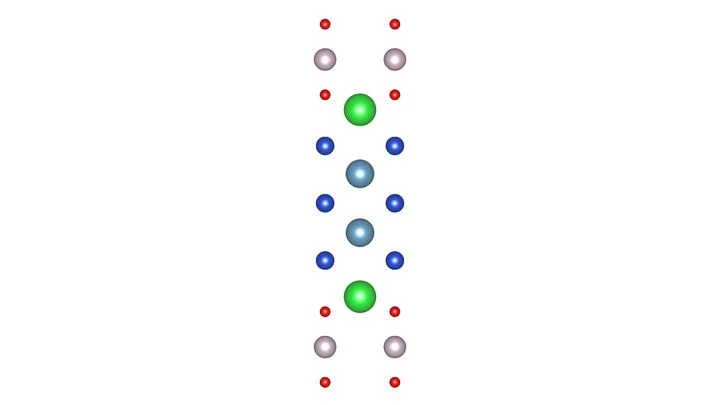
A tiny sandwich of oxides, grown layer by layer, becomes perfectly conducting at about minus 200 degrees Celsius. This is not a magic trick but a new chapter in the search for high-temperature superconductors.
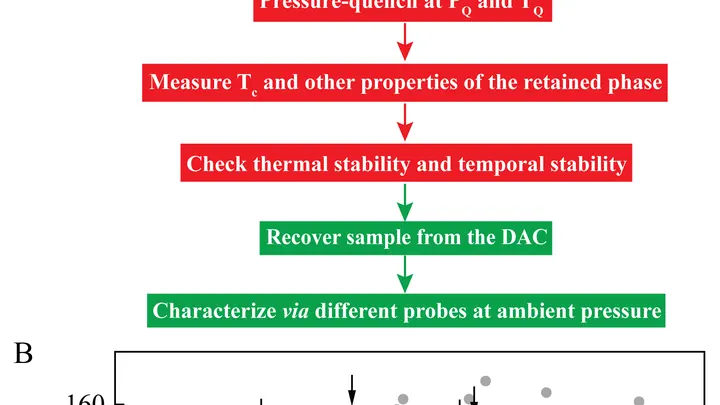
Many materials behave like finicky ice: at one pressure they melt, at another they turn harder. Superconductors in the cuprate family are no exception. Their ability to carry current without loss depends on how tightly the crystal lattice is squeezed. In a new study, physicists traced this dependence for the compound Bi-2223.
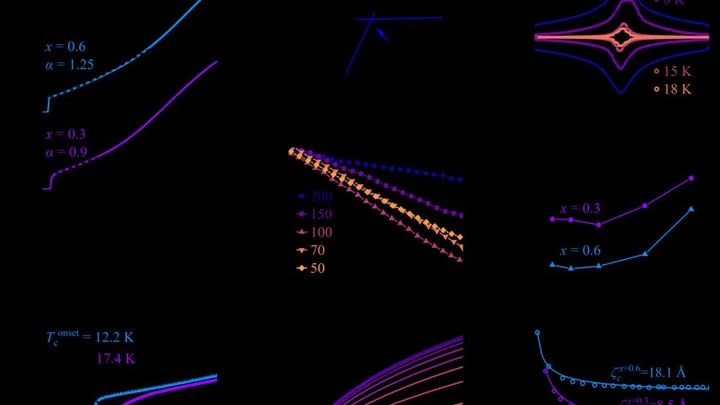
Hidden within thin layers of tantalum selenide (TaSe₂) is a property that defies conventional physics. When guest atoms were added between the layers of this material, the structure lost its center of symmetry, and inside, superconductivity with armor emerged.
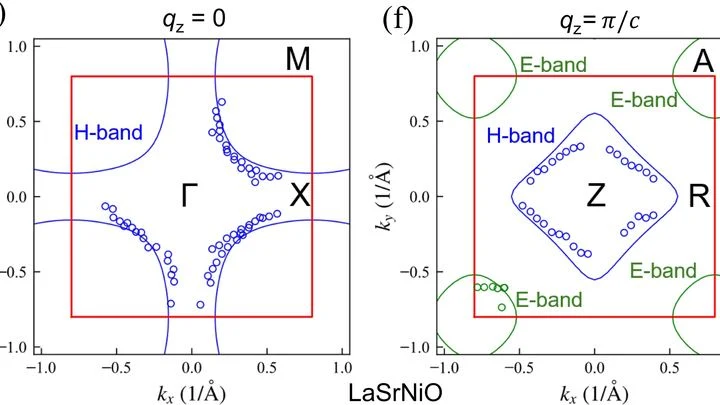
Lossless current is the dream of energy technology. Some materials become superconductors, but usually only at extreme cold. Recently, in the family of nickelates, compounds based on nickel, candidates were found that work at higher temperatures.
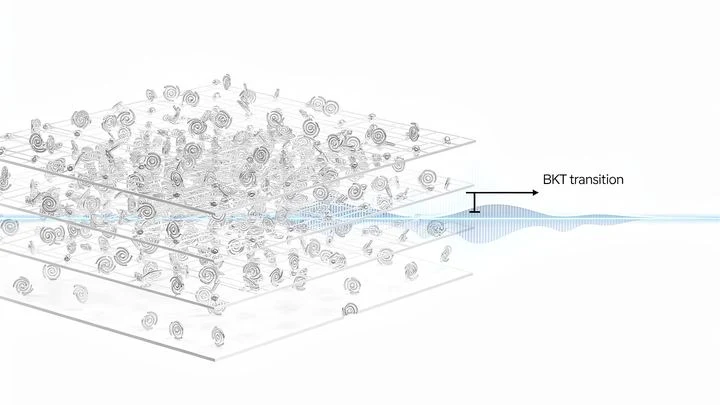
A thin film of a special crystal (for instance, molybdenum disulfide) sits on a microscope stage. The temperature is just above the point where the material becomes a superconductor.
Superconductivity is often pictured as a frozen dance of electrons: they pair up and move without resistance, like figure skaters on perfect ice. But in high-temperature superconductors, that ice turns out to be not so smooth.
Graphene, a two-dimensional carbon crystal, has long tantalized physicists with the hope of high-temperature superconductivity. Its electrons obey the relativistic equation of Paul Dirac, racing at tremendous speed, barely noticing each other.
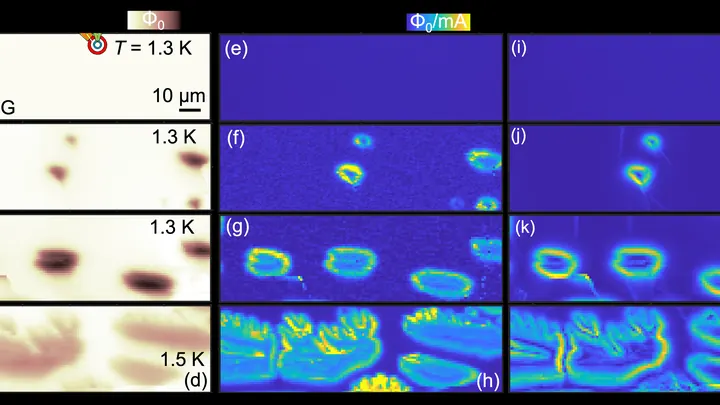
In the crystal CsV3Sb5-xSnx, which becomes a superconductor at low temperatures, current does not flow as a uniform stream but along narrow, winding paths. A scanning microscope with a sensitive magnetic field sensor helped reveal these paths: it picks up the faintest currents, much like a sonar probes the seafloor.
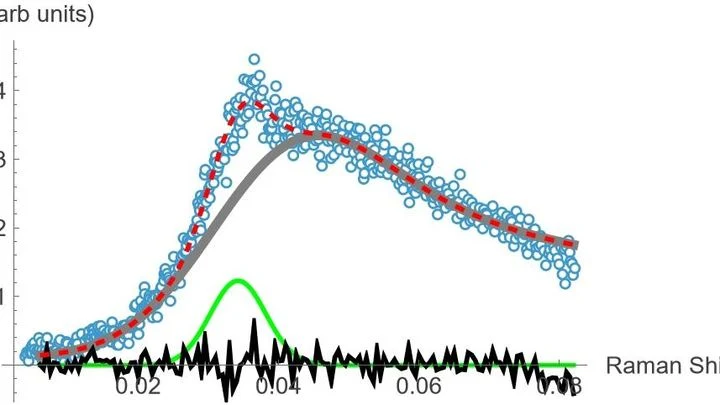
A thin film of yttrium barium copper oxide warms under a stream of infrared light, and suddenly stops dissipating energy. That's superconductivity: electrons pair up and move as a single quantum swarm. But in underdoped samples, the harmony breaks long before the pairs fall apart. The pairs are there, but the collective rhythm isn't.
A pot of water always boils the same way: hit 100 degrees and bubbles start. Quantum fluids are different. When a cloud of atoms is cooled to near absolute zero, it can turn into a single matter wave — a Bose–Einstein condensate. But the transition itself, it turns out, can happen in three different ways.
Superconductors conduct current without loss, but usually require extreme cold. Hg1223 — a mixture of mercury, barium, calcium, copper and oxygen — breaks the rule: it stops resisting current already at –139°C. The secret is that the strong electrical repulsion between electrons forces them to pair up.
A long, narrow pan, and a thin pancake sets in uneven stripes. For decades, scientists saw a similar picture when modeling the behavior of electrons in superconductors — materials that conduct electricity without loss. They used elongated "cylinders," and the result was always the same: rigid magnetic "stripes" that were thought to hinder superconductivity.
A handful of matches falls on the table. Each lies however it lands, but in our minds we turn each into an arrow — from one end to the other. Now ask: can you get from one point to another by moving only in the direction of the arrows? A group of points where you can reach any one from any other is called a strongly connected cluster.
The dance floor is full of couples waltzing. Usually, partners move in opposite directions: one steps forward, the other backward, to keep the overall rhythm.
A stone falls into a pond — ripples spread across the water. In physics, a similar conservation law works for energy and momentum: what goes in comes out. But in curved spacetime, where gravity rules, conserved quantities are harder to define.
In familiar metals like copper, electrons move almost independently, like cars on an open highway. Resistance arises from rare collisions and can be described by simple formulas.
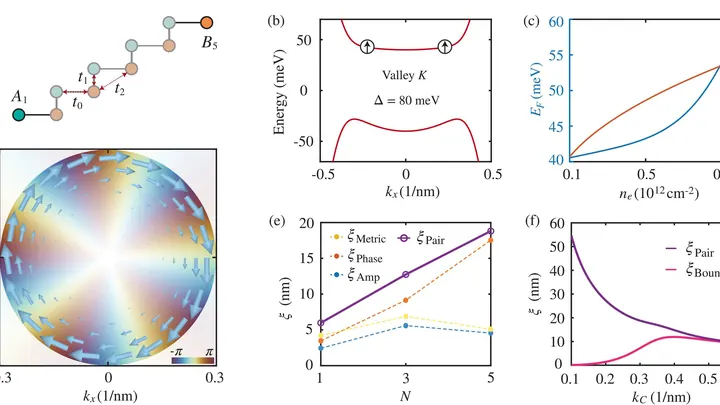
In a superconductor, electrons pair up like dancers holding hands. Usually, the distance between them, the pair size, depends on how fast they move and how strongly they are bound. But sometimes the dance floor almost disappears, and there's nowhere to move. This happens in materials with flat electronic bands: electrons nearly freeze, and the usual rules stop working.
A magnetic field penetrates a superconductor not as a continuous flux but as thin filaments — vortices. Usually, they repel each other and arrange into a neat triangular lattice, like floats on water. But in CaSb₂, things went differently: vortices bunched into tight clusters, with almost empty space between them.
In the world of superconductors, electrons don't like to be alone. They typically pair up into Cooper pairs and move without resistance, like figure skaters holding hands. But you can make them dance in fours. The authors of this work propose a scheme where Cooper quartets, groups of four electrons exchanging partners in a rapid rhythm, are born.
A copper crystal is squeezed in diamond anvil cells. As pressure mounts, a battle unfolds inside the material between two states: one prepares electrons for superconductivity, the other hinders their pairing. Scientists tracked this struggle using ultrashort laser pulses.
Superconductivity is when electric current flows without losses, like water through a perfectly smooth pipe. It usually occurs at very low temperatures, but there are materials where it appears at higher ones.
In a pot of boiling water, bubbles of steam are born and pop, but the water itself remains a liquid. Something similar happens in an ultracold atomic gas: atoms constantly form pairs and then fly apart again, even though superfluidity has not yet set in.
In a crystal lattice that resembles a woven basket, electrons sometimes pair up and flow without resistance. Such a material, a superconductor based on a kagome lattice, behaves like a temperamental orchestra: add a bit of titanium, and the conductor's baton switches from one order to another.
Electric current in a superconductor is like a crowd running down a frictionless corridor. But in type-II superconductors there are obstacles, tiny vortices of magnetic field, that the current shoves out of place. Once a vortex moves, resistance appears and the current drops.
Atoms settled along a chain of traps, like a line of coastal forts. Nearby, a quantum sea: a Bose-Einstein condensate (a substance with zero resistance, where particles move as a single wave).
Superconductivity is the ability of a material to conduct electricity without losses. Ordinary wires heat up, and some energy is lost as heat, but a superconductor carries current with zero resistance.
A uranium crystal the size of a grain of rice was cooled to one-fiftieth of a degree above absolute zero. At such temperatures, heat is not transported chaotically but strictly according to the rules of the quantum world.
Certain materials, near absolute zero, superconduct: electricity flows without loss. The critical temperature starts this. John Bardeen and colleagues explained that atomic vibrations glue electrons into Cooper pairs.
The quantum Hall effect has long been suspected of superfluidity — the ability to flow without friction. Imagine a cook following a recipe: for each unit of magnetic flux, he must add exactly a certain number of electrons.
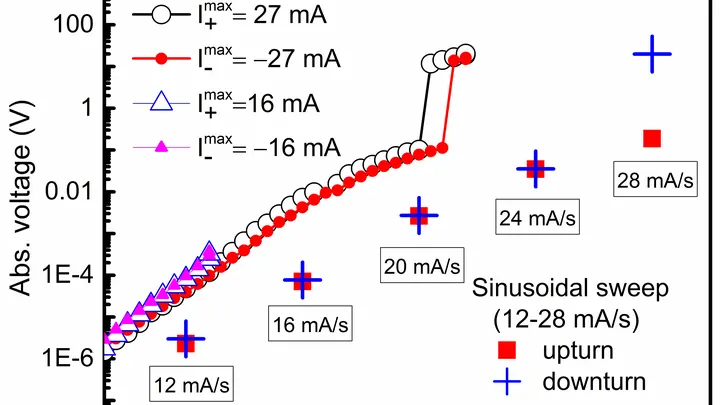
An ordinary conductor carries current equally in both directions, like a door that swings both inward and outward. A diode, by contrast, is a door with a self-closing hinge: it opens easily one way but pushes back the other.
A metal alloy is like a cocktail: mix a few elements and you get a material with new properties. But while a bartender tastes the drink, engineers need to know in advance how an alloy will behave in service.
An ordinary superconductor is like a squad of soldiers marching in pairs: electrons pair up, and their spins (internal 'tops') point in opposite directions. A magnetic field easily flips such pairs, destroying superconductivity.
In UTe₂, things are different.
An X-ray beam strikes a piece of superconductor, and the material warms up ever so slightly. That heating, by billionths of a degree, is the only trace the light leaves behind. The new detector catches exactly that, like a sensitive thermometer pressed against cold metal.
In the crystal lattice of iron selenide, iron and selenium atoms alternate like bricks in a wall. But sometimes extra iron atoms sneak into the voids between them, like uninvited guests squeezing into the gaps between bricks.