Porous implant with drug: how blood flow controls the dosage express
A porous implant filled with a drug works like a sponge that slowly releases the substance into the surrounding fluid. But if the fluid flows quickly, it washes out the drug differently than in a calm environment. The authors computed on a computer how different flow rates and properties of the porous structure affect drug release.
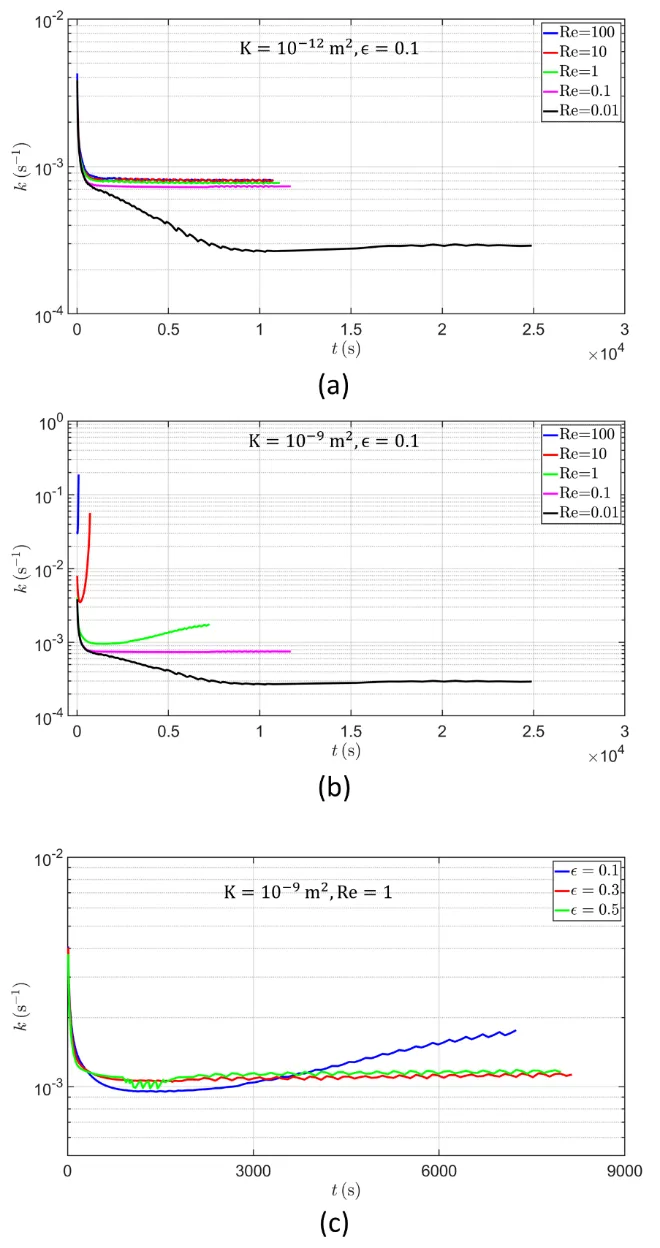
It turned out that at high flow rates (large Reynolds numbers), the drug release rate may not decrease but increase toward the end of the implant's operation. This is unusual: typically, the drug is released quickly at first and then more and more slowly. This effect allows the drug delivery to be stretched out and tailored to the body's needs.
Original abstract
as written by the authors arXiv:2604.23191
Drug-Filled Porous Implants (DFPIs) are an innovative solution for delivering drugs in a controlled and sustained manner to target sites. To optimize their performance across various physiological conditions, it is essential to understand how fluid flow and porous media properties influence the drug release process. In this work, we numerically investigate a wide range of flow conditions and their effects on drug release from DFPI. The DFPI is modeled as a homogeneous, saturated porous medium, with flow through the porous structure modeled using the Forchheimer-extended Darcy law. Drug diffusion within the DFPI and its transport through the surrounding channel are simulated using a diluted species transport approach. The results reveal the impact of flow conditions and porous media characteristics on the drug release profile of the implant and drug availability within the channel. The variations in drug release behavior are analyzed by modeling the release as an apparent first-order process with a time-dependent rate constant. Notably, the results highlight specific conditions under which the rate constant increases during the later stages of drug release from the DFPI, particularly at high Reynolds numbers, while also ensuring a prolonged operational time period of the implant. These findings suggest the potential for developing intelligent DFPI designs capable of delivering drugs in a manner more attuned to the specific needs of the application.
The Reynolds number is the ratio of inertial forces to viscous forces in a flow. For water in a pipe, it determines whether the flow is laminar or turbulent.