Flux is a measure of how much of a quantity—particles, energy, fluid, or even a field—passes through a given area over time. It is a central concept in physics because it connects the microscopic motion of individual entities to the macroscopic behavior of systems. In the context of the provided titles, flux appears in diverse settings: the flow of blood carrying drugs through porous implants, the movement of cerebrospinal fluid in the brain, the transport of substances in porous media, and even the behavior of quantum vortices. In each case, flux quantifies the rate of transfer, making it essential for understanding how systems change and how materials or energy move from one place to another.
History
The concept of flux has roots in the work of Isaac Newton, who used the term 'fluxion' for derivatives, but the modern integral definition in physics was formalized in the 19th century, particularly through the work of James Clerk Maxwell in electromagnetism and later in fluid dynamics. The specific application to porous media was developed by Henry Darcy in 1856.
How it works
Flux is defined mathematically as the integral of a vector field over a surface. For a simple case, if a fluid flows with velocity v through a flat area A, the flux is the product of the component of velocity perpendicular to the area and the area itself: Φ = v·A·cos(θ), where θ is the angle between the flow direction and the normal to the surface. For more complex situations, such as flow through a porous medium or turbulentmixing, the flux is computed by summing contributions over infinitesimal surface elements, often using differential equations like Darcy's law or the Navier-Stokes equations.
In practice
Flux is used in designing drug delivery systems, such as porous implants that release medication at controlled rates, and in environmental engineering to model groundwater contamination and remediation. It is also fundamental in astrophysics for interpreting observations of radiation and particle flows from cosmic sources.
Fun fact
In the brain, the flux of cerebrospinal fluid is not constant—it pulses with each heartbeat, which helps distribute drugs more effectively through the brain tissue.
Units by system: SI: per square meter per second · CGS: per square centimeter per second · Planck: per planck area per planck time · natural: per square meter per second
In 1934 Jean Leray proved that the Navier–Stokes equations always have solutions "in a generalized sense". Whether a solution stays smooth or can break down into a singularity he could not tell, and nobody could for ninety years. In 2000 the Clay Institute made the question one of its seven Millennium Prize problems.
A vacuum cleaner sucks in dust even if there is more of it near the nozzle. The same happens in a tokamak: plasma particles are drawn toward the center, even though their density is higher at the edge. This phenomenon is called particle pinch, and it contradicts the usual rule that everything tends to move from dense regions to sparse ones.
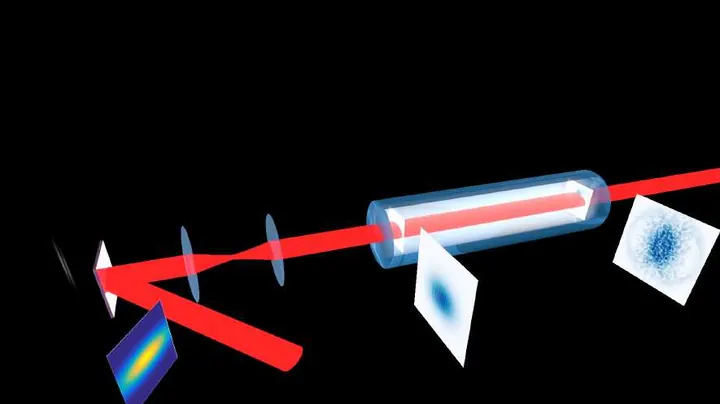
In a Paris laboratory, light was made to flow around an obstacle the way water flows around a rock in a stream. But this water is special: it feels no friction.
A bacterium swims toward food. A chemical signal guides it forward, but with each movement the signal changes. A loop emerges: sensation, action, new sensation. The authors turned this loop into a measurable quantity.
At night, when we sink into deep, dreamless sleep, a tide begins in the depths of the brain. Each heartbeat and each breath sends gentle pulses through the fluid-filled cavities (the ventricles). During the day, these pulses are timid and monotonous — the fluid sloshes back and forth almost in place.
But with the onset of slow-wave sleep, the rhythm changes.
The brain self-cleans its waste: cerebrospinal fluid flows through narrow channels surrounding arteries. The channel walls are soft and ripple with each pulse, and the tissue is porous like a sponge. Every heartbeat turns arteries into tiny pumps, driving fluid through the pores.
In a grand courtroom, a meeting is in session. Hundreds of translator-neurons simultaneously hear fragments of phrases, and must piece them into a single coherent picture. This is exactly how large brain networks turn scattered signals from the eyes into a unified object image.
A drop of thick shampoo falls into water and freezes into a strange rope. A liquid that both flows and springs back is called viscoelastic. In it, tiny particles under ultrasound behave quite differently than in water. Viscoelasticity is a material's ability to both spread like honey and return to shape like rubber.
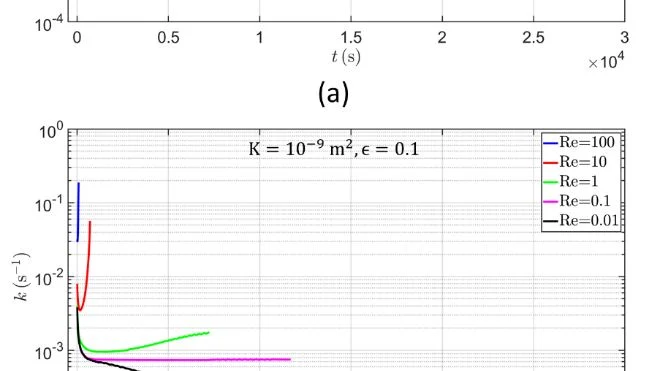
A porous implant filled with a drug works like a sponge that slowly releases the substance into the surrounding fluid. But if the fluid flows quickly, it washes out the drug differently than in a calm environment. The authors computed on a computer how different flow rates and properties of the porous structure affect drug release.
In porous materials (soil, rocks, filters) fluids move through tiny, winding channels. When two immiscible fluids, such as water and air, are present simultaneously, their interface constantly shifts: air bubbles push water out of some pores and open paths through others.
An amoeba turns left. For a long time, this was considered the result of a rigid chain of causes, like dominoes. But at the core of matter, there's a gap for freedom. The 'Agent Choice via Quantum Flux' model shows: each decision corresponds not to one, but to many quantum histories.
Lymphatic vessels are one-way streets. Through them, fluid flows only forward thanks to tiny flap valves. These valves open in just one direction, creating asymmetry, directionality, without which the flow would stop.
In the lab, scientists modeled a vessel and sent compression waves along it, like a parade of gentle nudges.
A cell is a city with gates. Each gate is a protein channel in the membrane: through it, ions, sugars, and signaling molecules pass in and out. Some gates are almost always open, while others open and close randomly, like subway doors that let a passenger through one moment and slam shut in their face the next.
Water in a narrow gap crawls on its own: that's the capillary effect that pulls sap up a stem. But if it hits a step, the liquid can freeze, like a traveler before a high threshold. Scientists built tiny glass channels and watched when a drop steps over the ledge and when it gets stuck.
A superfluid flows without friction, like water in a perfectly smooth pipe, but the moment it hits an obstacle, the picture changes. In a new study, researchers looked at how a superfluid stream flows around rectangular walls and pits with sharp corners.
Fluid flows in the narrow gaps between brain cells. It doesn't stay still: each heartbeat pushes it forward, and breathing adds its own waves. This was seen in images ten years ago, but only now have researchers calculated how this pulsing accelerates molecules.
If you drop ink into a stream, it drifts with the current. But if the stream speeds up and slows down, the ink spreads wider.
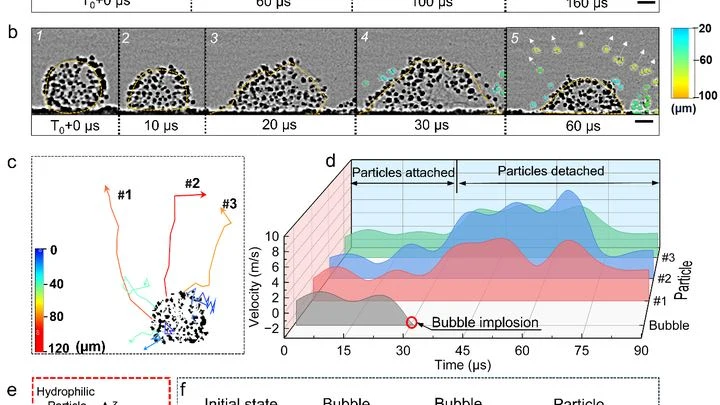
In a glass of water, ultrasound creates tiny bubbles. They grow and shrink, and sometimes they collapse sharply, like a popping soap bubble, but thousands of times faster. Near these bubbles float small particles — for example, nickel spheres the size of dust motes.
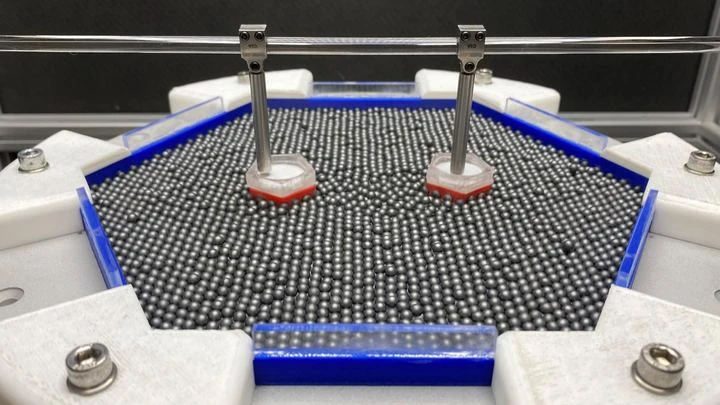
Shake a jar of sand and marbles, and you'll see large objects float or sink depending on their size. But if you shake it cleverly, you can make the marbles gather into pairs and chains, as if glued together. It's this kind of 'invisible glue' that physicists from India and Germany have now caught and measured for the first time.
In superfluid helium, a state where liquid flows without friction, quantized vortices spontaneously arise: microscopic funnels resembling whirlpools in ordinary Water, but governed by quantum mechanics.
Drop honey onto a sponge. It lazily creeps, avoiding the voids. But if the honey becomes thinner under pressure, the flow gets trickier. Liquid with variable thickness in an uneven labyrinth of pores — a problem that had defied calculation. The authors of the new work averaged the chaos of microchannels into simple equations.