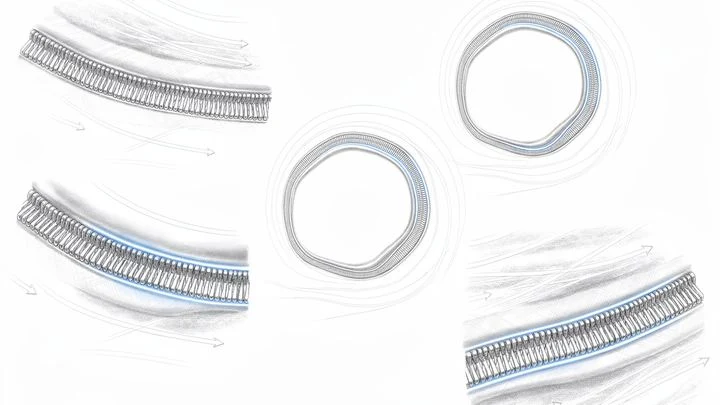
In 1855, German physician and physiologist Adolf Fick sought a way to describe how substances penetrate living membranes. He noticed that the particle flux is always directed against the concentration gradient — toward where there are fewer particles. Fick wrote this as an equation similar to Fourier's law of heat conduction: the amount of substance passing through a unit area per unit time is proportional to the difference in its concentration. The proportionality coefficient — the diffusion coefficient — depends on the properties of the medium and the particles themselves. Today, Fick's law is the foundation of all mass transfer engineering, from semiconductor manufacturing to dialysis.
History
Adolf Fick formulated his law in 1855, drawing an analogy between diffusion and heat conduction, which had been mathematically described earlier by Joseph Fourier. Fick experimentally verified his equations on the diffusion of salts in water. Later, Albert Einstein (1905) linked the diffusion coefficient to particle mobility and temperature, and Jean Baptiste Perrin used Fick's law to determine Avogadro's number from the motion of Brownian particles. In the 1940s, the law was generalized for multicomponent systems by Lars Onsager.
How it works
The law applies wherever there is spontaneous mass transfer: from respiration and cell nutrition to creating homogeneous alloys and semiconductor structures. Its limits of applicability are isotropic media without convection and chemical reactions; at high concentrations or in non-ideal solutions, the diffusion coefficient ceases to be constant, and the law requires modification.
In practice
Calculating the rate of oxygen delivery from blood to tissues and designing water purification systems.
Fun fact
The diffusion coefficient of glucose in water is about 10,000 times smaller than that of oxygen in air — that's why sugar in a cup of tea dissolves so slowly, even when stirred.
A molecule works like a marketplace: electron shoppers enter through two gates (contacts) and head for stalls with the most attractive goods — the chemically active spots. Previously, current was thought to spread evenly, but it turns out up to 90% of all flow rushes through these 'hot spots'. Reactive centers become superconducting highways inside the molecule.
In the brain's white matter, the signal travels along axons — long neuronal processes wrapped in an insulating myelin sheath. Water fills the space inside axons and outside, in the narrow gaps between fibers.
Membraneless organelles, tiny factories inside the cell, defy conventional rules. Take the nucleolus: here ribosomal RNA is synthesized — long chains woven from carbon sugars, rich in oxygen phosphate groups, and stitched with hydrogen bonds, suspended in the watery environment of the nucleus.
A lump of sugar drops into hot tea, a spoon stirs a few times, and the sugar disappears. But how exactly does it spread through the churning liquid? Physicists have peered into this process with unprecedented detail: they simulated turbulence on a grid of 8192³ points. If you were to split every millimeter of the cup into a hundred cells, you'd get a similar resolution.
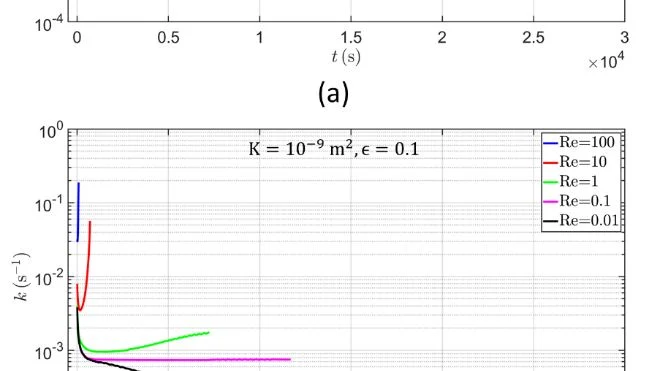
A porous implant filled with a drug works like a sponge that slowly releases the substance into the surrounding fluid. But if the fluid flows quickly, it washes out the drug differently than in a calm environment. The authors computed on a computer how different flow rates and properties of the porous structure affect drug release.
Fluid flows in the narrow gaps between brain cells. It doesn't stay still: each heartbeat pushes it forward, and breathing adds its own waves. This was seen in images ten years ago, but only now have researchers calculated how this pulsing accelerates molecules.
If you drop ink into a stream, it drifts with the current. But if the stream speeds up and slows down, the ink spreads wider.
The diffusion equation, a mathematical tool describing how particles spread out in space, has long painted a paradoxical picture: a disturbance, like ripples on Water, instantly engulfs the entire universe. This challenged the theory of relativity, which holds that nothing can move faster than light.