Hunting for Genes by a Single Word express
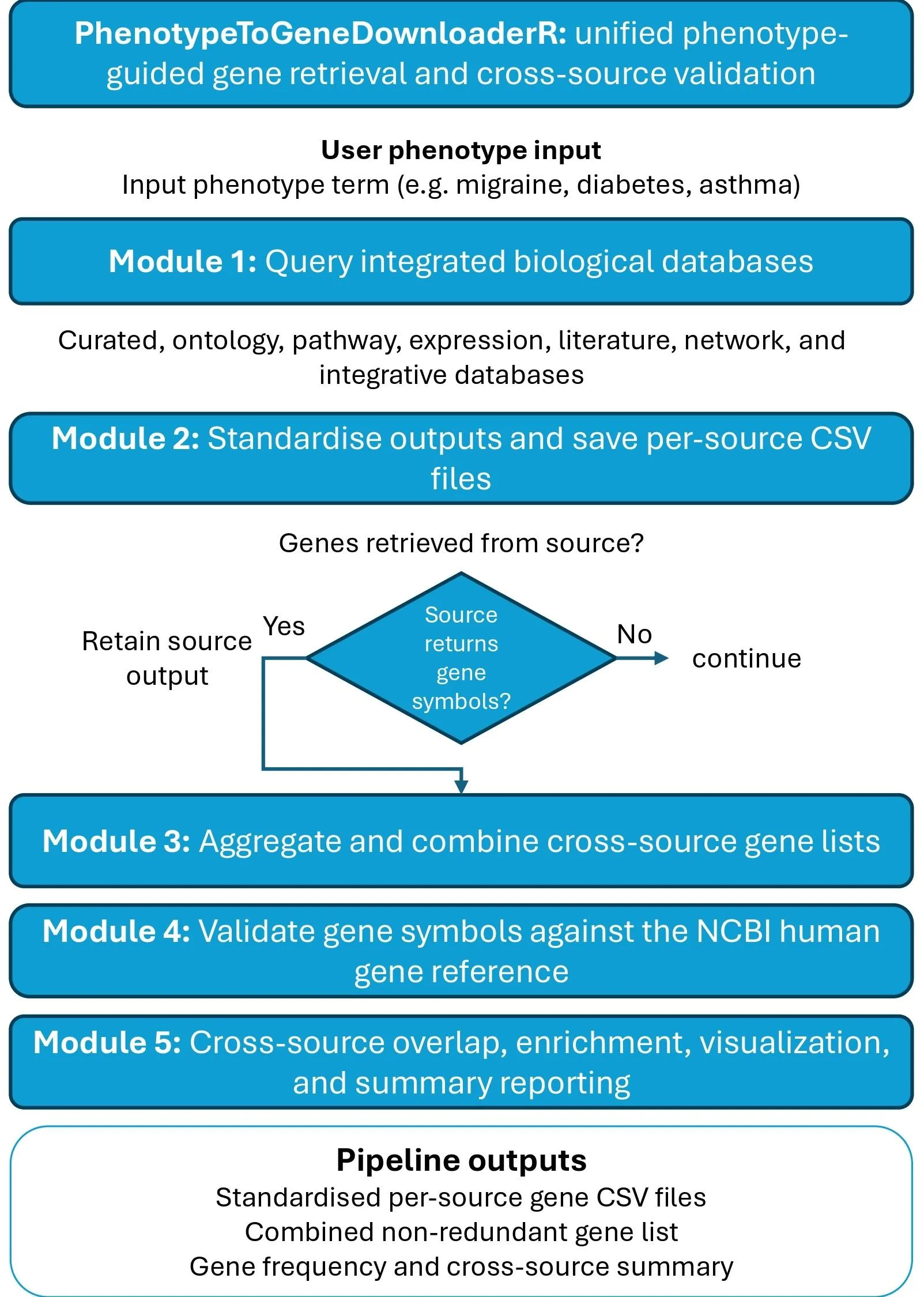
Assembling a puzzle when the pieces are scattered across 13 boxes with different numbering systems: that's roughly what it's like to search for genes linked to a specific disease. The data exist, but they're hidden in databases with their own interfaces, formats, and even descriptive languages. The new program PhenotypeToGeneDownloaderR acts as a translator and sorter: you give it a disease name, and it automatically visits all repositories, extracts gene lists, and brings them to a common denominator.
The collected lists often don't match each other — different databases view the problem from different angles, and that's the strength of the approach: by combining them, we get a more complete picture. When the program was tested against a 'gold standard' of three authoritative sources (HPO, ClinVar, and OMIM), it found 1,039 out of 1,056 known genes: that is, 98.4%. This means almost nothing is missed, and false positives are minimal. Such a tool saves weeks of manual work and reduces the risk of errors when a clinician or researcher manually transfers names from one system to another.
Original abstract
as written by the authors arXiv:2605.01378
Identifying phenotype-associated genes is a common first step in polygenic risk score construction, enrichment testing, target prioritisation and variant interpretation, but relevant evidence is distributed across heterogeneous databases with different interfaces, formats and evidence models. Here, we present PhenotypeToGeneDownloaderR, a phenotype-guided R/Python pipeline for automated gene retrieval, harmonisation, symbol validation and cross-source summary analysis. Given a phenotype term, the pipeline queries integrated biological databases, standardises per-source outputs, combines gene lists, validates retrieved symbols against the NCBI human gene reference and generates summary tables and visualisations. Across 13 clinically relevant phenotypes and 13 databases, PhenotypeToGeneDownloaderR generated 136,487 raw gene retrievals, with at least one source returning genes for every phenotype. Across all 13 phenotypes, 100,175 of 114,345 combined input symbols were retained after direct or synonym-based validation, corresponding to an 87.6\% validation rate. Cross-source overlap was low, supporting the complementarity of integrated evidence sources. Against an HPO/ClinVar/OMIM-derived gold standard, the pipeline recovered 1,039 of 1,056 known phenotype-associated genes, corresponding to 98.4\% recall. PhenotypeToGeneDownloaderR provides a lightweight, reproducible upstream framework for generating candidate gene sets for downstream prioritisation and interpretation. The pipeline is implemented in R and Python, released under the MIT licence, and available at https://github.com/MuhammadMuneeb007/PhenotypeToGeneDownloaderR.
Gene names sometimes change, like street addresses when a city is renamed, and without checking against a fresh reference, you could be citing the 'old house' for years, even though it's no longer on official maps.