How Genes and Environment Shape Teen Behavior express
An orchestra plays without a conductor. Each musician has a score: that's the genes. But the volume and tempo depend on the acoustics of the hall, the mood, and the neighbors on stage. That's roughly how heredity and daily life together shape a teenager's behavior.
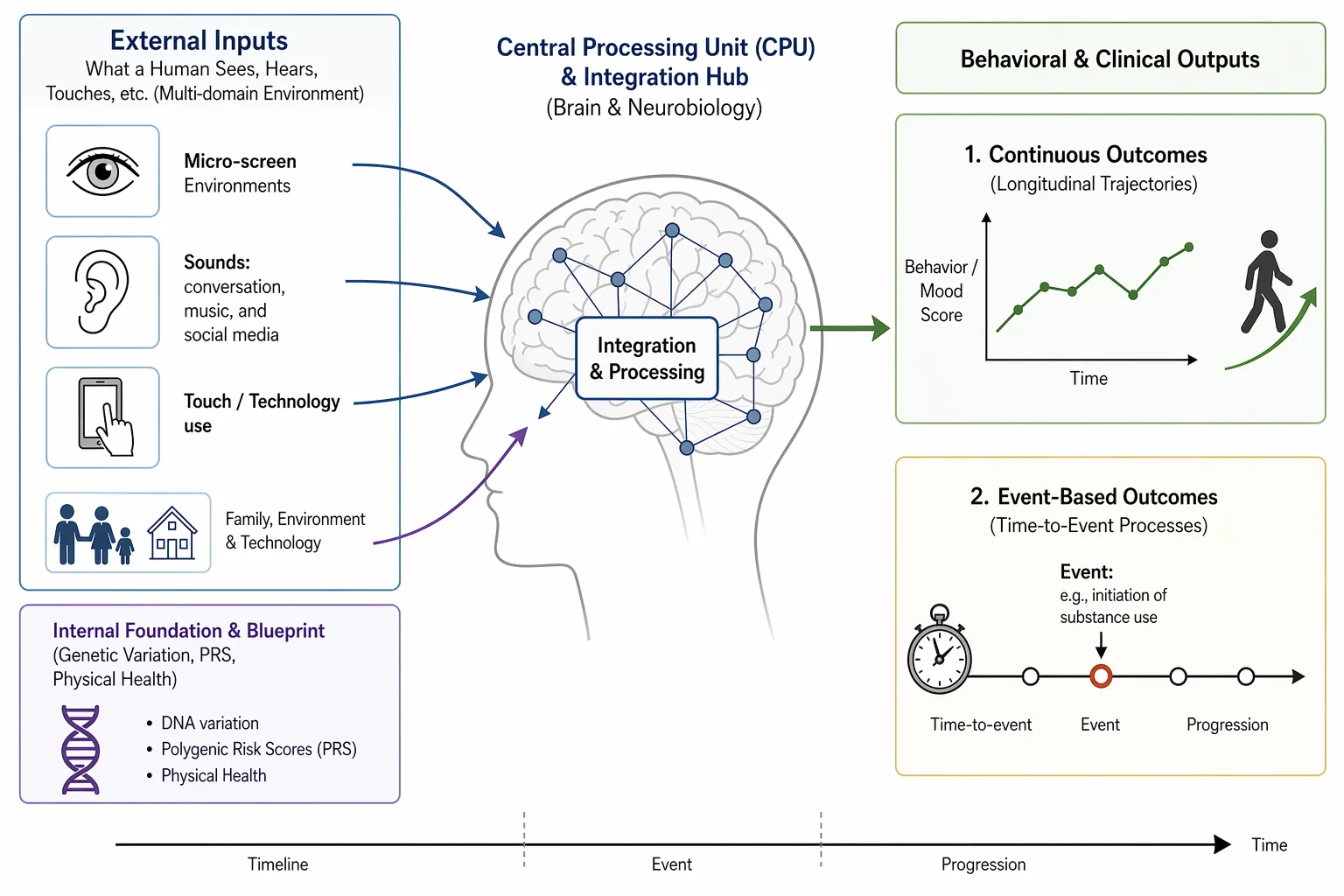
In the new study, scientists gathered data from thousands of children in the long-term ABCD project. They accounted for hereditary risks (special genetic scores), dozens of environmental features, from family relationships to neighborhood, and brain scans. All of this was combined into a single mathematical model. In the model, the brain acts as a mediator: it receives signals from genes and external events, and the output is behavior — for example, a tendency toward anxiety or a first sip of alcohol.
The authors used several methods to compress complex data into simple yet informative indicators. It's like turning a detailed city map into a clear subway diagram: the lines and stations are the same, but it's easier to navigate. This approach helps avoid drowning in a sea of numbers and spot the main levers of influence.
The result is not just a set of formulas but a working tool. It shows that heredity is not destiny. The environment can amplify or dampen genetic predispositions, especially during the transitional age. So a timely helping hand can change the trajectory of growing up.
So the orchestra of the teenage body finds its conductor. That conductor is life itself — with its quiet hints and loud events. And the score no longer sounds the same in every hall.
Original abstract
as written by the authors arXiv:2605.02952
Understanding the development of adolescent behavioral and mental health outcomes requires integrating genetic predisposition, environmental exposures, and neurobiological processes over time. Here, we present a unified quantitative framework that models the human body as a dynamic system, where genetic factors form the foundational state, environmental exposures act as time-varying inputs, the brain might serve as a mediation processor, and behavioral phenotypes emerge as system outputs. Using longitudinal data from the Adolescent Brain Cognitive Development (ABCD) Study, we construct harmonized multi-domain representations across six phenotypes: externalizing behavior, internalizing behavior, and four substance use initiation outcomes (alcohol, nicotine, cannabis, and any substance use). We integrate polygenic risk scores (PRS), multi-domain environmental features, and multimodal neuroimaging representations derived through stability selection and dimensionality reduction. Our framework supports both continuous longitudinal modeling and survival-based event modeling through a unified data structure. We further develop interpretable domain-level representations using principal components, weighted risk scores, and cluster-based summaries. These representations enable downstream modeling using survival analysis, state-space models, and machine learning approaches. This work establishes a scalable and interpretable framework for studying how genetic and environmental factors interact over time to shape behavioral outcomes, providing a foundation for identifying modifiable risk factors and informing early intervention strategies.
The model used data on four types of first experiences: alcohol, nicotine, cannabis, and any psychoactive substance. It turned out that for each, the set of key environmental factors differs slightly, like different locks opened by their own keys.