Birth of Twin Particles and Quantum Magic ✛ ✎ ✦
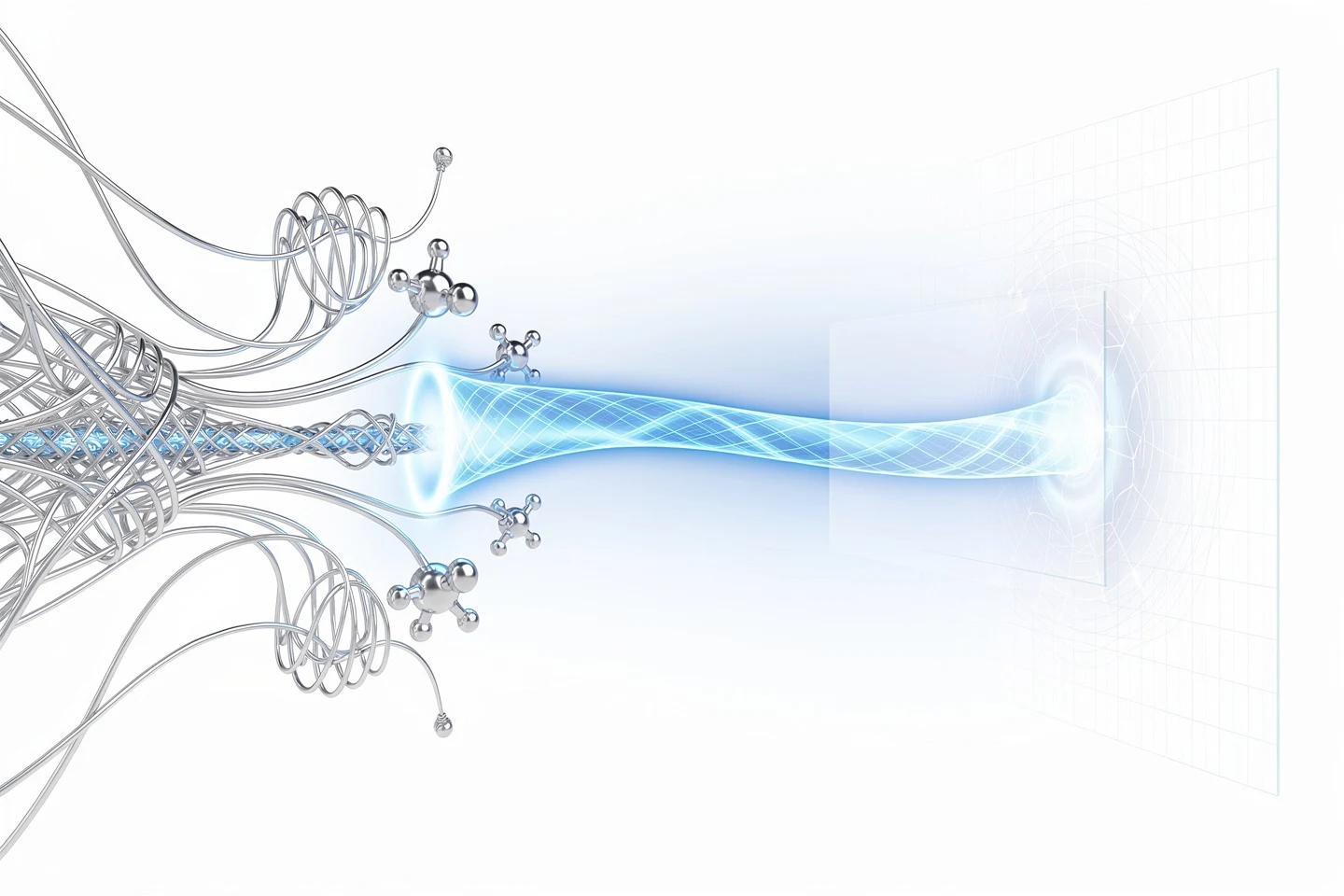
Like a dance duo suddenly materializing on stage out of thin air, a particle and its mirror twin of antimatter appear when a powerful jolt shakes the quantum field. Their movements are instantly synchronized: change one and the other responds, even if they’ve been flung to opposite galaxies. This invisible bond is called quantum entanglement. Recent research has uncovered a new facet of this connection — quantum magic. It’s not just entanglement, but a measure of complexity that no ordinary computer can calculate; only a quantum computer can handle it. Remarkably, the magic doesn’t fade even when the particles are light-years apart. But the biggest surprise is that each such pair essentially forms a microscopic wormhole — a tunnel through warped spacetime. This explains why the connection is instantaneous: distance simply vanishes. These ideas, tracing back to the insights of John Archibald Wheeler and Stephen Hawking about the nature of black holes, were fully shaped in the work of Juan Maldacena on string theory and gravity. Thus, the dance of microparticles intertwines with the geometry of the Universe.
Quantum magic is a measure of a state’s complexity. Even a planet-sized supercomputer couldn’t simulate it; only a quantum one can.
As in 'Interstellar', where a wormhole connected galaxies, here microscopic tunnels link pairs of particles, turning distance into an illusion.