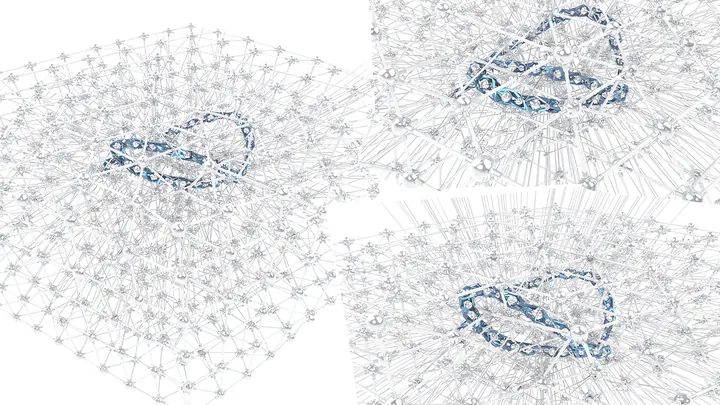
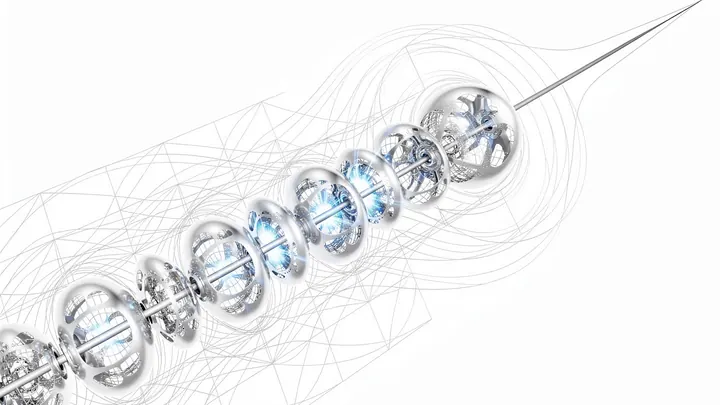
Wherever there seems to be emptiness, invisible life seethes. The quantum field is an ocean in which every particle is a ripple on its surface. Photons are light waves on the electromagnetic field, electrons are waves on the electron field.
History
Maxwell's classical field theory (1860s) became the forerunner. In the 1920s–1930s, Dirac, Heisenberg, and Pauli developed quantum electrodynamics. Emmy Noether in 1918 proved a theorem linking field symmetries and conservation laws. Satyendra Nath Bose and Albert Einstein created statistics for bosonic fields in 1924. Wolfgang Pauli formulated the exclusion principle for fermionic fields and the spin-statistics theorem.
How it works
The field is described by a Lagrangian, from which the equations of motion are derived via the Euler-Lagrange equations (for example, the Dirac equation for fermions). Quantization occurs by imposing canonical commutation or anticommutation relations: [φ(x), π(y)] = iħδ³(x-y) for bosons, {ψ(x), ψ†(y)} = δ³(x-y) for fermions. The creation and annihilation operators in the field expansion act on Fock space. Interactions are introduced through gauge invariance. At high energies, quantum fields exhibit renormalizability.
Fun fact
Even in absolute vacuum, pairs of particles and antiparticles are constantly born and disappear, like bubbles in soda.
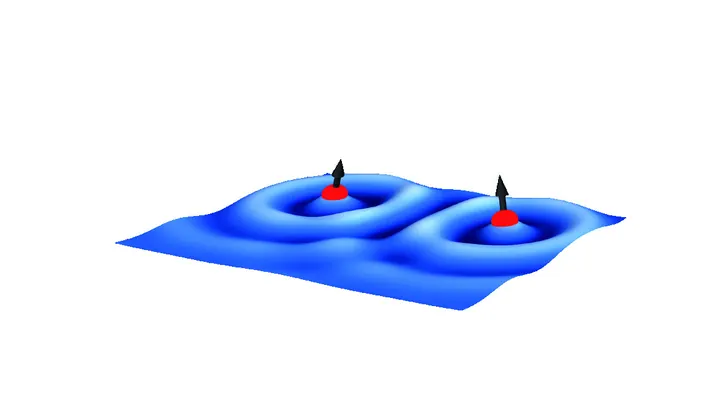
Electrons in an ultra-clean gallium arsenide film behave like a crowd at a crossroads, where the tilt of the magnetic field sets the direction. At zero tilt, they form a compressible liquid of composite fermions, particles made of an electron and a pair of vortices.
A laser pulse slams into a gas cloud and knocks electrons out of it, leaving behind a bubble: a cavity almost devoid of particles. This bubble races through the plasma at nearly the speed of light, and its walls drag along the electrons trapped inside, much like a speedboat tows a water skier.
Plasma is a gas in which electrons are stripped from atoms and roam freely. Sometimes, regions where electrons are almost absent spontaneously appear in such a gas; they are called holes. It is like a whirlpool forming in a stream, pulling everything around it in. But exactly how such a whirlpool is born has long remained a mystery.
Space is expanding, and that expansion is accelerating. But what if, in the first instants after the Big Bang, gravity behaved differently? The authors of a new study added an invisible field to Einstein's equations that siphons energy from ordinary matter and radiation.
A stone thrown at a wall bounces off. In the quantum world, a particle can pass right through, as if the wall were woven from mist. This is quantum tunneling: it lights up stars, works in microchips, and even operates in the cells of our bodies. But most particles have spin — an intrinsic rotation, like a spinning top.
Quantum field theory is the language physicists use to describe elementary particles and their interactions. The authors of the work decided to slightly "tweak" this language: they introduced deformations, that is, small changes to the rules of the game.
Newton gave us a world where bodies move in a void and clocks tick the same for everyone. For three centuries, this picture worked flawlessly. But it relies on many invisible props: absolute position, the 'up-down' direction, and a single rhythm of time for the entire universe. We have never measured these directly — only through the relations between objects.
In the quantum world, particles sometimes behave like acrobats on invisible tightropes. An instanton field is a brief vortex that appears and vanishes in an instant. When a fermion (a particle like an electron) enters such a vortex, its energy does not stay put. Instead, it smoothly slides from one level to another, like a ball rolling down a hill.
The quantum world is like a kitchen where particles suddenly appear out of "nothing." But you need a chef — a classical field acting as an external source. Glauber's theorem, long known in optics, has now been generalized: it shows exactly how the field "cooks up" particles, be they photons or gravitons.
The quantum world is a constant buzz of activity. Particles exchange energy, become entangled, and influence one another. You'd think that the more players in this game, the harder it is to predict the outcome. But sometimes, order emerges from chaos.
Physicists took a close look at the SYK model — a mathematical playground for studying quantum chaos.
The early universe resembled an overheated cauldron, seething with quantum fluctuations (random bursts of energy). In this chaos, like steam over boiling water, a special field, the scalar field, condensed. It became the 'engine' that made space expand at an incredible rate. This process is called inflation.
Imagine a postal service where couriers suddenly stop moving. It would seem that letters would stop arriving and communication between cities would break down. But what if the envelopes themselves suddenly gained the ability to change shape and transmit messages through a shared web without moving an inch?
Electric charge is a slippery thing. You can measure how much there is in the entire universe or in a single particle, but try to point your finger and say, 'Right here, in this cubic centimeter, there is exactly this much charge right now,' and you hit a fundamental wall.
The issue is that total charge, which physicists denote by the letter Q, is nonlocal.
The quantum vacuum is not empty: it is permeated by entanglement linking distant regions. But when physicists tried to compute this entanglement, it turned out to be infinite. The culprit: particles with very low energy that can smear out over arbitrarily large volumes. They are like waves with no shores to contain them.
An empty resonator isn't truly empty. Even in an absolute vacuum, where not a single photon exists, quantum fluctuations persist. They resemble ripples on water in a dead calm: the surface appears smooth, but molecules keep jittering. Physicists have learned to turn this jitter into real waves.
A black hole is a gargantuan cosmic whirlpool that drags in everything nearby. But beyond visible matter, an invisible mist can hover in its vicinity — dark matter. Physicists have studied its behavior. Unlike ordinary matter, the field doesn’t necessarily fall through the horizon.
A fraction of a second after the big bang, the universe was a searing hot soup of particles and antiparticles. By all rights, they should have annihilated each other completely, leaving only emptiness. But for some unknown reason, one "extra" matter particle survived for every billion pairs. It was from these surviving scraps that galaxies, stars, and people eventually formed.
Clocks in the Universe are tricky things. Usually, in calculations of the birth of the world, a special scalar field plays the role of a clock — something like an invisible fluid filling all of space. It ticks, and physicists watch how the world changes relative to that ticking. But these clocks are man-made, introduced for convenience.
The authors of the new work took a different path.
A black hole sitting on a thin cosmic membrane (brane) resembles a heavy ball stretching an elastic sheet. In classical physics, it is bald — only mass, charge, and rotation. But add a scalar field (an invisible substance like temperature), and the hole can spontaneously grow 'fur' from this field.
Space is not a void but a mosaic of tiny cells. In loop quantum gravity, spacetime curvature is transferred from a smooth sheet to a network of 'atoms' of volume — spin networks. Each node of such a network is a quantum of space, and the links between them are quanta of area.
But how does this mosaic change over time?
A quantum particle can be a wave, and pass through two paths at once. But if something 'peeks' at which path it took, the wave disappears. This effect is called loss of interference. Usually, photons or air molecules do the peeking.
Inflate a balloon, and the dots on its surface move apart from each other. Our universe expands in much the same way. The mathematical model of this process is called de Sitter space — where scientists study how the tiniest 'building blocks' of matter, elementary particles, behave.
But in a curved, constantly expanding space, the usual description of particles breaks down.
Plasma is not just hot gas; it's an entire orchestra of charged particles, each group playing its own part. Heavy ions (atoms that have lost electrons) set the slow rhythm, while light electrons dart around ten thousand times faster.
For a long time, the event horizon behaved like a cosmic dictator: everything that crossed its boundary vanished irretrievably from our Universe. But quantum mechanics, like a dissident's voice, whispered: information cannot simply disappear.
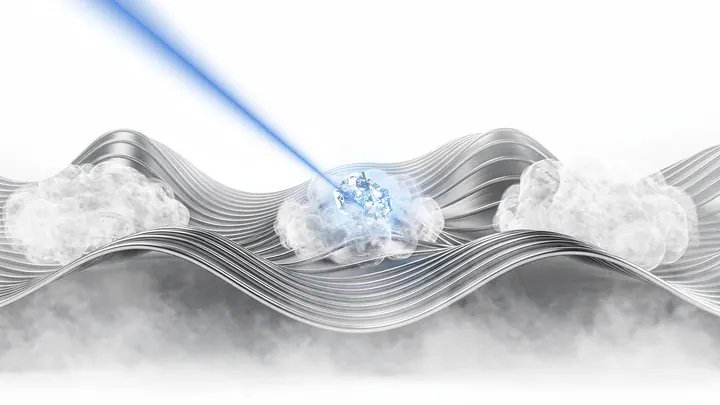
Imagine an old theater in the damp fog. On the stage, a scattering of actors, but only one is caught by the spotlight beam, made to freeze in the bright patch. The rest billow in the dim light, ready to dissolve at any moment.
In a world locked in a crystal lattice and cooled nearly to absolute zero, matter knows how to hide its deepest secrets. A quantum spin liquid is a state where electron spins never freeze, even at zero temperature, remaining in an eternally flickering superposition.
Photographing hummingbird wings with an ordinary camera gives a blurry smudge. For a sharp picture, you take many rapid shots from different angles and piece them together: that's how a quantum 'snapshot' is made. In the lab, scientists 'feel' the vibrations of a tiny mirror with a laser beam.
Quantum vacuum is not absolute emptiness. It is more like a taut membrane that constantly ripples from invisible particles popping in and out of existence. Even in total darkness, this membrane trembles. Physicists decided to see how it behaves around a thin spherical shell, inside which is ordinary flat space, like in our room.
In the first moments after the big bang, the universe was filled with quantum jitters — tiny fluctuations that could later turn into gravitational waves, ripples in space itself. But when physicists try to calculate this process, infinitely large numbers pop up in the equations.
A false vacuum is not just a supercooled liquid, but a quantum hologram, ready to spring to life under the right projection. Its decay is described by the tunneling of a quantum field from a metastable minimum, and the classic calculation via Euclidean instantons is as elegant as a still life under spotlights.
A quantum wave is like a long-exposure photograph: everything’s blurred, but the blur itself reveals motion. Usually these frozen waves are treated as convenient abstractions. Yet if at each point in the image you estimate, by brightness, the moment on the particle’s internal clock it landed there, flat space suddenly acquires curves.
In quantum field theory, there is a long-standing mystery: infrared divergences. Usually they are seen as an annoying technical nuisance that must be carefully 'papered over' in calculations. But what if this is not a bug, but a feature?
In the vast clouds of rarefied gas that fill the space between stars, something is always churning. Supernova explosions, colliding streams — all of it shakes the plasma. And in this rippling, as it turns out, hides the mechanism that gives birth to magnetic fields.
Plasma is a gas in which electrons are stripped from atoms.
The quantum vacuum is not a dead void but a boiling cauldron of probabilities. In some theories, our Universe is frozen in a metastable state: like superheated water, it's ready to explode into steam at the slightest nudge.
Quantum matter rarely treats us to the spectacle of self-motion. Where the classical world teems with starling murmurations, fish schools, and bustling bacteria, quantum thermodynamics long remained serene.
The space we live in appears three-dimensional. But when physicists try to reconcile gravity with quantum mechanics, familiar dimensions start behaving strangely. In a new study, scientists showed that to describe a massive particle while accounting for quantum gravitational effects, it is natural to add two more dimensions.
Building a house on sand is a bad idea. In physics, it was long believed that a quantum theory of gravity could not be built on a fixed "sand"—a pre-existing spacetime.
Diamond is a symbol of perfection, but its true magic is revealed through flaws. Perfect lattice purity gives transparency and hardness, while defects, such as color centers, open a portal to the quantum world, becoming the foundation for quantum computers and quantum sensors.
Plastic deformation is the language through which materials tell the story of their internal stresses. For almost a century, its grammar has been the theory of dislocations: tiny linear defects gliding through the crystal lattice and carrying shear.